The post has been translated automatically. Original language: Russian




McKinsey, in its report "The state of AI in 2025: Agents, innovation, and transformation", compiled based on the results of an earlier study (June–July 2025 survey, November 2025 publication, 1993 respondents from 105 countries), analyzed what distinguishes these 6%. It's not just about access to technology, but how the process is built around the AI model. Leaders are 2.8 times more likely to redesign processes, and their most common practice is to verify AI output by humans (65% versus 23% for the rest).
The latest issue, "The state of AI in 2026: On the road to ROI" (May–June 2026 survey, 1,719 respondents from 97 countries), confirms and reinforces the picture: the share of leaders is still the same 6%, the contribution of AI to EBIT has hardly shifted over the year (37%), despite the that 60% of companies plan to increase investments in AI. They spend more, but the result is the same. But the gap in redesigning processes has grown - almost three quarters for the leaders against a quarter for the rest.
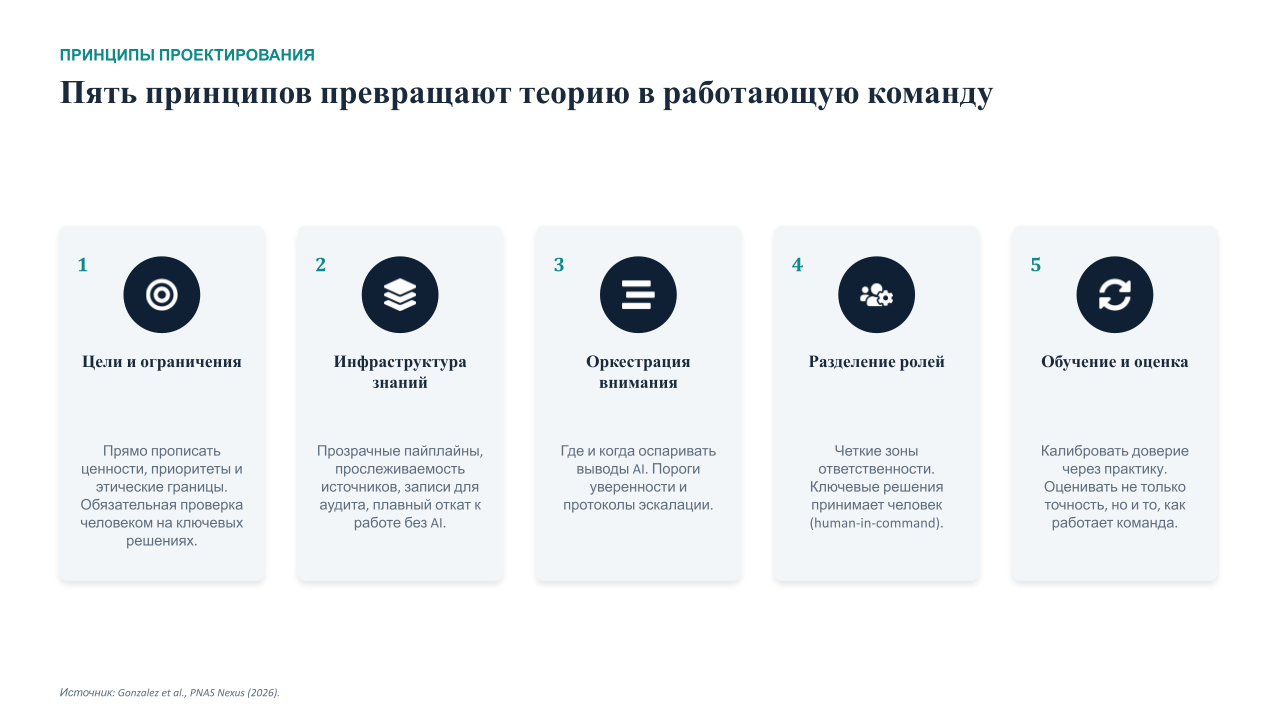
It's not just human-in-the-loop. By itself, the presence of a person in the circuit does not guarantee anything. If he simply agrees with the model's conclusion, then this is not a test, but an imitation of it. Something else works: designing control points and conditions under which the AI output must pass through a human. Gonzalez et al. (2026) formulate this as a complementarity condition. The “human + AI” team beats both the human and the AI separately, but only if the roles are fixed, and the verification procedure itself is calibrated based on actual errors, rather than being left to the discretion of the examiner.
I designed this framework in 10 slides (watch the YouTube video): three cognitive functions and five design principles. Bookmark it and check your next AI implementation against it.
McKinsey в своем отчете "The state of AI in 2025: Agents, innovation, and transformation", составленном по результатам ранее проведенного исследования (опрос июнь–июль 2025, публикация ноябрь 2025, 1993 респондента из 105 стран), разобрала, что отличает эти 6%. Дело не только в доступе к технологии, а в том, как выстроен процесс вокруг AI-модели. Лидеры в 2,8 раза чаще перепроектируют процессы, а самая распространённая практика у них - проверять вывод AI человеком (65% против 23% у остальных).
Свежий выпуск, «The state of AI in 2026: On the road to ROI» (опрос май–июнь 2026, 1719 респондентов из 97 стран), картину подтверждает и усиливает: доля лидеров всё те же 6%, вклад AI в EBIT за год практически не сдвинулся (37%), при том что 60% компаний планируют наращивать вложения в AI. Тратят больше, но результат тот же. Зато разрыв по перепроектированию процессов вырос - почти три четверти у лидеров против четверти у остальных.
Это не просто human-in-the-loop. Само по себе присутствие человека в контуре ничего не гарантирует. Если он просто соглашается с выводом модели, то это не проверка, а ее имитация. Работает другое: проектирование точек контроля и условий, при которых вывод AI обязан пройти через человека. Gonzalez et al. (2026) формулируют это как условие комплементарности. Команда “человек + AI” обыгрывает и человека, и AI по отдельности, но только если роли закреплены, а сама процедура проверки калибруется по фактическим ошибкам, а не остается на усмотрение проверяющего.
Я оформил этот фреймворк в 10 слайдов (смотрите ролик YouTube): три когнитивные функции и пять принципов проектирования. Бросьте в закладки и сверьте с ним своё следующее внедрение AI.
 Share