
The post has been translated automatically. Original language: Russian




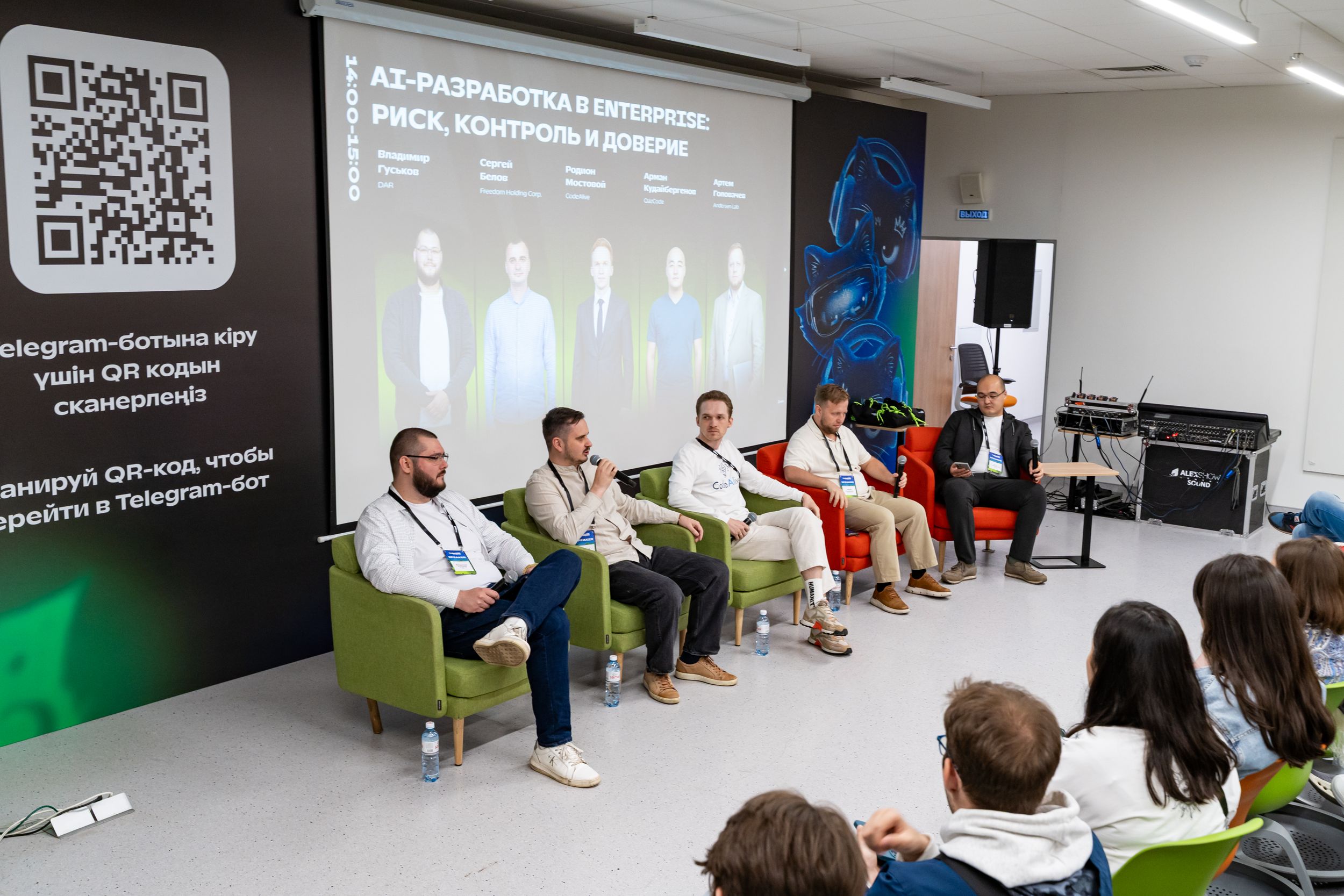
What changes when an AI solution goes beyond the pilot and starts working with real data, customers, and company processes? The quartermaster at beetech conf 2026 was dedicated to this.
The moderator was Arman Kudaibergenov, Head of the QazCode Process Automation Department.
The following participated in the discussion:
- Sergey Belov, Head of Technical Security at Freedom Holding Corp.;
- Artyom Golovachev, architect at Andersen Lab;
- Rodion Mostovoy, CEO and AI architect of CodeAlive;
- Vladimir Guskov, Senior Product Development Manager DAR.
One of the questions that came up in the conversation was: why does a company need an AI agent with access to work systems? If he only analyzes the situation and suggests action, there is only one risk. If he can change the data or settings on his own, the cost of the error becomes different. Therefore, the agent's level of independence must be determined for a specific task: what actions are available to him, where the person's confirmation is required, and how to undo an erroneous change.
A separate topic is the responsibility for the launch. It is important for the security team to identify the risks, especially when the solution is working with sensitive data or performing operations. But the decision about what task the product solves and what result the business needs does not disappear behind technical approvals. The AI script should have a clear owner.
The participants also discussed the choice between cloud and on-premise models. One approach may be suitable for quick hypothesis testing, while another may be suitable for working with sensitive data. There is no universal answer here: the choice depends on the data, integrations, security requirements, and cost of the solution.
The team's trust also has to be earned in practice. For example, an AI code review tool can provide useful comments, but also make mistakes or raise unnecessary questions. It needs to be customized to the project context, see if recommendations help developers, and keep the possibility of human verification.
As a result, the mature implementation of AI begins with several specific solutions.:
- What problem are we solving?,
- who is responsible for the result,
- what data does the system use?,
- what does she have the right to do on her own
- and how does the team know that the tool really benefits.
View the entire discussion: "AI development in enterprise: Risk, Control, and Trust"
Что меняется, когда AI-решение выходит за пределы пилота и начинает работать с реальными данными, клиентами и процессами компании? Этому посвятили квартирник на beetech conf 2026.
Модератором выступил Арман Кудайбергенов, начальник отдела автоматизации процессов QazCode.
В дискуссии участвовали:
- Сергей Белов, руководитель технической безопасности Freedom Holding Corp.;
- Артём Головачёв, архитектор Andersen Lab;
- Родион Мостовой, CEO и AI-архитектор CodeAlive;
- Владимир Гуськов, Senior Product Development Manager DAR.
Один из вопросов, который прозвучал в разговоре: зачем компании нужен AI-агент с доступом к рабочим системам? Если он только анализирует ситуацию и предлагает действие, риск один. Если он может самостоятельно изменить данные или настройки, цена ошибки становится другой. Поэтому уровень самостоятельности агента нужно определять для конкретной задачи: какие действия ему доступны, где требуется подтверждение человека и как отменить ошибочное изменение.
Отдельная тема — ответственность за запуск. Команде безопасности важно выявить риски, особенно когда решение работает с чувствительными данными или совершает операции. Но решение о том, какую задачу решает продукт и какой результат нужен бизнесу, не исчезает за техническими согласованиями. У AI-сценария должен быть понятный владелец.
Участники также обсудили выбор между облачными и локальными моделями. Для быстрой проверки гипотезы может подойти один подход, для работы с чувствительными данными — другой. Универсального ответа здесь нет: выбор зависит от данных, интеграций, требований к безопасности и стоимости решения.
Доверие команды тоже приходится зарабатывать на практике. Например, AI-инструмент для проверки кода может давать полезные замечания, но также ошибаться или поднимать лишние вопросы. Его нужно настраивать под контекст проекта, смотреть, помогают ли рекомендации разработчикам, и сохранять возможность человеческой проверки.
В итоге зрелое внедрение AI начинается с нескольких конкретных решений:
- какую проблему мы решаем,
- кто отвечает за результат,
- какие данные использует система,
- что она вправе делать самостоятельно
- и как команда узнает, что инструмент действительно приносит пользу.
Посмотреть дискуссию целиком: «AI-разработка в enterprise: риск, контроль и доверие»
 Share