
The post has been translated automatically. Original language: Russian




After the advent of ChatGPT, it is easy to imagine a future in which almost all program management is reduced to a single input field. I wrote what I needed, and the system figured it out on its own and did everything.
This is really convenient for some tasks. But if you look more closely, it becomes clear: chat will not replace forms, tables, calendar and other familiar interface elements.
He would rather become another level above them.
It is not convenient to explain everything in words
Let's imagine a simple task: choose a date for a meeting.
You can write:
"Set an appointment for next Thursday afternoon."
The system will try to understand exactly what "after lunch" means, look at your free time and suggest an option.
But if a person needs to choose a specific day from several free days, a regular calendar will be faster and clearer.
The same applies to the time range, the list of employees, access rights, or a set of parameters. Sometimes it's easier to see the options in front of you and choose the right one than to describe them in words.
Text is good for intent, form is good for accuracy.
It seems to me that the two roles are well separated here.
Chat is convenient when a person knows the goal, but does not want to figure out exactly how to achieve it.
For example:
"Schedule a meeting with the team next week."
But once the system has found several suitable options, it is much more convenient to show a calendar with three free windows.
The user sees the situation at a glance and clicks on the right time.
That is, the conversation helps to define the task, and the usual interface helps to accurately select the result.
A table is still better than a long conversation
There are tasks where the text starts to play especially quickly.
Let's say you need to change the access rights of twenty employees.
You can have a conversation:
"Leave a review for Ivanov."
"Petrov add edit."
"Sidorov should have access removed."
But the table shows it all at once.
The rows are employees.
The columns are right.
The changes can be compared in a few seconds.
Chat doesn't make things easier here. It only turns a well-structured task into a long sequence of phrases.
The panel shows the status better.
The same thing happens with tasks and metrics.
If I have ten projects, I don't want to ask every time.:
"Which ones are active now?"
"What's overdue?"
"Where is the problem?"
It is much more convenient to open the panel and immediately see the status.
The chat is good for the question:
"Why is this project lagging behind?"
But it is better to leave the list of projects in the usual form.
That is, the panel answers the question "what is happening now?", and the chat answers the question "what do I want to understand or change?".
A good interface should not force you to choose one method.
It seems to me that the mistake would be to contrast the chat and the regular interface.
There is no need to decide which of them will win.
They are good for different tasks.
The form is good where the structure is known in advance.
Chat is good where a request can be any.
The table is good for comparing large amounts of the same type of data.
The graph is for dynamics.
The document is for long text.
The conversation is for setting goals and clarifying.
They work much better together than they do individually.
The AI can show you the right tool by itself.
The most interesting part begins when the user does not manually select the interface at all.
He's writing:
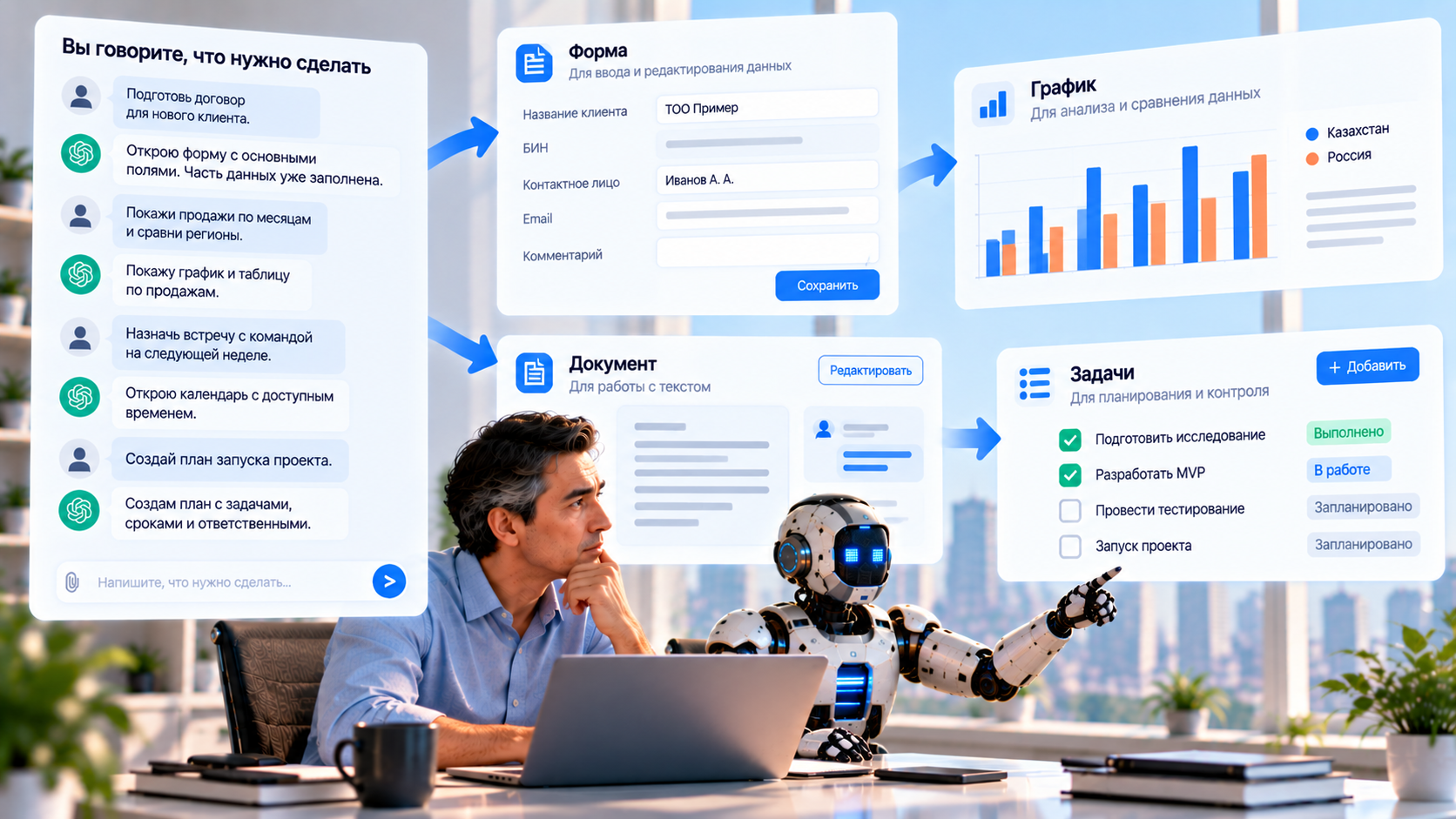
"Show the sales by month and compare the regions."
The system responds not only with text.
She builds a graph and a table.
The user writes:
"Leave only Kazakhstan and Russia."
The table is being updated.
Then:
"Now show only deviations of more than ten percent."
The system changes the view again.
Chat remains a way to explain what is needed, and the visual part changes to suit the task.
The form can also appear on request.
Let's give another example.
The user writes:
"Create a new client."
Instead of a long conversation, the system can open a small form with already filled out data that has been determined from the context.
All that remains is to check the name, banking details and confirm the save.
This approach is much more convenient than forcing a person to dictate each field separately.
Especially if the action is important and the mistake can be costly.
Critical actions must remain explicit.
There's another reason why buttons and forms won't disappear.
Some actions cannot be performed solely on the basis of free text.
Transfer money.
Delete the data.
Change access rights.
Sign the document.
Start an expensive process.
In such cases, it is important for a person to see the exact parameters before confirmation.
Even if the intention was expressed in a chat, the system must show before execution:
what exactly will be done;
with what data;
for whom;
for what amount;
with what consequences.
And only after that, the person confirms the action.
Chat becomes the top level
Therefore, I would not say that chat replaces the interface.
Rather, it becomes the top level of management.
Previously, the person himself was looking for the right shape.
Now he can just say:
"I need to change the terms of the contract."
The system will open the document.
"Show the sales."
A graph will appear.
"Reschedule the meeting."
The calendar opens.
"Add an employee."
A form will appear.
That is, the person stops looking for the right screen, and the system displays it at the appropriate moment.
What is changing for the developer
Previously, the developer designed one fixed path.
Main page.
Menu.
Chapter.
Form.
Button.
Now we will also have to design the transition from intention to correct representation.
The system must understand not only what a person wants to do, but also which method of interaction is most convenient for this task.
Sometimes it will be text.
Sometimes a table.
Sometimes a calendar.
Sometimes there is only one confirmation button.
The buttons won't disappear.
ChatGPT has shown that a huge number of actions can be started with a common phrase.
But this does not mean the end of the GUI.
On the contrary, good AI can make forms and panels more useful, because they will appear exactly when needed.
It seems to me that the future does not look like one endless chat or a screen with a thousand buttons.
Rather like this:
the person formulates the intention, and the system chooses the appropriate interface for the next step.
And then the chat stops competing with the buttons.
It just helps you find the right buttons without having to search for them.
После появления ChatGPT легко представить будущее, в котором почти всё управление программой сводится к одному полю ввода. Написал, что нужно, — система сама разобралась и всё сделала.
Для части задач это действительно удобно. Но если посмотреть внимательнее, становится понятно: чат не заменит формы, таблицы, календарь и другие привычные элементы интерфейса.
Он скорее станет ещё одним уровнем над ними.
Не всё удобно объяснять словами
Представим простую задачу: выбрать дату встречи.
Можно написать:
«Поставь встречу на следующий четверг после обеда».
Система попробует понять, что именно значит «после обеда», посмотреть свободное время и предложить вариант.
Но если человеку нужно выбрать конкретный день из нескольких свободных, обычный календарь будет быстрее и понятнее.
То же самое с диапазоном времени, списком сотрудников, правами доступа или набором параметров. Иногда проще увидеть варианты перед собой и выбрать нужный, чем описывать их словами.
Текст хорош для намерения, форма — для точности
Мне кажется, здесь хорошо разделяются две роли.
Чат удобен, когда человек знает цель, но не хочет разбираться, как именно её достичь.
Например:
«Назначь встречу с командой на следующей неделе».
Но как только система нашла несколько подходящих вариантов, гораздо удобнее показать календарь с тремя свободными окнами.
Пользователь одним взглядом видит ситуацию и нажимает на нужное время.
То есть разговор помогает определить задачу, а обычный интерфейс — точно выбрать результат.
Таблица всё ещё лучше длинного разговора
Есть задачи, где текст особенно быстро начинает проигрывать.
Допустим, нужно изменить права доступа двадцати сотрудников.
Можно вести разговор:
«Иванову оставить просмотр».
«Петрову добавить редактирование».
«Сидорову убрать доступ».
Но в таблице всё это видно сразу.
Строки — сотрудники.
Столбцы — права.
Изменения можно сравнить за несколько секунд.
Чат здесь не упрощает работу. Он только превращает хорошо структурированную задачу в длинную последовательность фраз.
Панель лучше показывает состояние
То же самое происходит с задачами и показателями.
Если у меня десять проектов, я не хочу каждый раз спрашивать:
«Какие сейчас активны?»
«Что просрочено?»
«Где есть проблема?»
Гораздо удобнее открыть панель и сразу увидеть состояние.
Чат хорош для вопроса:
«Почему этот проект отстаёт?»
Но сам список проектов лучше оставить в привычной форме.
То есть панель отвечает на вопрос «что происходит сейчас?», а чат — на вопрос «что я хочу понять или изменить?».
Хороший интерфейс не должен заставлять выбирать один способ
Мне кажется, ошибка была бы в том, чтобы противопоставлять чат и обычный интерфейс.
Не нужно решать, кто из них победит.
Они хороши для разных задач.
Форма хороша там, где структура заранее известна.
Чат хорош там, где запрос может быть любым.
Таблица хороша для сравнения большого количества однотипных данных.
График — для динамики.
Документ — для длинного текста.
Разговор — для постановки цели и уточнений.
Вместе они работают намного лучше, чем по отдельности.
ИИ может сам показывать нужный инструмент
Самое интересное начинается тогда, когда пользователь вообще не выбирает интерфейс вручную.
Он пишет:
«Покажи продажи по месяцам и сравни регионы».
Система отвечает не только текстом.
Она строит график и таблицу.
Пользователь пишет:
«Оставь только Казахстан и Россию».
Таблица обновляется.
Потом:
«А теперь покажи только отклонения больше десяти процентов».
Система меняет представление ещё раз.
Чат остаётся способом объяснить, что нужно, а визуальная часть меняется под задачу.
Форма тоже может появляться по запросу
Представим другой пример.
Пользователь пишет:
«Создай нового клиента».
Вместо длинного разговора система может открыть небольшую форму с уже заполненными данными, которые удалось определить из контекста.
Останется только проверить имя, реквизиты и подтвердить сохранение.
Такой подход намного удобнее, чем заставлять человека диктовать каждое поле отдельно.
Особенно если действие важное и ошибка может дорого стоить.
Критические действия должны оставаться явными
Есть ещё одна причина, почему кнопки и формы никуда не исчезнут.
Некоторые действия нельзя выполнять только на основании свободного текста.
Перевести деньги.
Удалить данные.
Изменить права доступа.
Подписать документ.
Запустить дорогой процесс.
В таких случаях человеку важно видеть точные параметры перед подтверждением.
Даже если намерение было выражено в чате, перед выполнением система должна показать:
что именно будет сделано;
с какими данными;
для кого;
на какую сумму;
с какими последствиями.
И только после этого человек подтверждает действие.
Чат становится верхним уровнем
Поэтому я бы не говорил, что чат заменяет интерфейс.
Скорее он становится верхним уровнем управления.
Раньше человек сам искал нужную форму.
Теперь он может просто сказать:
«Мне нужно изменить условия договора».
Система откроет документ.
«Покажи продажи».
Появится график.
«Перенеси встречу».
Откроется календарь.
«Добавь сотрудника».
Появится форма.
То есть человек перестаёт искать нужный экран, а система сама выводит его в подходящий момент.
Что меняется для разработчика
Раньше разработчик проектировал один фиксированный путь.
Главная страница.
Меню.
Раздел.
Форма.
Кнопка.
Теперь придётся проектировать ещё и переход от намерения к правильному представлению.
Система должна понимать не только, что человек хочет сделать, но и какой способ взаимодействия будет для этой задачи самым удобным.
Иногда это будет текст.
Иногда таблица.
Иногда календарь.
Иногда всего одна кнопка подтверждения.
Кнопки никуда не исчезнут
ChatGPT показал, что огромное количество действий можно начинать с обычной фразы.
Но это не означает конец графического интерфейса.
Наоборот, хороший ИИ может сделать формы и панели полезнее, потому что они будут появляться именно тогда, когда нужны.
Мне кажется, будущее выглядит не как один бесконечный чат и не как экран с тысячей кнопок.
Скорее так:
человек формулирует намерение, а система сама выбирает подходящий интерфейс для следующего шага.
И тогда чат перестаёт конкурировать с кнопками.
Он просто помогает находить правильные кнопки без необходимости их искать.
 Share