
The post has been translated automatically. Original language: Russian




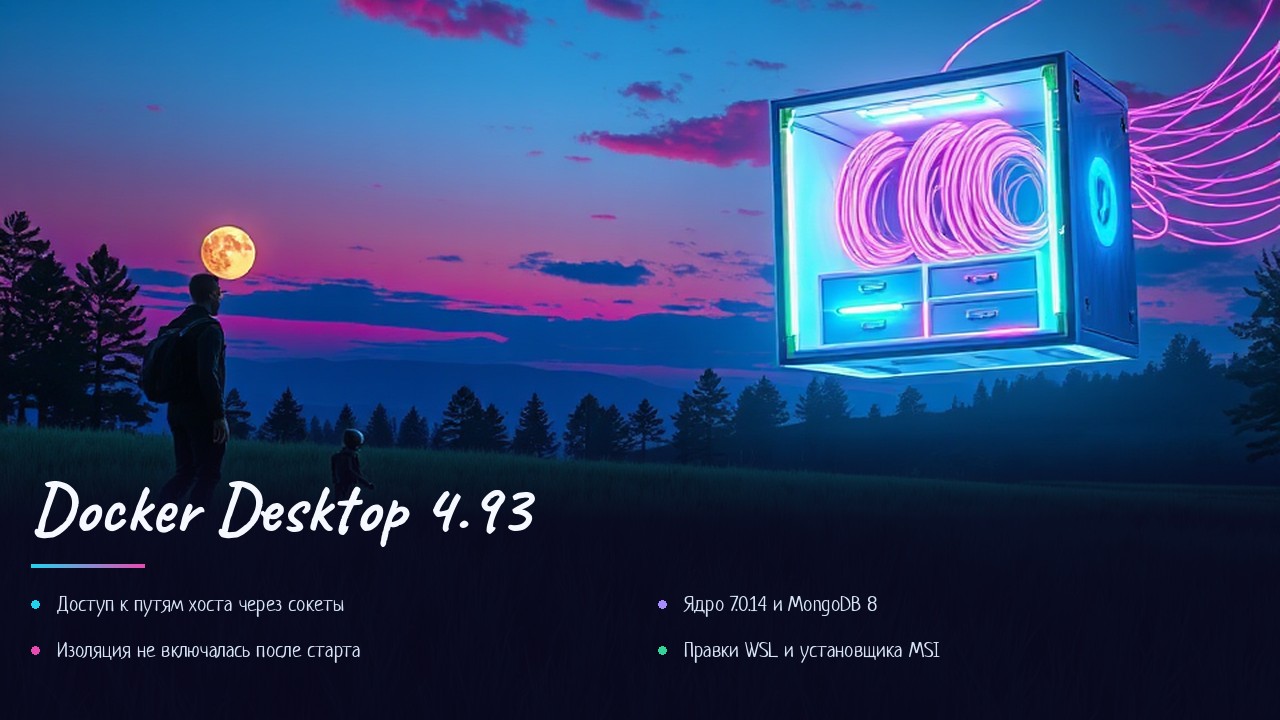
On September 28, 2026, Docker Desktop 4.93.0 was released. There are no major new features in the release, but the set of fixes is dense: a vulnerability has been closed through which code from a virtual machine could reach arbitrary host paths, three scenarios have been eliminated in which Enhanced Container Isolation was not silently applied, and the Docker Engine and Linux kernel have been updated to versions 29.8.1 and 7.0.14.
Access to host paths through Unix sockets
The most serious fix concerns the boundary between the Docker Desktop VM and the host. The VM-side code could request the forwarding of Unix sockets and use this mechanism to reach arbitrary paths of the host's file system — release notes describe this as an opportunity to manipulate arbitrary paths. The CVE identifier is not specified in the notes, but according to the description, this is a classic problem of trust in requests from the guest system: the service channel accepted requests more widely than it should. All platforms are affected, there is no separate mitigation — only an update.
Enhanced Container Isolation was not applied in three scenarios
Enhanced Container Isolation is enhanced container isolation that Docker Business administrators include as a policy for the entire organization. The release closes three cases when it was not applied: if the engine remained running while another one was being used; if the administrator's policy came after the engine was started; and if the user's account login ended after the engine was started. The common denominator of all three is that the setting was applied only at the start of the engine and was not reread later. For companies where this insulation is a mandatory safety requirement, this meant windows in which containers worked without it, and without any warnings.
Components and daily fixes
In addition to Docker Engine 29.8.1, the Linux kernel was updated to 7.0.14 (this fixed the failure to launch MongoDB 8 containers), Docker Offload to 0.6.33 and Docker Agent to 1.141.0. The CLI plug-in update model has changed: they are now controlled by the application itself, and the automatic component update setting has been removed; on Mac and Linux, the program no longer overwrites the more recent a plugin installed manually in the user's cli-plugins directory. Fixed resetting the list of shared directories after cleaning and restarting, the suspended Kubernetes status after an external shutdown of the cloud cluster, and startup failure when the engine needed more than five minutes to recover from an abnormal shutdown.
On Windows, the long-standing problem of the MSI installer, which did not add a user to the docker users group, was fixed, the crash when reading configuration files from UTF-8 BOM was fixed, and a pack of WSL integration fixes was collected, from an unexpected reset of the CLI credential storage to a proxy timeout when restoring bind mounts.
What does this mean in practice?
- Teams where Enhanced Container Isolation is enabled by the policy should update first and check the versions on all machines: before 4.93.0, isolation might not work quietly.
- The vulnerability with Unix sockets lies in the Docker Desktop architecture itself, so the only protection is an update; it's not worth postponing it on machines running other people's images.
- For those who install CLI plugins manually, it is useful to check their operation after the update: the plugin management mechanism has changed.
- Administrators who roll out Docker Desktop on Windows via MSI should make sure that users are in the docker-users group, as previously it had to be configured manually.
The draft text was prepared with the participation of AI, the facts are checked against the original source — official release notes Docker Desktop on the Docker documentation website
28 сентября 2026 года вышел Docker Desktop 4.93.0. Новых крупных функций в релизе нет, зато набор исправлений плотный: закрыта уязвимость, через которую код из виртуальной машины мог добраться до произвольных путей хоста, устранены три сценария, в которых Enhanced Container Isolation молча не применялась, а Docker Engine и ядро Linux обновлены до версий 29.8.1 и 7.0.14.
Доступ к путям хоста через проброс Unix-сокетов
Самое серьёзное исправление касается границы между виртуальной машиной Docker Desktop и хостом. Код, работающий на стороне VM, мог запрашивать проброс Unix-сокетов и через этот механизм дотягиваться до произвольных путей файловой системы хоста — release notes описывают это как возможность манипуляции произвольными путями. Идентификатор CVE в примечаниях не указан, но по описанию это классическая проблема доверия к запросам из гостевой системы: служебный канал принимал запросы шире, чем следовало. Затронуты все платформы, отдельного смягчения нет — только обновление.
Enhanced Container Isolation не применялась в трёх сценариях
Enhanced Container Isolation — усиленная изоляция контейнеров, которую администраторы Docker Business включают политикой для всей организации. Релиз закрывает три случая, когда она не применялась: если движок оставался запущенным, пока использовался другой; если политика администратора приходила уже после старта движка; и если вход пользователя в аккаунт завершался после запуска движка. Общий знаменатель у всех трёх — настройка применялась только в момент старта движка и позже не перечитывалась. Для компаний, где эта изоляция является обязательным требованием безопасности, это означало окна, в которых контейнеры работали без неё, причём без каких-либо предупреждений.
Компоненты и повседневные исправления
Кроме Docker Engine 29.8.1, обновлены ядро Linux до 7.0.14 (это починило отказ запуска контейнеров MongoDB 8), Docker Offload до 0.6.33 и Docker Agent до 1.141.0. Изменилась модель обновления CLI-плагинов: теперь ими управляет само приложение, а настройка автоматического обновления компонентов удалена; на Mac и Linux программа больше не перезаписывает более свежий плагин, установленный вручную в пользовательский каталог cli-plugins. Исправлены сброс списка общих каталогов после очистки и перезапуска, зависший статус Kubernetes после внешней остановки облачного кластера и отказ запуска, когда движку требовалось больше пяти минут на восстановление после нештатного завершения.
На Windows закрыта давняя проблема MSI-установщика, который не добавлял пользователя в группу docker-users, устранён крах при чтении конфигурационных файлов с UTF-8 BOM и собрана пачка исправлений WSL-интеграции — от неожиданного сброса хранилища учётных данных CLI до таймаута прокси при восстановлении bind-монтирований.
Что это значит на практике
- Командам, где Enhanced Container Isolation включена политикой, стоит обновляться в первую очередь и проверить версии на всех машинах: до 4.93.0 изоляция могла тихо не работать.
- Уязвимость с Unix-сокетами лежит в самой архитектуре Docker Desktop, поэтому единственная защита — обновление; откладывать его на машинах, где запускаются чужие образы, не стоит.
- Тем, кто ставит CLI-плагины вручную, полезно проверить их работу после обновления: механизм управления плагинами поменялся.
- Администраторам, раскатывающим Docker Desktop на Windows через MSI, стоит убедиться, что пользователи попали в группу docker-users, — раньше её приходилось настраивать руками.
Черновик текста подготовлен с участием ИИ, факты сверены с первоисточником — официальные release notes Docker Desktop на сайте документации Docker
 Share