



The post has been translated automatically. Original language: Russian




Companies spend months searching for a Product Manager, get a person with the right CV, and after six months they are unhappy. Not because the candidate is bad. It's because they hired the wrong guy.
A few words about me: I am a CPO at Ecar, responsible for the development and development of digital products. I decided to publish some useful but short articles for HR, Business and Product(s). I hope it will be useful to you.
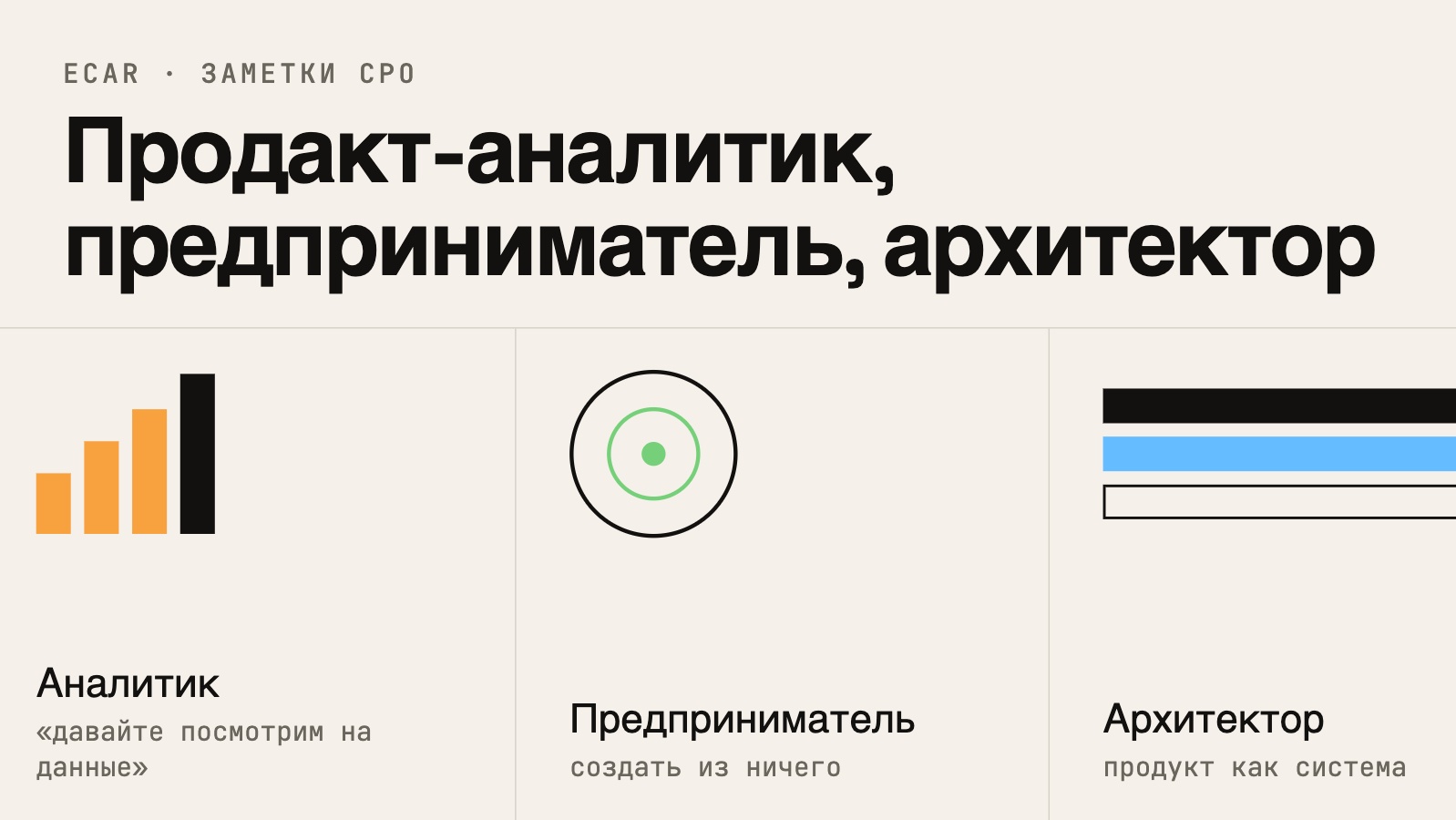
So, my observations led me to the conclusion that there are three fundamentally different types in the profession of a Product Manager. They are rarely distinguished in interviews, and even more rarely in job descriptions. But it is this difference that determines whether a person will take root in your company or leave after a year with a feeling of mutual disappointment.
Type 1. Product Analyst
It's easy to find out: This is a person who answers any question with "let's look at the data." He lives on dashboards, builds cohorts, knows how to write SQL, and feels uncomfortable when a decision is made without numbers.
In communication, he is restrained. Not because he is arrogant, but because he prefers a written asynchronous format to live rallies. Stakeholders sometimes perceive this as closeness.
Where it is strong: a mature product with traffic and data. The task is to find growth points, optimize the funnel, and reduce outflow. Where it is necessary not to invent, but to improve.
Where it is stalling: starting from scratch, when there is no data and you need to make decisions based on intuition and conversations with five users.
Type 2. Product Entrepreneur
This is someone who sees the product as a business. He understands metrics, but he doesn't live in them — he uses them as a tool, not as a goal. The main source of information for him is real people: users, team, market.
Takes responsibility for the result without detailed instructions. It is this type that most often grows up to a CPO or leaves to found their own product.
Where he is strong: starting from scratch, searching for product-market fit, pivot, new directions. Where you need to create something out of nothing and convince everyone around you that this is the right direction.
Where it is stalling: monotonous optimization of a mature product. He's bored, and it shows.
Type 3. Product Architect
Superficially, he looks like an analyst — he's also not the most talkative, he also likes structure. But he's not looking at metrics, he's looking at systems. He thinks about APIs, integrations, scalability, and technical debt.
In fact, this is a hybrid between a product and a development manager. He speaks the same language as engineers and translates business tasks into architectural solutions better than anyone.
Where it is strong: platform products, B2B with deep technical integration, IoT, infrastructure solutions. Where the product is not an interface, but a system.
Where it is stalling: direct work with end users, qualitative research, selling ideas to businesses.
So who do you need?
A few simple questions that will save you six months:
Do you already have a product with an audience and data — do you need growth? Type 1
Are you launching a new direction or looking for a market? Type 2
Is your product technically complex, there are many integrations, and the development team is the main audience? Type 3
Do you want a station wagon? It certainly exists, but it is expensive, rare, and will be partially used in most tasks. It is better to answer the question above honestly.
One last observation.:
If you look closely at the CEOs of successful companies, you will see the same three types. Satya Nadella is an architect. Steve Jobs is an entrepreneur. Most of Google's executives are analysts. Everyone built the company according to their own type of thinking.
The product does the same thing, only at the scale of the product. Therefore, the question "what kind of product do we need" is really the question "What kind of product are we building".
Компании тратят месяцы на поиск Product Manager, получают человека с правильным CV и через полгода недовольны. Не потому что кандидат плохой. А потому что наняли не тот тип.
Пара слов обо мне: я CPO в компании Ecar, отвечаю за развитие и разработку цифровых продуктов. Решил опубликовать несколько полезных, но коротких статей для HR, бизнеса и Product(ов). Надеюсь, что вам будет полезно.
Итак, мои наблюдения привели меня к выводу, что в профессии Product Manager существует три принципиально разных типажа. Их редко разграничивают на собеседованиях, ещё реже — в описаниях вакансий. Но именно это различие определяет, приживётся ли человек в вашей компании или уйдёт через год с ощущением взаимного разочарования.
Тип 1. Продакт-аналитик
Узнать просто: это человек, который на любой вопрос отвечает "давайте посмотрим на данные". Он живёт в дашбордах, строит когорты, умеет писать SQL и чувствует себя некомфортно, когда решение принимается без цифр.
В коммуникации — сдержан. Не потому что высокомерен, а потому что предпочитает письменный асинхронный формат живым митингам. Стейкхолдеры иногда воспринимают это как закрытость.
Где он силён: зрелый продукт с трафиком и данными. Задача — найти точки роста, оптимизировать воронку, снизить отток. Там, где нужно не придумать, а улучшить.
Где он буксует: старт с нуля, когда данных нет и нужно принимать решения на основе интуиции и разговоров с пятью пользователями.
Тип 2. Продакт-предприниматель
Это тот, кто видит продукт как бизнес. Он понимает метрики, но не живёт в них — использует как инструмент, а не как цель. Главный источник информации для него — живые люди: пользователи, команда, рынок.
Берёт ответственность за результат без подробных инструкций. Именно этот тип чаще всего дорастает до CPO или уходит основывать свой продукт.
Где он силён: запуск с нуля, поиск product-market fit, pivot, новые направления. Там, где нужно создать что-то из ничего и убедить всех вокруг, что это правильное направление.
Где он буксует: монотонная оптимизация зрелого продукта. Ему скучно, и это видно.
Тип 3. Продакт-архитектор
Поверхностно похож на аналитика — тоже не самый разговорчивый, тоже любит структуру. Но смотрит не на метрики, а на системы. Думает API, интеграциями, масштабируемостью, техническим долгом.
По факту это гибрид между продактом и руководителем разработки. Он говорит на одном языке с инженерами и переводит бизнес-задачи в архитектурные решения лучше, чем кто-либо.
Где он силён: платформенные продукты, B2B с глубокой технической интеграцией, IoT, инфраструктурные решения. Там, где продукт — это не интерфейс, а система.
Где он буксует: прямая работа с конечными пользователями, качественные исследования, продажи идей бизнесу.
Так кто нужен вам?
Несколько простых вопросов, которые сэкономят вам полгода:
У вас уже есть продукт с аудиторией и данными — нужен рост? Тип 1
Вы запускаете новое направление или ищете рынок? Тип 2
Ваш продукт технически сложный, много интеграций, команда разработки — основная аудитория? Тип 3
Хотите универсала? Он конечно существует, но стоит дорого, встречается редко и в большинстве задач будет использоваться частично. Лучше честно ответить на вопрос выше.
Еще одно наблюдение напоследок:
Если присмотреться к CEO успешных компаний, вы увидите те же три типажа. Сатья Наделла - архитектор. Стив Джобс - предприниматель. Большинство руководителей Google - аналитики. Каждый строил компанию под свой тип мышления.
Продакт делает то же самое - только в масштабе продукта. Поэтому вопрос "какой продакт нам нужен" — это на самом деле вопрос "А какой продукт мы строим".
 Share





