
The post has been translated automatically. Original language: Russian




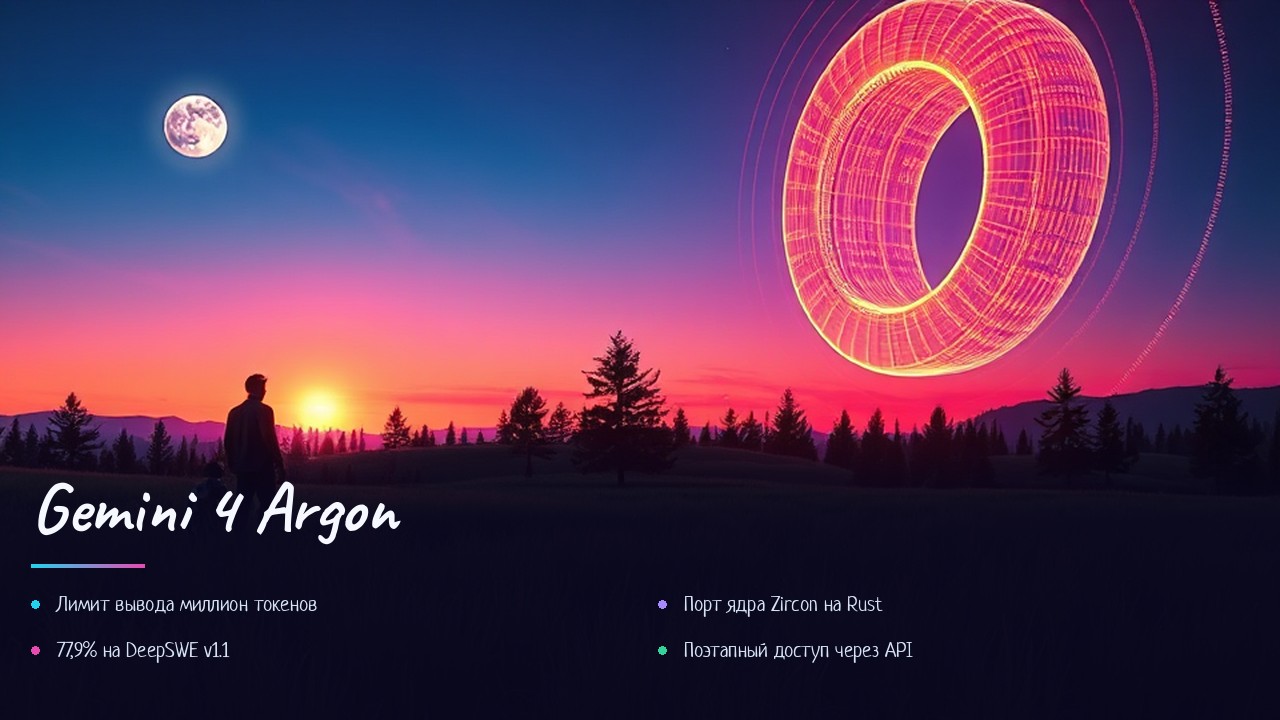
On September 30, 2026, Google DeepMind introduced Gemini 4 Argon, the flagship model of the new generation, designed for long multistep tasks: real software development, analytical work and cybersecurity. The announcement was signed by Korai Kavukciuoglu, senior vice president of Google DeepMind. The main technical news for developers is that the withdrawal limit has increased from 64,000 to one million tokens, and the model has set a new record for long—term engineering tasks.
One million tokens for withdrawal
The contextual windows of the models have long been measured in millions of tokens, but the response length limit remained a bottleneck: the previous Google model had a withdrawal limit of 64,000 tokens. Argon raised it to one million — according to the company, this is an industry record. In practice, this means that the model can generate a major refactoring, a multi-file patch, or a detailed report in one call, without cutting off the response in the middle and forcing the developer to glue together a continuation of several requests.
Records on engineering benchmarks
On DeepSWE v1.1, a benchmark that measures the performance of a model on real long—term software engineering tasks, Argon scored 77.9% and set a new state of the art. On AutomationBench (workflow automation), the model has 51.3% and the first place, on CWE-bench v1, which checks for security defects in the code, 68%, is also the best result. Google emphasizes that the model is designed for autonomous chains of actions.: It searches, validates, and fixes vulnerabilities entirely on its own; in collaboration with Wiz, the model has already found a critical vulnerability in medical software.
Rust instead of C++ and 300 tibibytes of memory
Google also provided internal cases. Argon-based agents have freed up more than 300 TiB of memory in the company's data centers, optimizing its services. The second story is the migration of code from C and C++ to Rust: agents port projects with up to 800,000 lines, including the Zircon core of the Fuchsia operating system. The third example is the libgav1 video decoder: the model has replaced about 32,000 lines of SIMD code, and the new version is 2.7 times faster than the old one.
Access and prices
The release is staged: first, the model is received by trusted cyber defense teams under the Fairwind program, then by paid API clients and Google AI Ultra subscribers. The introductory price is $ 2 per million input tokens and $ 10 per million output tokens, after the start period — $ 4 and $ 20; cached input tokens are 95% cheaper. Security measures are described separately: monitoring of internal model activations, testing of resistance to injection of prompta on the Gray Swan IPI benchmark, and isolated sandboxes for risky scenarios.
What does this mean in practice?
For a backend developer, the main thing here is not benchmarks, but the withdrawal limit. The usual workarounds — asking the model to continue from the point of the cliff, cutting the task into pieces, assembling a patch from several answers — are built around old limitations, and when switching to models with a large output, they should be reviewed. The second point is the price: a million output tokens for $ 10, and then $ 20 means that one extra—long response can cost a lot of money, so it's useful to limit max_tokens in the client code in advance and set up alerts for consumption. Finally, step-by-step access means that it's too early to include Argon in production plans: before the API is publicly released, it makes sense to debug pipelines on current models and monitor the expansion of the access program.
The draft text was prepared with the participation of AI, the facts were checked against the original source — the official Google blog, the announcement of the Gemini 4 Argon model.
30 сентября 2026 года Google DeepMind представил Gemini 4 Argon — флагманскую модель нового поколения, рассчитанную на длинные многошаговые задачи: реальную разработку ПО, аналитическую работу и кибербезопасность. Анонс подписал Корай Кавукчуоглу, старший вице-президент Google DeepMind. Главная техническая новость для разработчиков — лимит вывода вырос с 64 тысяч до миллиона токенов, а на бенчмарке долгих инженерных задач модель поставила новый рекорд.
Миллион токенов на вывод
Контекстные окна моделей давно измеряются миллионами токенов, но ограничение на длину ответа оставалось узким местом: у предыдущей модели Google лимит вывода составлял 64 тысячи токенов. В Argon его подняли до миллиона — по заявлению компании, это рекорд индустрии. На практике это значит, что модель может за один вызов сгенерировать крупный рефакторинг, многофайловый патч или развёрнутый отчёт, не обрывая ответ на середине и не заставляя разработчика склеивать продолжение из нескольких запросов.
Рекорды на инженерных бенчмарках
На DeepSWE v1.1 — бенчмарке, измеряющем работу модели на реальных долгих задачах программной инженерии, — Argon набрал 77,9% и установил новый state of the art. На AutomationBench (автоматизация рабочих процессов) у модели 51,3% и первое место, на CWE-bench v1, который проверяет поиск дефектов безопасности в коде, — 68%, тоже лучший результат. Google подчёркивает, что модель рассчитана на автономные цепочки действий: поиск, валидацию и исправление уязвимостей она проходит целиком сама; в совместной работе с компанией Wiz модель уже нашла критическую уязвимость в медицинском ПО.
Rust вместо C++ и 300 тибибайт памяти
Google привёл и внутренние кейсы. Агенты на базе Argon освободили более 300 TiB памяти в дата-центрах компании, оптимизируя её сервисы. Вторая история — миграция кода с C и C++ на Rust: агенты портируют проекты объёмом до 800 с лишним тысяч строк, включая ядро Zircon операционной системы Fuchsia. Третий пример — видеодекодер libgav1: модель заменила около 32 тысяч строк SIMD-кода, и новый вариант работает в 2,7 раза быстрее прежнего.
Доступ и цены
Выпуск поэтапный: сначала модель получают проверенные команды киберзащиты по программе Fairwind, затем — платные клиенты API и подписчики Google AI Ultra. Вводная цена — 2 доллара за миллион входных токенов и 10 долларов за миллион выходных, после стартового периода — 4 и 20 долларов; кешированные входные токены дешевле на 95%. Отдельно описаны меры безопасности: мониторинг внутренних активаций модели, проверка устойчивости к инъекциям промптов на бенчмарке Gray Swan IPI и изолированные песочницы для рискованных сценариев.
Что это значит на практике
Для backend-разработчика главное здесь не бенчмарки, а лимит вывода. Привычные обходные приёмы — просить модель продолжить с места обрыва, резать задачу на куски, собирать патч из нескольких ответов — построены вокруг старых ограничений, и при переходе на модели с большим выводом их стоит пересмотреть. Второй момент — цена: миллион выходных токенов по 10, а затем 20 долларов означает, что один сверхдлинный ответ может стоить заметных денег, поэтому в клиентском коде полезно заранее ограничивать max_tokens и настроить алерты на расход. Наконец, поэтапный доступ значит, что закладывать Argon в продакшен-планы пока рано: до публичного релиза API имеет смысл отладить пайплайны на текущих моделях и следить за расширением программы доступа.
Черновик текста подготовлен с участием ИИ, факты сверены с первоисточником — официальный блог Google, анонс модели Gemini 4 Argon.
 Share