
The post has been translated automatically. Original language: Russian




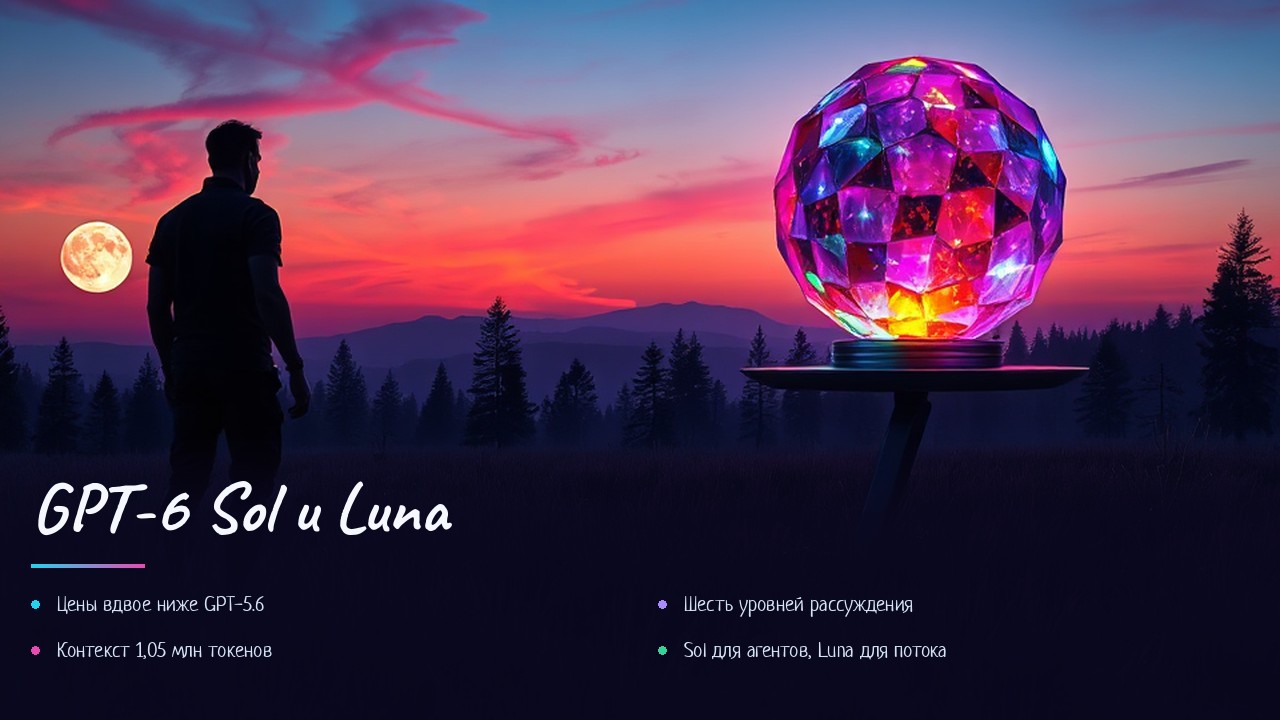
On September 22, OpenAI released two reasoning models of the GPT-6 family — Sol and Luna. They complement GPT-6 Astra, which was released earlier this month, and are available immediately in the API, Codex, and ChatGPT. The main thing for developers is that API prices are twice as low as the promo prices of the previous generation GPT-5.6, and in terms of context limits, the new models are not inferior to the older ones.
Two models for different tasks
The division of roles is described by OpenAI as follows: Sol is designed for complex development and agent—based scenarios, Luna is designed for repetitive tasks with a large volume of requests. According to the company, both models are trained using the same methods as the GPT-6 Astra and transfer its improvements in programming, actual accuracy, computer operation and alignment to faster and cheaper models.
The IDs in the API are gpt—6-sol and gpt-6-luna. Both accept text and images as input, and output only text.
Prices and limits
Cost per million tokens based on model cards:
- GPT-6 Sol: $2 for input tokens, $0.2 for cached, $10 for output; write to cache — $2.5;
- GPT-6 Luna: $0.1 for entry, $0.01 for cached entry, $0.5 for exit; write to cache — $0.125.
For comparison, GPT-5.6 Sol currently has promo prices of $4 for entry and $20 for exit. OpenAI explains the price reduction with improvements in caching and inference.
The context window for both models is 1,050,000 tokens, of which up to 922,000 can be entered, and the maximum response is 128,000 tokens. Sol's knowledge boundary is April 20, 2026, and Luna's is May 18, 2026.
What is supported
The models work via Responses, Chat Completions, and Batch. Live, Realtime, Assistants, and Advanced training are not supported. The built-in tools include web search, file search, code interpreter, computer management, cloud shell, patch application, skills, MCP, and tool search.
The reasoning.effort parameter takes six values: none, low, medium, high, xhigh, and max. The default value is medium.
At the first access level, Sol provides 500 requests and 500 thousand tokens per minute, Luna has the same 500 requests per minute, but the queue of batch jobs is noticeably larger. At the fifth level, Luna's limits are 30,000 requests and 180 million tokens per minute.
What does this mean in practice?
If you have GPT-5.6 in production, the transition looks like a replacement for the model ID, but it's worth checking not only the price.:
- Run through your set of reference queries. New models are trained differently, and the response format, length of reasoning, and behavior in tool calls may vary. This is especially true for agents who parse the model's response using regular intervals or a strict scheme.
- Explicitly set reasoning.effort. The default value is medium, and if you relied on it before, the cost and delay on the new model may still change. None or low is often enough to classify and extract fields in Luna.
- Look at caching. A cached login is ten times cheaper than a regular one, but writing to the cache is more expensive than a regular login. A long, unchanging system prompt at the beginning of a request pays off, and a frequently changing prefix can make the score higher than expected.
- Check which endpoints you are using. If the service is running on Assistants or Realtime, you won't be able to upgrade to new models without reworking them.
- Consider the boundary of knowledge. For questions about the latest library versions, the web-search-free model will rely on data from spring 2026.
A reasonable strategy for the backend team: give Sol complex agent tasks and code review, mass text processing, routing and markup to Luna via Batch, and compare bills based on real traffic, not price.
The draft text was prepared with the participation of AI, the facts were checked against the original source — the official OpenAI API changelog and the GPT-6 Sol and GPT-6 Luna model cards in the developer documentation
22 сентября OpenAI выпустила две рассуждающие модели семейства GPT-6 — Sol и Luna. Они дополняют вышедшую в начале месяца GPT-6 Astra и доступны сразу в API, в Codex и в ChatGPT. Главное для разработчиков: цены в API вдвое ниже промо-цен предыдущего поколения GPT-5.6, а по лимитам контекста новые модели не уступают старшим.
Две модели под разные задачи
Разделение ролей OpenAI описывает так: Sol рассчитана на сложную разработку и агентные сценарии, Luna — на повторяющиеся задачи с большим объёмом запросов. По словам компании, обе модели обучены теми же методами, что и GPT-6 Astra, и переносят её улучшения в программировании, фактической точности, работе с компьютером и выравнивании на более быстрые и дешёвые модели.
Идентификаторы в API — gpt-6-sol и gpt-6-luna. Обе принимают на вход текст и изображения, на выходе отдают только текст.
Цены и лимиты
Стоимость за миллион токенов по карточкам моделей:
- GPT-6 Sol: 2 доллара за входные токены, 0,2 доллара за кешированные, 10 долларов за выходные; запись в кеш — 2,5 доллара;
- GPT-6 Luna: 0,1 доллара за вход, 0,01 доллара за кешированный вход, 0,5 доллара за выход; запись в кеш — 0,125 доллара.
Для сравнения, у GPT-5.6 Sol сейчас действуют промо-цены 4 доллара за вход и 20 долларов за выход. Снижение цен OpenAI объясняет улучшениями в кешировании и инференсе.
Окно контекста у обеих моделей — 1 050 000 токенов, из них на вход можно подать до 922 000, максимальный ответ — 128 000 токенов. Граница знаний у Sol — 20 апреля 2026 года, у Luna — 18 мая 2026 года.
Что поддерживается
Модели работают через Responses, Chat Completions и Batch. Live, Realtime, Assistants и дообучение не поддерживаются. Из встроенных инструментов доступны веб-поиск, поиск по файлам, интерпретатор кода, управление компьютером, облачная оболочка, применение патчей, навыки, MCP и поиск инструментов.
Параметр reasoning.effort принимает шесть значений: none, low, medium, high, xhigh и max. По умолчанию стоит medium.
На первом уровне доступа Sol даёт 500 запросов и 500 тысяч токенов в минуту, у Luna те же 500 запросов в минуту, но заметно больше очередь пакетных заданий. На пятом уровне лимиты Luna — 30 тысяч запросов и 180 миллионов токенов в минуту.
Что это значит на практике
Если у вас в продакшене GPT-5.6, переход выглядит как замена идентификатора модели, но проверять стоит не только цену:
- Прогоните свой набор эталонных запросов. Новые модели обучены иначе, и формат ответа, длина рассуждений и поведение в вызовах инструментов могут отличаться. Особенно это касается агентов, которые разбирают ответ модели регулярками или строгой схемой.
- Явно задайте reasoning.effort. Значение по умолчанию medium, и если раньше вы на него полагались, стоимость и задержка на новой модели всё равно могут измениться. Для классификации и извлечения полей в Luna часто хватит none или low.
- Посмотрите на кеширование. Кешированный вход в десять раз дешевле обычного, но запись в кеш стоит дороже обычного входа. Длинный неизменный системный промпт в начале запроса окупается, а часто меняющийся префикс может сделать счёт выше ожидаемого.
- Проверьте, какие эндпоинты вы используете. Если сервис сидит на Assistants или Realtime, перейти на новые модели без переделки не получится.
- Учитывайте границу знаний. Для вопросов о свежих версиях библиотек модель без веб-поиска будет опираться на данные весны 2026 года.
Разумная стратегия для backend-команды: сложные агентные задачи и ревью кода отдать Sol, массовую обработку текстов, маршрутизацию и разметку — Luna через Batch, и сравнивать счета по реальному трафику, а не по прайсу.
Черновик текста подготовлен с участием ИИ, факты сверены с первоисточником — официальный журнал изменений API OpenAI и карточки моделей GPT-6 Sol и GPT-6 Luna в документации для разработчиков
 Share