
The post has been translated automatically. Original language: Russian


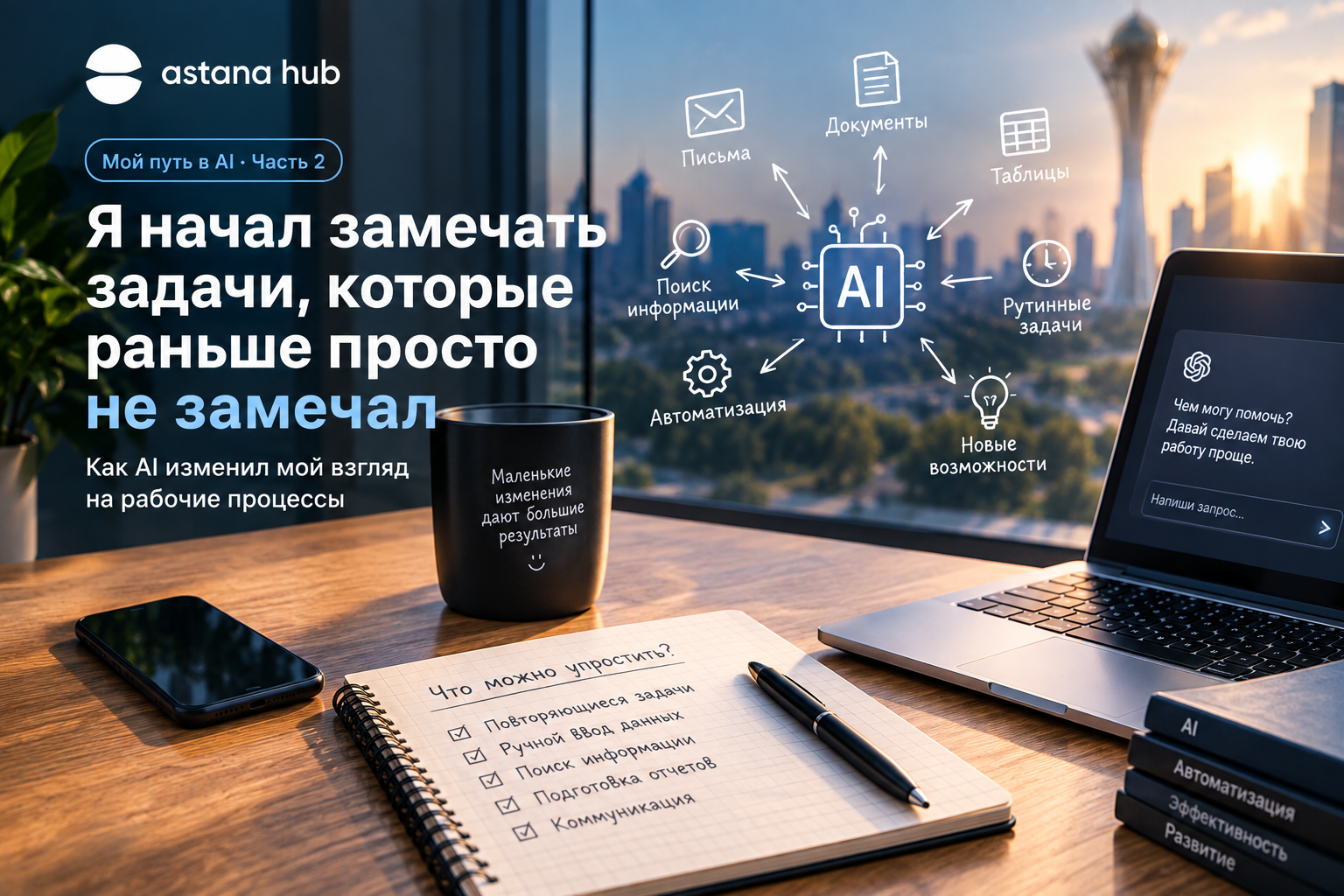
How AI has changed my view of Workflows
My Way to AI · Part 2
When I first started learning about AI, it seemed to me that it was something from the world of IT and development. I thought that such tools were primarily needed by programmers, analysts, and specialists who work with large systems and data.
But over time, I realized that AI is interesting not only for its capabilities. He also makes you look at your usual work in a different way.
After the first experiments, I began to notice things that I had never seen before.
It turned out that in a typical working day, quite a lot of tasks are repeated, take time, and at the same time do not require any complex solutions.
We just got used to doing them.
From habit to awareness
Previously, the working day looked quite simple: there is a task that needs to be completed.
There is a table that needs to be filled in.
If you have a letter, you need to write it.
There is a document that needs to be processed.
And at some point you stop wondering why this process works the way it does.
It seems: "Well, then, that's the way it should be."
But when you start to get acquainted with AI and automation, a slightly different view appears.
You start asking yourself:
How much time do I spend on repetitive actions?
Can any part of this work be simplified?
Is it necessary to do it manually every time?
And that's where the fun started for me.
Not technology for the sake of technology
I used to be able to see a new AI tool and think:
"I wonder what he can do?"
Now I prefer a different approach.:
"I have a specific task. How can modern tools help solve it easier?"
The difference seems small, but in practice it is significant.
In the first case, you're looking for a technology application.
In the second case, you solve a real problem.
It seems to me that this is where useful digitalization begins.
Not from buying a new service or using the buzzword "AI", but from understanding exactly what we want to improve.
I started to notice repetitive work
For example, I used to be able to calmly relate to the fact that some information was transferred from one place to another several times.
Or to the fact that a certain document has to be created almost from scratch every time.
Or the fact that it takes more time to find the information you need than to work with it directly.
Now such moments have become a kind of signal for me.
If I see a recurring operation, I start thinking:
"Is it possible to do this once and then use the result many times?"
Sometimes the answer is automation.
Sometimes it's a template.
Sometimes it's Excel or another tool.
Sometimes AI can really help.
And sometimes, after analysis, it turns out that automation is not needed at all — it is enough to change the process itself.
And this is also a useful result.
Not everything needs to be automated
This is probably one of the important conclusions I have come to.
Automation should not become an end in itself.
If the task takes two minutes and is completed once a month, there may be absolutely no point in spending a week creating a complex solution.
And if a person performs the same operation dozens of times every day, it's worth stopping and thinking about.
It turns out a simple principle:
first understand the process, then look for the technology.
Not the other way around.
The most interesting change wasn't in the tools.
Perhaps the main change for me is not even that I have learned how to use certain AI tools.
The very attitude towards work has changed.
Now, when faced with some kind of repetitive task, I often ask myself the question:
"Can it be made easier?"
Sometimes I find the answer right away.
Sometimes you have to search for information, experiment, and try different options.
And sometimes the answer is "no, it's better to leave it as it is."
But the very fact that you started asking this question is already changing the approach.
Perhaps this is one of the main skills of the AI era.
You don't have to know dozens of neural networks.
You don't have to be able to program.
It is not necessary to understand all new technologies.
To begin with, it is enough to learn to notice opportunities for improvement.
See a recurring task.
To ask a question.
To try.
Check the result.
And, if it worked out, save the decision and move on.
For me, AI is not so much about "giving work to artificial intelligence" right now.
Rather, it's an opportunity to look at a familiar job from the outside and ask:
"Do I really have to do it this way?"
And sometimes one such question turns out to be more useful than learning another new tool.
And now it's interesting to find out from you:
What is the most annoying or time-consuming repetitive task in your work?
Perhaps that's where you should start looking for a way to make your job easier.
Как AI изменил мой взгляд на рабочие процессы
Мой путь в AI · Часть 2
Когда я только начал знакомиться с AI, мне казалось, что это что-то из мира IT и разработки. Я думал, что такие инструменты в первую очередь нужны программистам, аналитикам и специалистам, которые работают с большими системами и данными.
Но со временем я понял: AI интересен не только своими возможностями. Он еще и заставляет по-другому посмотреть на привычную работу.
После первых экспериментов я начал замечать то, чего раньше просто не видел.
Оказалось, что в обычном рабочем дне довольно много задач повторяются, занимают время и при этом не требуют каких-то сложных решений.
Мы просто привыкли их выполнять.
От привычки к осознанности
Раньше рабочий день выглядел достаточно просто: есть задача — ее нужно выполнить.
Есть таблица — ее нужно заполнить.
Есть письмо — его нужно написать.
Есть документ — его нужно обработать.
И в какой-то момент перестаешь задумываться, почему этот процесс устроен именно так.
Кажется: «Ну, значит, так и надо».
Но когда начинаешь знакомиться с AI и автоматизацией, появляется немного другой взгляд.
Начинаешь спрашивать себя:
Сколько времени я трачу на повторяющиеся действия?
Можно ли какую-то часть этой работы упростить?
Обязательно ли каждый раз делать это вручную?
И вот здесь для меня началось самое интересное.
Не технология ради технологии
Раньше я мог увидеть новый AI-инструмент и подумать:
«Интересно, что он умеет?»
Сейчас мне больше нравится другой подход:
«У меня есть конкретная задача. Как современные инструменты могут помочь решить ее проще?»
Разница кажется небольшой, но на практике она существенная.
В первом случае ты ищешь применение технологии.
Во втором — решаешь реальную проблему.
Мне кажется, именно с этого и начинается полезная цифровизация.
Не с покупки нового сервиса и не с модного слова «AI», а с понимания того, что именно мы хотим улучшить.
Я начал замечать повторяющуюся работу
Например, раньше я мог спокойно отнестись к тому, что какая-то информация несколько раз переносится из одного места в другое.
Или к тому, что определенный документ каждый раз приходится создавать практически с нуля.
Или к тому, что на поиск нужной информации уходит больше времени, чем непосредственно на работу с ней.
Теперь такие моменты стали для меня своеобразными сигналами.
Если я вижу повторяющуюся операцию, я начинаю думать:
«А можно ли это сделать один раз и потом использовать результат много раз?»
Иногда ответ — автоматизация.
Иногда — шаблон.
Иногда — Excel или другой инструмент.
Иногда действительно может помочь AI.
А иногда после разбора оказывается, что автоматизация вообще не нужна — достаточно изменить сам процесс.
И это тоже полезный результат.
Не всё нужно автоматизировать
Это, пожалуй, один из важных выводов, к которому я пришел.
Автоматизация не должна становиться самоцелью.
Если задача занимает две минуты и выполняется один раз в месяц, возможно, совершенно нет смысла тратить неделю на создание сложного решения.
А если человек каждый день выполняет одну и ту же операцию десятки раз — здесь уже стоит остановиться и подумать.
Получается простой принцип:
сначала понять процесс, потом искать технологию.
А не наоборот.
Самое интересное изменение произошло не в инструментах
Наверное, главное изменение для меня заключается даже не в том, что я научился пользоваться определенными AI-инструментами.
Изменилось само отношение к работе.
Теперь, сталкиваясь с какой-то повторяющейся задачей, я чаще задаю себе вопрос:
«Можно ли сделать это проще?»
Иногда я сразу нахожу ответ.
Иногда приходится искать информацию, экспериментировать и пробовать разные варианты.
А иногда ответ — «нет, здесь лучше оставить всё как есть».
Но сам факт, что ты начал задавать этот вопрос, уже меняет подход.
Возможно, это и есть один из главных навыков эпохи AI
Не обязательно знать десятки нейросетей.
Не обязательно уметь программировать.
Не обязательно разбираться во всех новых технологиях.
Для начала достаточно научиться замечать возможности для улучшения.
Увидеть повторяющуюся задачу.
Задаться вопросом.
Попробовать.
Проверить результат.
И, если получилось, сохранить решение и двигаться дальше.
Для меня сейчас AI — это не столько про то, чтобы «отдать работу искусственному интеллекту».
Скорее, это возможность посмотреть на привычную работу со стороны и спросить:
«А действительно ли я должен делать это именно так?»
И иногда один такой вопрос оказывается полезнее, чем изучение еще одного нового инструмента.
А теперь интересно узнать у вас:
Какая повторяющаяся задача в вашей работе больше всего раздражает вас или отнимает время?
Возможно, именно с нее и стоит начать искать способ сделать работу проще.

 Share