
The post has been translated automatically. Original language: Russian




There is one point in the development of artificial intelligence that is easy to miss.
We are used to thinking of AI as a tool: a person sets a task, a neural network helps to complete it.
But gradually another model appears.
AI begins to participate in the development of AI itself.
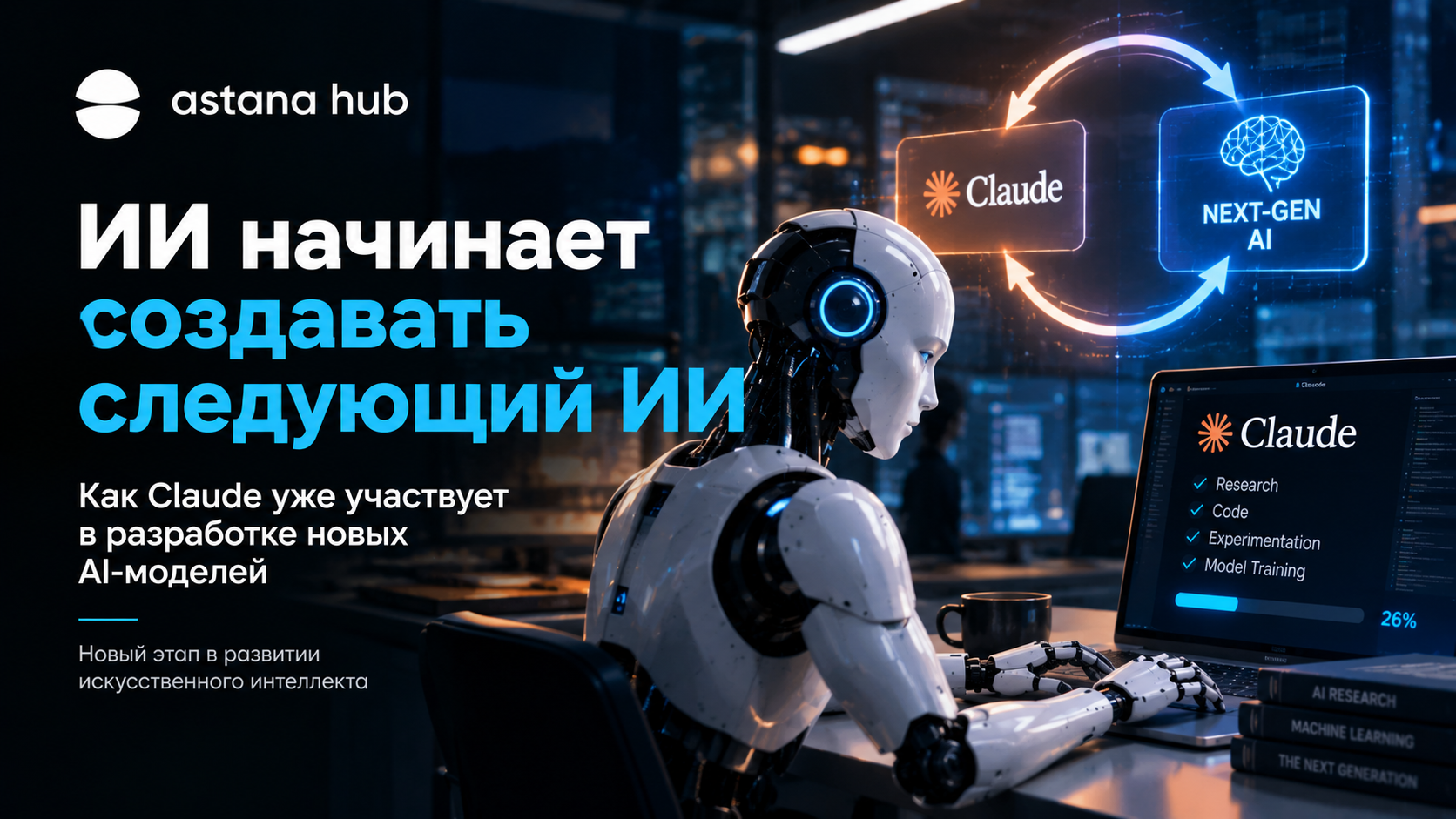
Anthropic reported that its Claude model is now involved in about 26% of the company's research and development of new AI models. Back in March, this figure was about 1%. At the same time, Anthropic emphasizes that Claude does not work completely independently — people continue to control the process.
The change here is not only quantitative.
It turns out to be a kind of cycle: people create more powerful AI systems, these systems help researchers write code faster, analyze experimental results and look for solutions, and the improvements obtained are used to create the next generation of models.
The better the AI gets, the more it can help in developing even more advanced AI.
That is why the current race is different from many previous technological revolutions.
Computers didn't help engineers build faster and faster computers at this scale. The Internet could not independently design the next Internet.
And artificial intelligence can potentially become part of its own development process.
This does not mean that a person ceases to be necessary.
On the contrary, the more tasks are transferred to machines, the more important it becomes to set goals, verify results, be responsible, and be able to understand what exactly is worth creating next.
But the fact itself is already changing the perception of technological progress.
Perhaps we are approaching the moment when the speed of AI development will depend not only on the number of engineers and computing resources.
AI itself will play an increasingly important role, helping people create the next AI.
And then the main question will be not only how smart the car can become.
The question is what will happen to the pace of technology development when the machine starts helping to create its next version.
Есть один момент в развитии искусственного интеллекта, который легко пропустить.
Мы привыкли представлять ИИ как инструмент: человек ставит задачу, нейросеть помогает её выполнить.
Но постепенно появляется другая модель.
ИИ начинает участвовать в разработке самого ИИ.
Anthropic сообщила, что её модель Claude сейчас участвует примерно в 26% работы компании по исследованиям и разработке новых AI-моделей. Ещё в марте этот показатель составлял около 1%. При этом Anthropic подчёркивает, что Claude не работает полностью самостоятельно — люди продолжают контролировать процесс.
Изменение здесь не только количественное.
Получается своеобразный цикл: люди создают более мощные AI-системы, эти системы помогают исследователям быстрее писать код, анализировать результаты экспериментов и искать решения, а полученные улучшения используются для создания следующего поколения моделей.
Чем лучше становится ИИ, тем больше он может помогать в разработке ещё более совершенного ИИ.
Именно поэтому нынешняя гонка отличается от многих предыдущих технологических революций.
Компьютеры не помогали инженерам создавать всё более быстрые компьютеры в таком масштабе. Интернет не мог самостоятельно проектировать следующий интернет.
А искусственный интеллект потенциально может стать частью собственного процесса развития.
Это не означает, что человек перестаёт быть необходимым.
Наоборот, чем больше задач передаётся машинам, тем важнее становятся постановка целей, проверка результатов, ответственность и способность понять, что именно стоит создавать дальше.
Но сам факт уже меняет представление о технологическом прогрессе.
Возможно, мы приближаемся к моменту, когда скорость развития ИИ будет зависеть не только от количества инженеров и вычислительных ресурсов.
Всё большую роль будет играть сам ИИ, который помогает людям создавать следующий ИИ.
И тогда главный вопрос будет уже не только в том, насколько умной может стать машина.
А в том, что произойдёт с темпами развития технологий, когда машина начнёт помогать создавать свою следующую версию.
 Share