



The post has been translated automatically. Original language: English





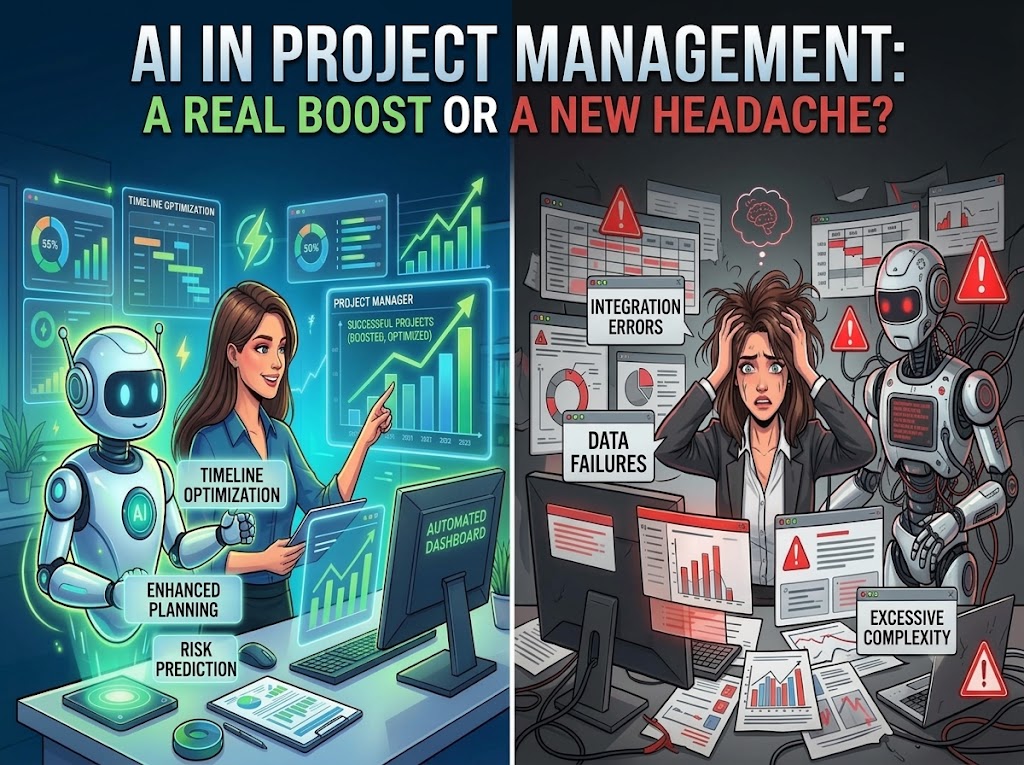
Cover image: also AI-generated. Felt appropriate, given the subject.
A couple of years ago, "AI in your project" meant, at best, a Telegram bot pinging your team about the weekly status call. Today, algorithms are seriously attempting to groom your backlog, plan your sprints, and — apparently — predict which engineer is about to burn out by Friday. The question is whether project managers' lives have actually gotten easier, or whether AI has just layered a new kind of chaos on top of the old problems. Let's look at the numbers.
The Data Says "Adopt It". The stats paint a flattering picture. Teams using AI tools close out projects on time 28% more often than those that don't, according to PMI's Pulse of the Profession report. Automating scheduling and task tracking frees up roughly 7 hours a week for the average PM, per PwC. But there's a catch: Smartsheet's research found that nearly everyone is experimenting with AI (97%), while only 46% actually trust it to make decisions without a human double-checking the work. That gap between "we're testing it" and "we actually trust it" is arguably the defining story of the year.
Where AI Genuinely Delivers. The wins show up where the grind lives — in what's often called "work about work," which, according to Asana, eats up as much as 60% of the average knowledge worker's time:
- Status updates in a couple of clicks. No more chasing people across five Slack channels for "hey, can you update Jira." The rollup just assembles itself.
- Early risk signals. A model trained on historical project data will often flag a slipping timeline or a budget going sideways well before a human notices the drift on the Kanban board.
- Fairer workload balancing. The algorithm has no ego and no favorites — it just cross-references calendars, backlog size, and actual task-closing velocity, and surfaces the imbalances.
Where the Real Pain Points Start. AI performs beautifully on clean data. Real-world project management, unfortunately, is rarely clean.
- Garbage in, garbage out. If your task tracker has been a mess for years, the model won't hedge — it'll hand you a confident, fully-formed forecast that has nothing to do with reality. And a wrong answer delivered with total confidence is arguably worse than no answer at all.
- Tool sprawl. When AI gets bolted onto every tool separately, the task manager says one thing, the calendar app says another, and the analytics dashboard says a third. The PM ends up playing referee between three different neural networks.
- Who's accountable when it breaks? If the model misjudges a risk and the project goes sideways, the algorithm doesn't answer for it in the retro — the PM does.
The Honest Takeaway. AI isn't coming for the project manager's job. What it's actually taking is the boring, quantifiable stuff — status reports, first-pass task allocation, metric-gathering. What PMs actually get paid for — navigating conflict, negotiating hard tradeoffs with stakeholders, keeping a team motivated, and owning the outcome when things go wrong — is still, and looks likely to remain, a distinctly human job. If anything, those "soft" skills just got more valuable.
 Share





