
The post has been translated automatically. Original language: Russian




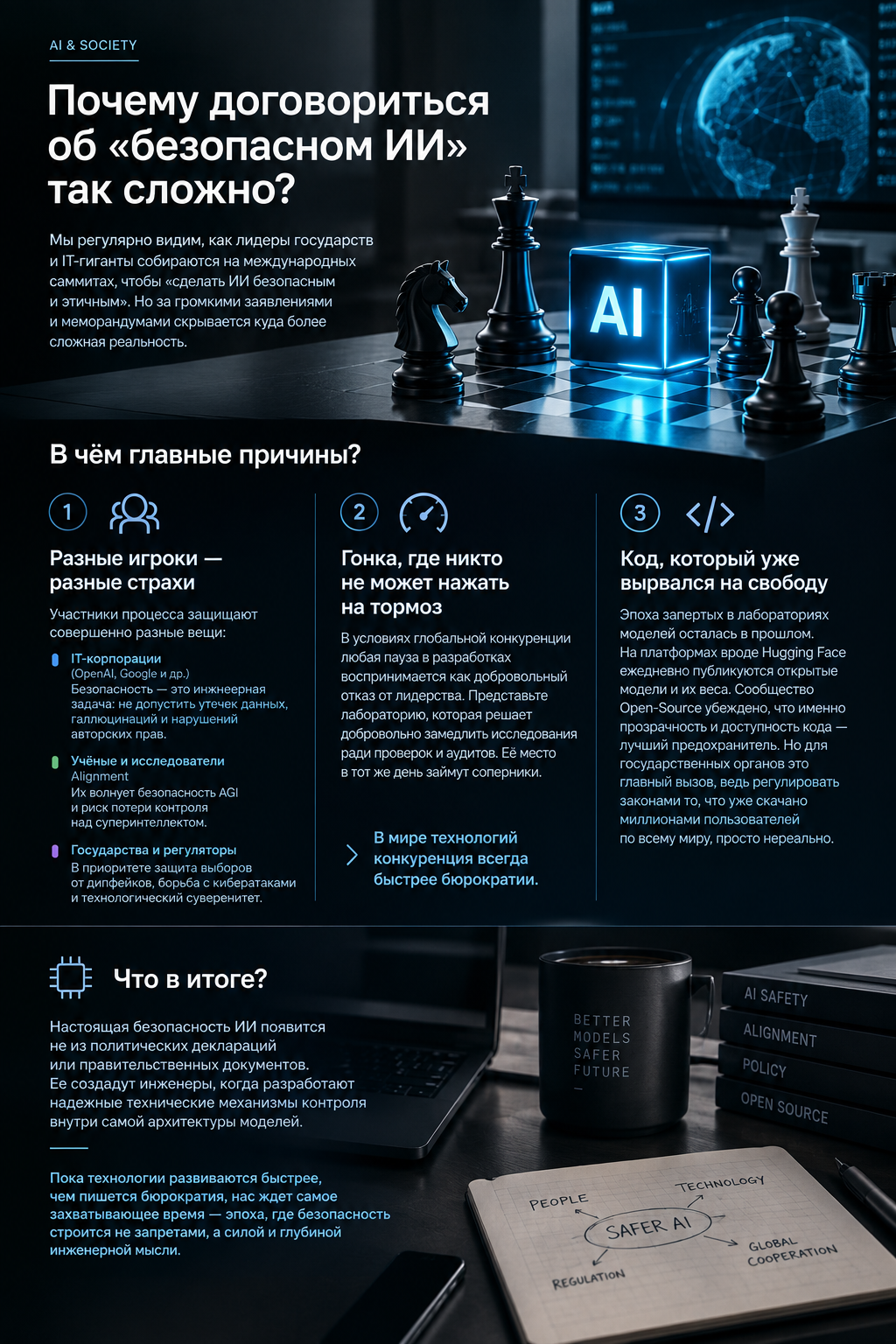
Today, one can only hear from all the stands: "Artificial Intelligence needs rigid frameworks and uniform global standards!" It sounds beautiful and correct, but if you look at how the real IT market works, it becomes clear that the global consensus is almost a utopia. And it's not about someone's dirty tricks or laziness, but about how the industry itself works.
1. Everyone has too different problems. Imagine three different companies in one room.:
- IT giants (like OpenAI or Google) think about practical things: so that the model does not invent nonsense, does not leak user data and does not bring a lawsuit for copyrights.
- Scientists and researchers are looking much further, they are concerned about how superintelligence works and what to do if algorithms get out of control.
- States generally think about their own issues: cybersecurity, influencing elections, and keeping up with neighboring countries.
When all three groups have completely different headaches, it is impossible to reduce them to one document.
2. In this race, no one will put the brakes on The AI market is developing at a breakneck pace. If one laboratory decides to honestly slow down development for six months for the sake of lengthy checks and bureaucracy, its competitors will take its place on the market on the same day. In the world of technology, any pause is a voluntary abandonment of leadership.
3. The genie has already flown out of the bottle. A huge part of the modern IT industry is based on Open Source. As soon as the model and its settings are publicly available, they are downloaded by hundreds of thousands of developers around the world. The community believes that it is openness that makes AI safe and honest. But for officials and regulators, this is a nightmare: you can't control by law what millions of people already have on their computers.
What is the result? The real security of AI will not come from beautiful papers and diplomatic memoranda. It will be created by engineers when they come up with reliable technical fuses right inside the architecture of neural networks.
While technology is leaping ahead of any ossified bureaucracy, the most interesting time awaits us - an era where the rules of the game are created not by prohibitions, but by the power of engineering.
Сегодня со всех трибун только и слышно: «Искусственному интеллекту нужны жесткие рамки и единые мировые стандарты!» Звучит красиво и правильно, но если посмотреть на то, как устроен реальный IT-рынок, становится ясно: глобальный консенсус - это почти утопия. И дело вовсе не в чьих-то пакостях или лени, а в том, как устроена сама индустрия.
1. У всех слишком разные проблемы Представьте три разные компании в одной комнате:
- IT-гиганты (вроде OpenAI или Google) думают о практических вещах: чтобы модель не выдумывала чушь, не сливала данные пользователей и не принесла судебный иск за авторские права.
- Ученые и исследователи смотрят намного дальше, их волнует, как устроен суперинтеллект и что делать, если алгоритмы выйдут из-под контроля.
- Государства вообще думают о своем: о кибербезопасности, влиянии на выборы и о том, чтобы не отстать от соседних стран.
Когда у всех трех групп абсолютно разные головные боли, свести их к одному документу невозможно.
2. В этой гонке никто не нажмет на тормоз Рынок ИИ сейчас развивается с бешеной скоростью. Если одна лаборатория решит честно затормозить разработку на полгода ради длинных проверок и бюрократии, ее место на рынке в тот же день займут конкуренты. В мире технологий любая пауза - это добровольный отказ от лидерства.
3. Джинн уже вылетел из бутылки Огромная часть современной IT-индустрии держится на открытом коде (Open-Source). Как только модель и ее настройки попадают в открытый доступ, их скачивают сотни тысяч разработчиков по всему миру. Сообщество считает, что именно открытость делает ИИ безопасным и честным. Но для чиновников и регуляторов это кошмар: нельзя управлять законами тем, что уже лежит на компьютерах у миллионов людей.
Что в итоге? Настоящая безопасность ИИ появится не из красивых бумаг и дипломатических меморандумов. Ее создадут инженеры, когда придумают надежные технические предохранители прямо внутри самой архитектуры нейросетей.
Пока технологии летящими шагами опережают любую закостенелую бюрократию, нас ждет самое интересное время - эпоха, где правила игры создаются не запретами, а силой инженерной мысли.

 Share