
The post has been translated automatically. Original language: Russian





Surveys seem like a simple matter: I wrote the questions, distributed them to people, and collected the answers. In practice, everything works differently. A poorly planned survey provides beautiful tables with useless data, and no amount of analysis will save them.
We understand how the professional data collection process works and what to pay attention to at each stage.
Step 1. Define the goal — specifically
The most common mistake is to start with questions rather than goals. Before you create a questionnaire, answer the question: what decision will you make based on this data? If there is no answer, the study is not ready to launch yet.
A good goal sounds like this: "To determine which barriers prevent residents of neighborhood X from using public transport." The bad one: "Get people's opinions about transportation."
Step 2. Choose a method: CAPI or CAWI
The two main digital survey formats are CAPI and CAWI.
CAPI (Computer-Assisted Personal Interview) — the interviewer works personally with the respondent, filling out the questionnaire on a tablet or laptop. It is suitable for complex research, vulnerable groups, and surveys in hard-to-reach areas.
CAWI (Computer-Assisted Web Interview) — the respondent completes the questionnaire independently online. It is faster and cheaper, but it requires competent sampling and quality control of responses.
Both methods can be combined in a single study.
Step 3. Control the selection through quotas
Representativeness is not an accident, but the result of planning. Quotas allow you to control the composition of the sample: how many men and women, which age groups, which regions. Without quotas, it's easy to get data that reflects only the audience that was most convenient to reach.
Step 4. Monitor the collection in real time
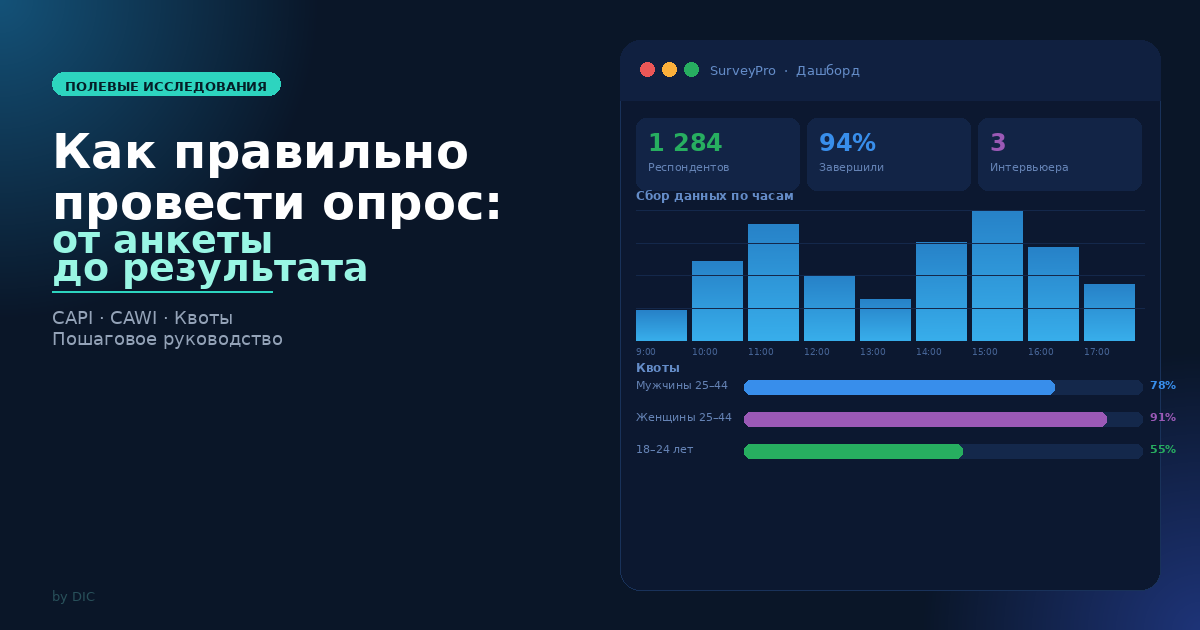
Waiting for the final dataset to realize that something went wrong is an expensive pleasure. Modern tools allow you to see the progress of collecting, distributing responses and filling quotas right in the process. This makes it possible to adjust the interviewers' work in time or redistribute the workload.
Step 5. Don't forget about media data
In qualitative research, it is often necessary to record not only text: photos of collection points, audio recordings of interviews, and sometimes videos. Make sure that your platform supports storing media files — this is critical when working in the field.
The tool solves
Even a well-planned study can easily be sunk by an inconvenient tool. An interviewer who loses data due to an offline glitch, or a supervisor who doesn't see real-time progress, is a waste of both money and time.
These were the tasks we solved when we developed SurveyPro at DIC, a platform for professional CAPI and CAWI surveys, based on real—world field experience. If the topic is close, we will be glad to receive feedback and are ready to tell you in more detail.
Опросы кажутся простым делом: написал вопросы, раздал людям, собрал ответы. На практике всё устроено иначе. Плохо спланированный опрос даёт красивые таблицы с бесполезными данными — и никакой анализ их не спасёт.
Разбираемся, как устроен профессиональный процесс сбора данных и на что обратить внимание на каждом этапе.
Шаг 1. Определите цель — конкретно
Самая частая ошибка: начинать с вопросов, а не с цели. Прежде чем составлять анкету, ответьте на вопрос: какое решение вы примете на основе этих данных? Если ответа нет — исследование ещё не готово к запуску.
Хорошая цель звучит так: «Определить, какие барьеры мешают жителям микрорайона X пользоваться общественным транспортом». Плохая: «Узнать мнение людей о транспорте».
Шаг 2. Выберите метод: CAPI или CAWI
Два основных формата цифровых опросов — это CAPI и CAWI.
CAPI (Computer-Assisted Personal Interviewing) — интервьюер работает лично с респондентом, заполняя анкету на планшете или ноутбуке. Подходит для сложных исследований, уязвимых групп, опросов в труднодоступных районах.
CAWI (Computer-Assisted Web Interviewing) — респондент проходит анкету самостоятельно онлайн. Быстрее и дешевле, но требует грамотной выборки и контроля качества ответов.
Оба метода можно комбинировать в рамках одного исследования.
Шаг 3. Контролируйте выборку через квоты
Репрезентативность — это не случайность, а результат планирования. Квоты позволяют контролировать состав выборки: сколько мужчин и женщин, какие возрастные группы, какие регионы. Без квот легко получить данные, которые отражают только ту аудиторию, до которой было удобнее всего дотянуться.
Шаг 4. Следите за сбором в реальном времени
Ждать финального датасета, чтобы понять, что что-то пошло не так — дорогое удовольствие. Современные инструменты позволяют видеть прогресс сбора, распределение ответов и заполнение квот прямо в процессе. Это даёт возможность вовремя скорректировать работу интервьюеров или перераспределить нагрузку.
Шаг 5. Не забудьте про медиаданные
В качественных исследованиях часто нужно фиксировать не только текст: фотографии точек сбора, аудиозаписи интервью, иногда видео. Убедитесь, что ваша платформа поддерживает хранение медиафайлов — это критично при работе в поле.
Инструмент решает
Даже хорошо спланированное исследование легко потопить неудобным инструментом. Интервьюер, который теряет данные из-за офлайн-сбоя, или руководитель, который не видит прогресс в реальном времени — это потери и денег, и времени.
Именно эти задачи мы решали, когда в DIC разрабатывали SurveyPro — платформу для профессиональных CAPI и CAWI-опросов, созданную с учётом реального полевого опыта. Если тема близка — будем рады обратной связи и готовы рассказать подробнее.
 Share