

The post has been translated automatically. Original language: Russian





A report from the tatami, where instead of paper protocols there are tablets, and instead of behind—the—scenes disputes there is a figure on the screen.
Prologue: The silent hall
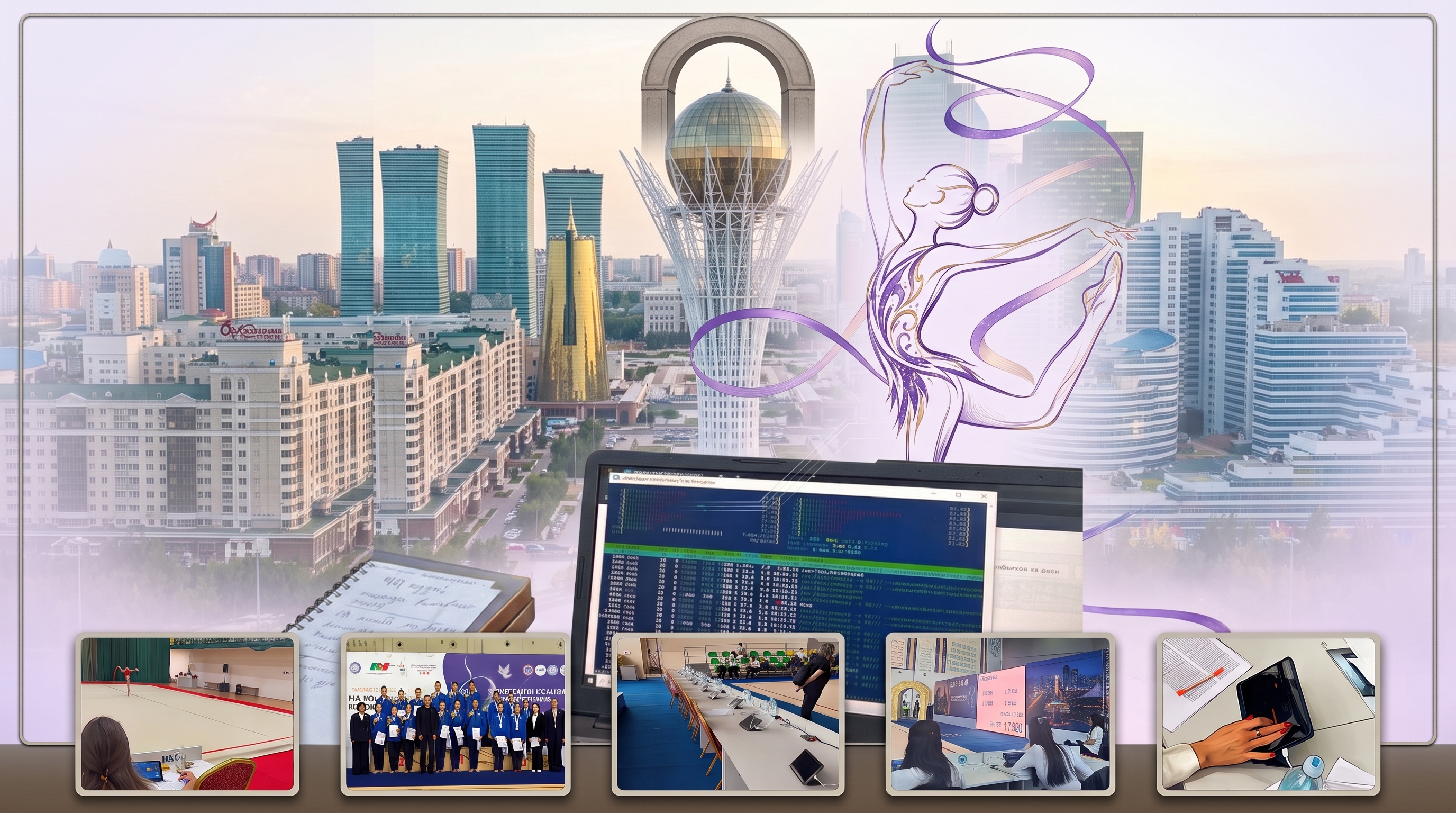
August 28, 2026. Astana. The Open Championship of the city brought together 13 schools and 220 participants under one roof — from very young gymnasts of the "1st sports category" to masters of sports performing with maces and ribbon at the highest level of difficulty. Usually on such days, there is a nervous buzz in the judging area: paper protocols, manual reconciliation of scores, gymnasts and coaches waiting at the secretary's desk while someone recalculates the amount on a calculator.
This time, the hall was unusually quiet. The judges — sixteen people in the team, arranged along the lines DB, DA, A and E — gave scores from tablets. The result appeared on the scoreboard before the gymnast had time to leave the mat.
It wasn't a rehearsal or a demonstration. It was the work of a system that the Kazakh ASPANS development team had built for the Kazakhstan Rhythmic Gymnastics Federation (KZFRG), and which had been fully tested by combat for the first time that day.
Chapter One: The disease that everyone considered the norm
The problem the team was solving didn't have a dramatic name, just "it's always been this way." Judging in rhythmic gymnastics is complicated: each program is evaluated by several teams at the same time — body complexity (DB), subject complexity (DA), artistry (A), performance (E), plus a separate line of allowances. The final score is the amount that was calculated manually in the paper world: someone dictated the numbers, someone wrote them down, someone then recalculated them in Excel after the gymnast left the gym.
In such a pipeline, an error is not uncommon, but a statistic. A typo in the postponement of the assessment, a lost protocol, a different interpretation of the total amount from the secretary and the team — and now the coach is standing at the head referee's table and demanding a recount. Not because anyone wanted to cheat. It's just that manual labor in real time is rarely error—free, and sports in the database in question are also schools, grades, categories, musical accompaniment for each projectile, and a mandatory commission that checks the documents of hundreds of athletes. All this used to live in different papers and different heads.
Chapter two: what was built
The ASPANS team did not design a stopwatch application, but a digital framework for the entire tournament, from the draft to the archive. In the federation's office, the competition goes through clear stages: draft → application collection → draw → tournament underway → completed → archive. Not a single stage is lost, not a single document remains "somewhere in the mail."
Within one tournament— there is a workplace for each function:
- Applications are submitted by schools, the system itself counts participants and groups; at the Astana City Championships, there were 13 schools and 220 gymnasts.
- The mandate commission used to have a separate table with a pile of documents, now it has a screen where you can see: 220 athletes, 112 groups, 135 packages of documents checked, 0 — "not allowed" by mistake or oversight.
- Music — for each projectile (hoop, ball, clubs, ribbon) there is a separate track with timing, and the organizer sees not "everything seems to be there", but an exact figure: 135 out of 135 are ready, zero — without music.
- The competition schedule is an hourly grid by day, with streams, breaks and automatic time calculation for each category.
- The judging panel is the DB/DA/ A1—A6 / E1–E5 line, where you can see which of the sixteen judges is on the tablet, who is offline, and who has which judge category.
- The results are a table that is updated live: DB, DA, A, E, deductions and total score, uploaded to PDF and Excel, a separate protocol for teams and a built—in TIE-BREAK module for parsing equal amounts.
In other words, what used to be a scattering of papers, excel, and WhatsApp chats between the secretary and the judges has become one workspace where each figure has a source and a history.
Chapter Three: the exam
The system passed the real test not in the test circuit, but in a live tournament. The Astana Open Championship is not the only one: a little earlier, on August 13-14, the Miss IZUMRUD tournament was already held on the Alpha Gym site through the same system. But it was the August Championship that became the first tournament of this scale — with a full range of categories, from individual performances of the first category to group programs of masters of sports, where all refereeing and all results accounting went through ASPANS from the first application to the last protocol.
By the time the final chord of the last program sounded in the hall, the results for each category — "Ind · 1 sports category", "Ind · KMS", "Ind · MS" and group scores — were already in the table with calculations for all judging lines. Not "roughly," not "we'll clarify later," but a ready-made protocol that could be uploaded and signed at the same minute.
Epilogue: What has changed
Sport does not tolerate retroactive calculations — trust in the result is either there immediately, or it takes a long time to restore. The tournament on August 28-29 in Astana showed that when referees, documents, music and schedules live in the same system, rather than in ten different places, there are fewer and fewer reasons to argue about numbers.
For the Kazakh IT team, this is not the end of history, but its beginning - turnir has passed, the system has withstood the load of 220 participants and sixteen judges at the same time, and now the federation has a tool that can be brought to the next championship not as an experiment, but as a standard.
The material was prepared for Astana Hub based on the case of eCapital LLP — ASPANS platform, solution start.aspans.com for the Kazakhstan Rhythmic Gymnastics Federation.
Репортаж с татами, где вместо бумажных протоколов — планшеты, а вместо кулуарных споров — цифра на экране
Пролог: зал, в котором молчат
28 августа 2026 года. Астана. Открытый Чемпионат города собрал под одной крышей 13 школ и 220 участниц — от совсем юных гимнасток на «1 спортивный разряд» до мастеров спорта, выступающих с булавами и лентой на высшем уровне сложности. Обычно в такие дни в судейской зоне царит нервное оживление: бумажные протоколы, сверка баллов вручную, гимнастки и тренеры, ожидающие у стола секретаря, пока кто-то пересчитает сумму на калькуляторе.
В этот раз в зале было непривычно тихо. Судьи — шестнадцать человек в бригаде, разложенные по линиям DB, DA, A и E, — выставляли оценки с планшетов. Результат появлялся на табло раньше, чем гимнастка успевала уйти с ковра.
Это была не репетиция и не демонстрация. Это была работа системы, которую казахстанская команда разработчиков ASPANS построила для Казахстанской федерации художественной гимнастики (KZFRG) — и которая в тот день впервые полноценно прошла проверку боем.
Глава первая: болезнь, которую все считали нормой
У проблемы, которую решала команда, не было драматичного названия — просто «так было всегда». Судейство в художественной гимнастике устроено сложно: каждую программу оценивают несколько бригад одновременно — сложность тела (DB), сложность с предметом (DA), артистизм (A), исполнение (E), плюс отдельная линия сбавок. Итоговый балл — это сумма, которую в бумажном мире сводили вручную: кто-то диктовал цифры, кто-то записывал, кто-то потом пересчитывал в Excel уже после того, как гимнастка покинула зал.
На таком конвейере ошибка — не редкость, а статистика. Опечатка при переносе оценки, потерянный протокол, разное толкование итоговой суммы у секретаря и у бригады — и вот уже тренер стоит у стола главного судьи и требует пересчёта. Не потому, что кто-то хотел смухлевать. Просто ручной труд в реальном времени редко бывает безошибочным, а cпорт в базе, о которой идёт речь, — это ещё и школы, разряды, категории, музыкальное сопровождение под каждый снаряд, мандатная комиссия, проверяющая документы у сотен спортсменок. Всё это раньше жило в разных бумагах и разных головах.
Глава вторая: что построили
Команда ASPANS спроектировала не приложение для секундомера, а цифровой каркас всего турнира — от черновика до архива. В кабинете федерации соревнование проходит понятные стадии: черновик → сбор заявок → жеребьёвка → турнир идёт → завершён → архив. Ни один этап не теряется, ни один документ не остаётся «где-то в почте».
Внутри одного турнира — рабочее место на каждую функцию:
- Заявки — школы подают составы, система сама считает участниц и группы; на Чемпионате г. Астана это были 13 школ и 220 гимнасток.
- Мандатная комиссия — раньше отдельный стол с грудой документов, теперь экран, где видно: 220 спортсменов, 112 групп, 135 пакетов документов проверено, 0 — «не допущены» по ошибке или недосмотру.
- Музыка — под каждый снаряд (обруч, мяч, булавы, лента) отдельный трек с таймингом, и организатор видит не «вроде всё есть», а точную цифру: 135 из 135 готовы, ноль — без музыки.
- График соревнований — почасовая сетка по дням, с потоками, перерывами и автоматическим расчётом времени на каждую категорию.
- Судейская бригада — та самая линия DB / DA / A1–A6 / E1–E5, где видно, кто из шестнадцати судей на планшете, кто офлайн, у кого какая судейская категория.
- Результаты — таблица, которая обновляется вживую: DB, DA, A, E, сбавки и общий балл, с выгрузкой в PDF и Excel, отдельным протоколом по бригадам и встроенным модулем TIE-BREAK для разбора равных сумм.
Иными словами: то, что раньше было россыпью бумаг, экселей и WhatsApp-чатов между секретарём и судьями, стало одним рабочим пространством, где каждая цифра имеет источник и историю.
Глава третья: экзамен
Настоящую проверку система прошла не в тестовом контуре, а на живом турнире. Открытый Чемпионат г. Астана — не единственный: чуть раньше, 13–14 августа, через ту же систему уже прошёл турнир Miss IZUMRUD на площадке Alpha Gym. Но именно августовский Чемпионат стал первым турниром такого масштаба — с полным набором категорий, от индивидуальных выступлений первого разряда до групповых программ мастеров спорта, — где всё судейство и весь учёт результатов шли через ASPANS от первой заявки до последнего протокола.
К моменту, когда в зале звучал финальный аккорд последней программы, результаты по каждой категории — «Инд · 1 спортивный разряд», «Инд · КМС», «Инд · МС» и групповые зачёты — уже стояли в таблице с расчётом по всем судейским линиям. Не «примерно», не «уточним после», а готовый протокол, который можно было в ту же минуту выгрузить и подписать.
Эпилог: что изменилось
Спорт не терпит пересчётов задним числом — доверие к результату либо есть сразу, либо его приходится долго восстанавливать. Турнир 28–29 августа в Астане показал: когда судейство, документы, музыка и график живут в одной системе, а не в десяти разных местах, у спора о цифрах остаётся всё меньше поводов возникнуть.
Для казахстанской IT-команды это не финал истории, а её начало — turnir прошёл, система выдержала нагрузку 220 участниц и шестнадцати судей одновременно, и теперь у федерации есть инструмент, который можно приносить на следующий чемпионат уже не как эксперимент, а как стандарт.
Материал подготовлен для Astana Hub на основе кейса ТОО «eCapital» — платформа START.ASPANS для Казахстанской федерации художественной гимнастики.

 Share





