
The post has been translated automatically. Original language: Russian





One difficult release. An urgent bug. A difficult conversation with the manager.
The body is usually able to cope with a short load.
The problem starts when the requests are continuous:
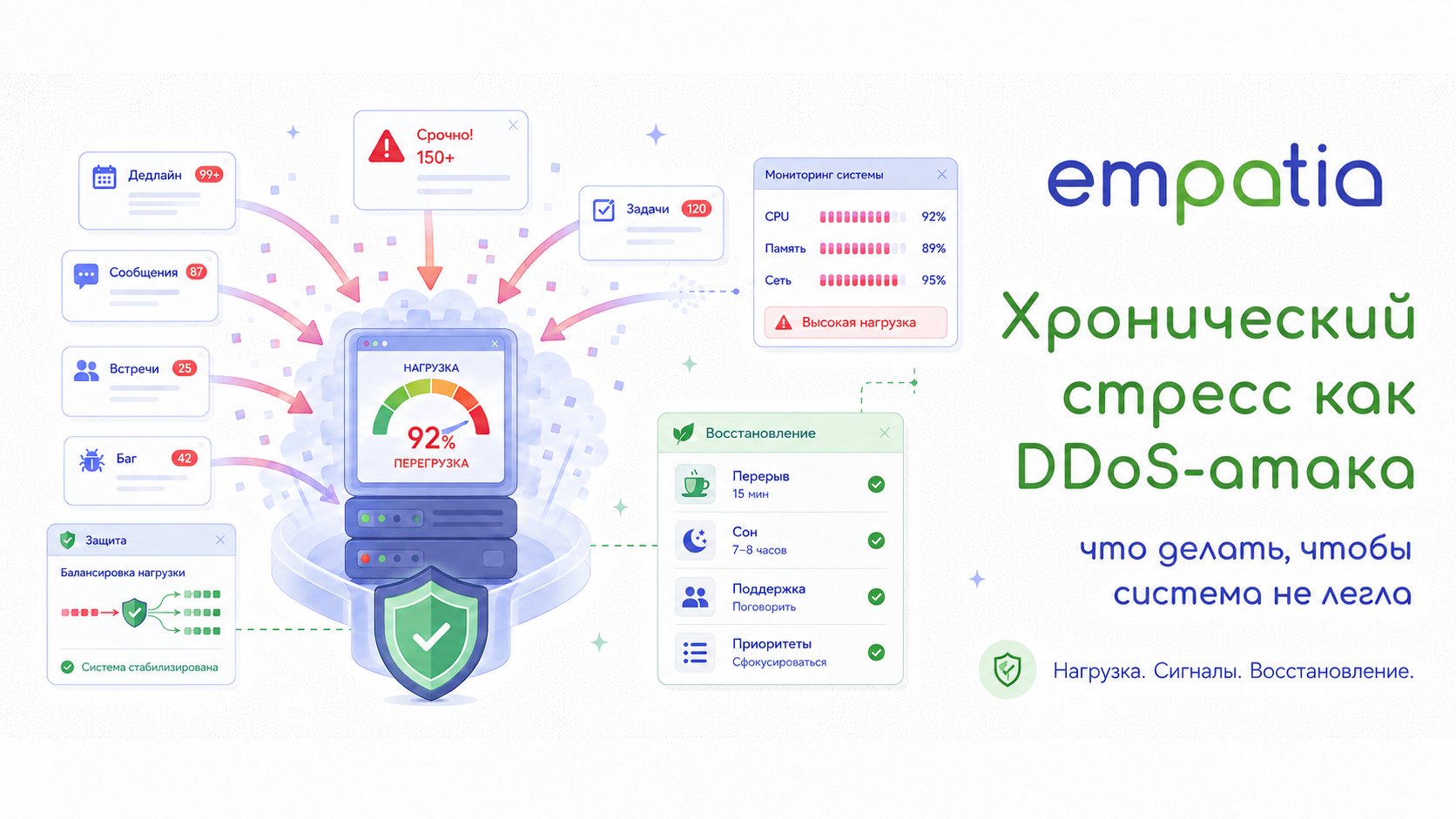
deadline
message
meeting
urgent task
production
issue
another deadline
And there's almost no recovery time between them.
In this sense, chronic stress really resembles DDoS attack: the system continues to process incoming requests, but there are fewer and fewer resources .
What is happening at this moment
Stress itself is not the enemy. This is a normal reaction of the body, which helps to mobilize before a difficult task.
But if stress becomes constant, the load on the system itself changes.
According to the American Psychological Association, prolonged stress can be associated with:
→ sleep disturbance
→ problems with concentration
→ irritability
→ muscle tension
→ high blood pressure
→ changes in the immune system
The reason is not just the experience itself. Under chronic stress, the body stays on high alert for too long. (APA)
There is also a direct impact on work.
In the APA study, 59% of employees reported that work stress over the past month had already negatively affected their work. Among the consequences:
26% — decreased interest, motivation or energy 21% — difficulty concentrating 19% is a reduction in the effort that a person puts into work. (APA)
And if work stress becomes chronic and nothing happens to it for a long time, the next level of the problem may be burnout.
WHO defines burnout as a syndrome that results from chronic stress at work that has not been successfully managed. He is characterized by exhaustion, distancing or cynicism towards work and a decrease in professional effectiveness. (World Health Organization)
How not to overload the system
01. Look not only at the load, but also at recovery
The conditional 8 hours of intensive work and 8 hours of intensive work without pauses, normal sleep and switching are different loads.
The schedule should include not only:
tasks
meetings
deadlines
but also:
breaks
recovery
offline
Recovery is not a bonus after all the work. This is part of the normal operation of the system.
02. Find sources of constant background traffic
Sometimes the main source of stress is not a big project, but dozens of small stimuli.:
→ Constantly enabled notifications
→ chaotic urgent tasks
→ lack of clear priorities
→ meetings without necessity
→ waiting for a response 24/7
A useful question: what regularly creates tension in my work process, although it could have been organized differently?
03. Don't keep all processes in RAM
If you simultaneously remember a deadline, five small tasks, a promise to a colleague, an idea for a project, and who needs to be answered, part of the cognitive resource is constantly occupied.
It is better to upload tasks to an external system.:
calendar
task
manager
notes
The brain is good for solving problems. You don't have to use it as a storage system either.
04. Limit the number of parallel processes
Multitasking often looks like high productivity.:
call + chat + Jira + email
In practice, this is a series of quick attention shifts.
Therefore, it is an important skill not only to add tasks to work, but also to limit WIP — work in progress.
The fewer processes are open at the same time, the easier it is to finish at least one.
05. Add a short recovery before it becomes forced
Walk. Sport. Lunch without a laptop. 10 minutes of silence after a difficult call. A few minutes without a screen.
It looks too easy against the background of a large task list.
But chronic stress is rarely solved with one long vacation once a year. It is much more important whether the body gets the opportunity to regularly exit the mode of constant mobilization.
06. If the workload is systemic, do not try to solve it only by personal productivity.
When the team is constantly overworking, it is impossible to prioritize, everything is declared urgent and the employee must be available at any time, the problem is not only at the human level.
Then we need changes in the system itself.:
workload
processes
priorities
communication
Organizational changes, such as workload, schedule, and communication management, are also considered by WHO to be work stress prevention measures. (World Health Organization)
The main signal
Sometimes it seems: "Now is just a difficult period, we need to be patient a little more." But if the "difficult period" doesn't end for months, it's no longer a temporary spike in traffic. Perhaps it's time to look not for ways to process requests faster, but for the reason why the system is running at its limit all the time.
Один сложный релиз. Срочный баг. Непростой разговор с руководителем.
Организм обычно умеет справляться с короткой нагрузкой.
Проблема начинается, когда запросы идут непрерывно:
deadline
message
meeting
urgent task
production
issue
ещё один deadline
И между ними почти нет времени на восстановление.
В этом смысле хронический стресс действительно напоминает DDoS-атаку: система продолжает обрабатывать входящие запросы, но ресурсов становится всё меньше.
Что происходит в этот момент
Стресс сам по себе не враг. Это нормальная реакция организма, которая помогает мобилизоваться перед сложной задачей.
Но если стресс становится постоянным, меняется уже сама нагрузка на систему.
По данным American Psychological Association, длительный стресс может быть связан с:
→ нарушением сна
→ проблемами с концентрацией
→ раздражительностью
→ мышечным напряжением
→ повышенным артериальным давлением
→ изменениями в работе иммунной системы
Причина не только в переживаниях как таковых. При хроническом стрессе организм слишком долго остаётся в режиме повышенной готовности. (АПА)
Есть и прямое влияние на работу.
В исследовании APA 59% сотрудников сообщили, что рабочий стресс за последний месяц уже негативно отражался на их работе. Среди последствий:
26% — снижение интереса, мотивации или энергии 21% — сложности с концентрацией 19% — снижение усилий, которые человек вкладывает в работу. (АПА)
А если рабочий стресс становится хроническим и с ним долго ничего не происходит, следующим уровнем проблемы может стать выгорание.
ВОЗ определяет выгорание как синдром, возникающий в результате хронического стресса на работе, с которым не удалось успешно справиться. Для него характерны истощение, дистанцирование или цинизм по отношению к работе и снижение профессиональной эффективности. (Всемирная организация здравоохранения)
Как не довести систему до overload
01. Смотреть не только на нагрузку, но и на восстановление
Условные 8 часов интенсивной работы и 8 часов интенсивной работы без пауз, нормального сна и переключения — это разная нагрузка.
В расписании должны появляться не только:
tasks
meetings
deadlines
но и:
breaks
recovery
offline
Восстановление — не бонус после всей работы. Это часть нормальной работы системы.
02. Найти источники постоянного фонового трафика
Иногда главный источник стресса — не большой проект, а десятки маленьких раздражителей:
→ постоянно включённые уведомления
→ хаотичные срочные задачи
→ отсутствие понятных приоритетов
→ встречи без необходимости
→ ожидание ответа 24/7
Полезный вопрос: что в моём рабочем процессе регулярно создаёт напряжение, хотя могло бы быть организовано иначе?
03. Не держать все процессы в RAM
Если одновременно помнить дедлайн, пять мелких задач, обещание коллеге, идею для проекта и то, кому нужно ответить, часть когнитивного ресурса постоянно занята.
Задачи лучше выгружать во внешнюю систему:
calendar
task
manager
notes
Мозг хорош для решения задач. Не обязательно использовать его ещё и как систему хранения.
04. Ограничивать количество параллельных процессов
Многозадачность часто выглядит как высокая продуктивность:
call + chat + Jira + email
На практике это серия быстрых переключений внимания.
Поэтому важный навык — не только добавлять задачи в работу, но и ограничивать WIP — work in progress.
Чем меньше процессов одновременно открыто, тем легче закончить хотя бы один.
05. Добавлять короткое восстановление до того, как оно станет вынужденным
Прогулка. Спорт. Обед без ноутбука. 10 минут тишины после сложного созвона. Несколько минут без экрана.
Это выглядит слишком просто на фоне большого списка задач.
Но хронический стресс редко решается одним длинным отпуском раз в год. Гораздо важнее, получает ли организм возможность регулярно выходить из режима постоянной мобилизации.
06. Если нагрузка системная — не пытаться решить её только личной продуктивностью
Когда в команде постоянные переработки, невозможно расставить приоритеты, всё объявляется срочным и сотрудник должен быть доступен в любое время, проблема находится не только на уровне человека.
Тогда нужны изменения в самой системе:
workload
processes
priorities
communication
Именно организационные изменения — управление нагрузкой, графиком и коммуникацией — ВОЗ также относит к мерам профилактики рабочего стресса. (Всемирная организация здравоохранения)
Главный сигнал
Иногда кажется: «Сейчас просто сложный период, надо ещё немного потерпеть». Но если «сложный период» не заканчивается месяцами, это уже не временный всплеск трафика. Возможно, пора искать не способы быстрее обрабатывать запросы, а причину, почему система всё время работает на пределе.

 Share