
The post has been translated automatically. Original language: Russian





The usual knowledge base perfectly collects documents and instructions. But AI needs to understand not only what is written, but what is really working now.
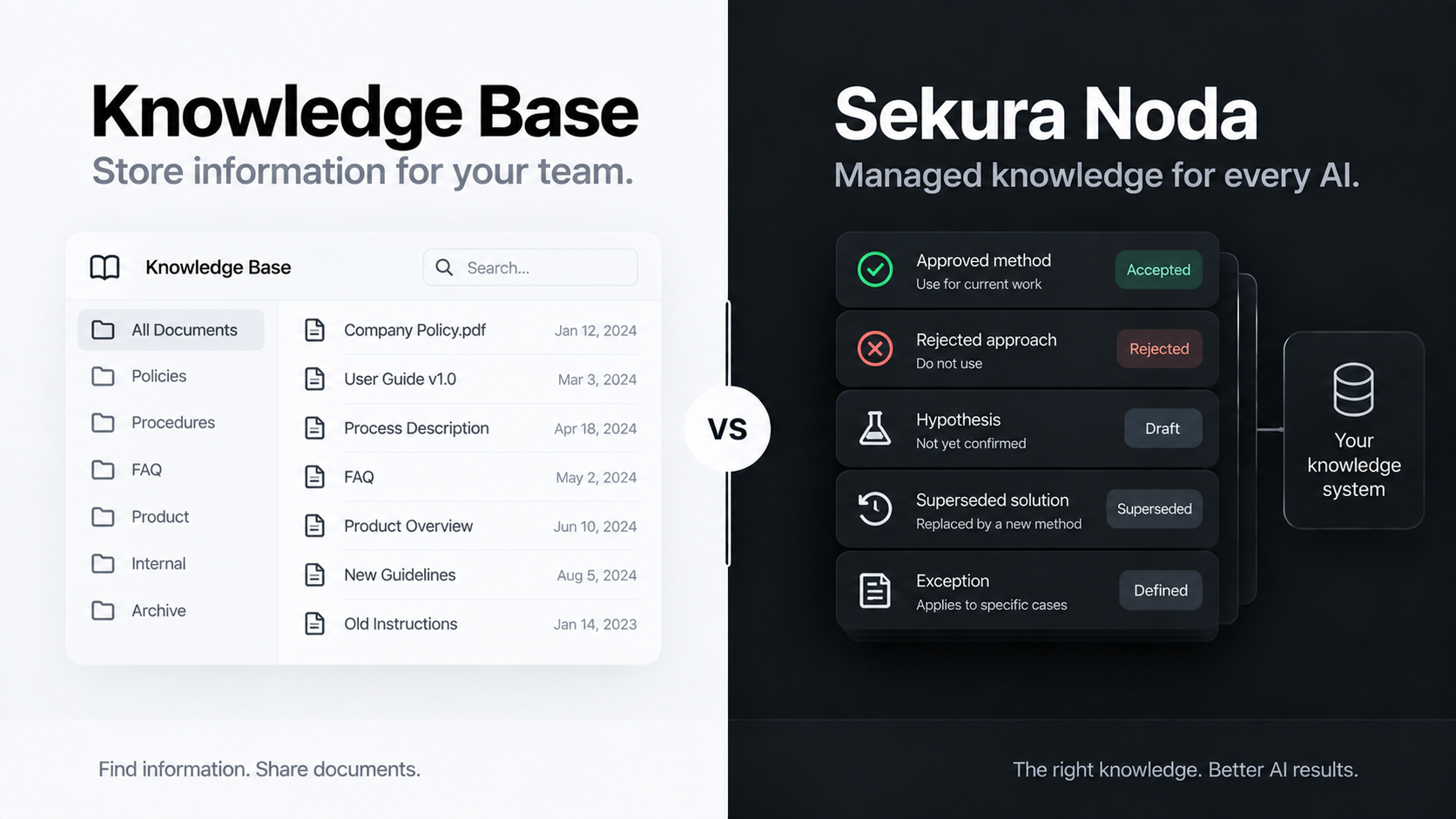
It is convenient to store in the knowledge base:
- documents;
- Instructions;
- answers to frequently asked questions;
- regulations;
- Process descriptions;
- internal materials.
This is often enough for a person.
He is able to notice that one document is outdated, another has replaced it, and the third rule applies only to a special case.
The situation is more complicated for AI.
Over time, the same storage may contain:
- old instructions;
- new version;
- exception;
- the solution from the previous project;
- an unconfirmed hypothesis;
- a material that should no longer be used.
All of this is searchable.
But the main question arises:
which of these knowledge should the AI use as an operating one?
Sekura Noda approaches it differently
In Sekura Noda, an important professional knowledge gets an explicit state.
It can be:
accepted; rejected; abandoned as a hypothesis; replaced with a newer solution.
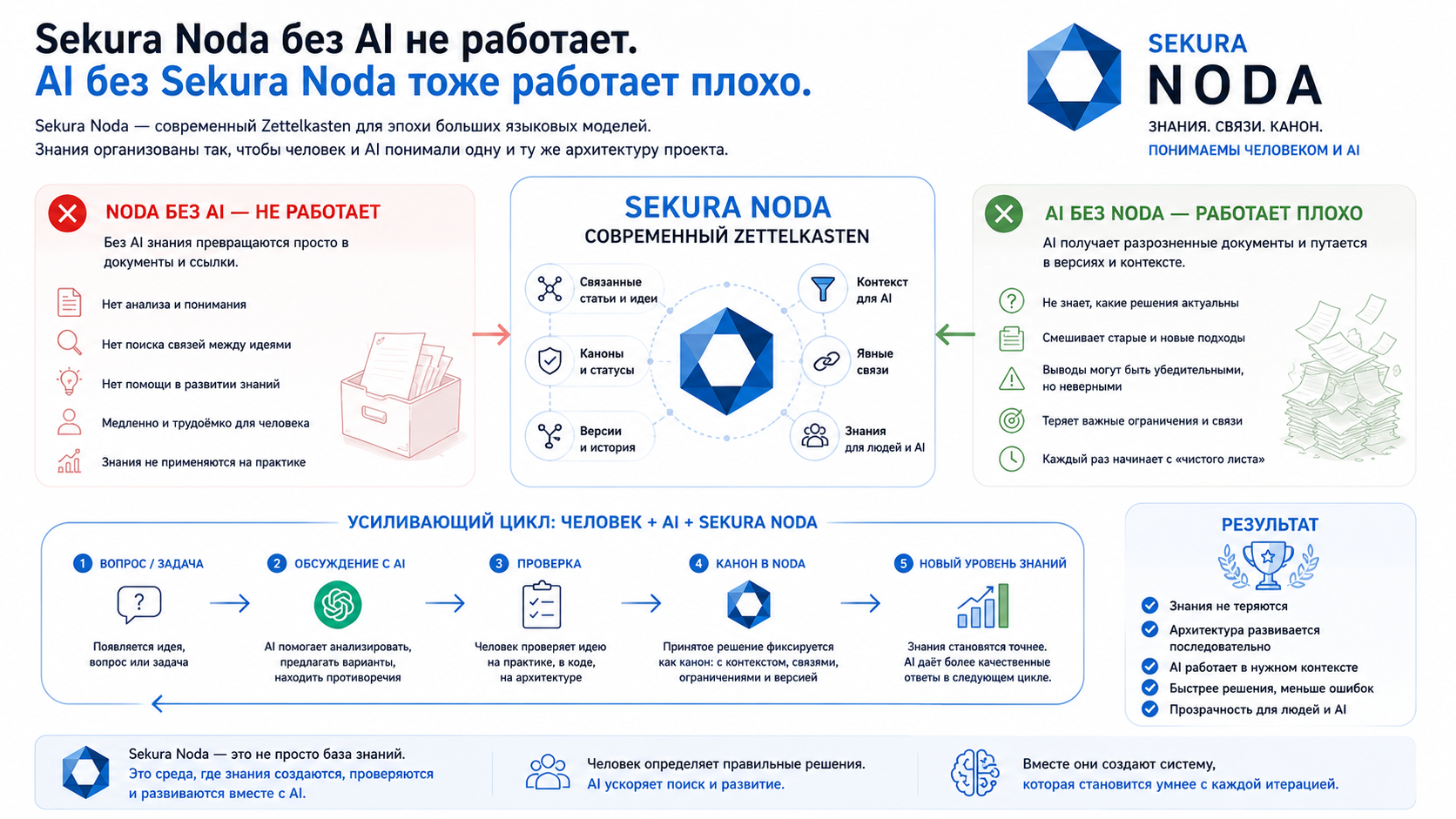
This is how AI works not just with an array of materials, but with a system where a person determines the relevance of knowledge.
The usual knowledge base helps to answer:
Where can I find the right material?
Sekura Noda answers another question:
What is considered the right decision now?
Where is the usual knowledge base better
When the main task is documentation, the search for materials and the collaboration of employees.
For this, the usual storage is simpler.
Where is Sekura Noda better
When AI should not just find text, but apply professional solutions in its work.
When changes, exclusions, rejected approaches, and relevance are important.
The knowledge base helps you find what was recorded. Sekura Noda helps AI use what is considered valid.
Обычная база знаний отлично собирает документы и инструкции. Но ИИ нужно понимать не только то, что написано, а то, что действительно действует сейчас.
В базе знаний удобно хранить:
- документы;
- инструкции;
- ответы на частые вопросы;
- регламенты;
- описания процессов;
- внутренние материалы.
Для человека этого часто достаточно.
Он способен заметить, что один документ устарел, другой заменил его, а третье правило относится только к особому случаю.
Для ИИ ситуация сложнее.
Со временем в одном хранилище могут одновременно находиться:
- старая инструкция;
- новая версия;
- исключение;
- решение из предыдущего проекта;
- неподтверждённая гипотеза;
- материал, который больше не должен применяться.
Всё это доступно для поиска.
Но возникает главный вопрос:
какое из этих знаний ИИ должен использовать как действующее?
Sekura Noda подходит к этому иначе
В Sekura Noda важное профессиональное знание получает явное состояние.
Оно может быть:
принято;отклонено;оставлено как гипотеза;заменено более новым решением.
Так ИИ работает не просто с массивом материалов, а с системой, где человек определяет актуальность знания.
Обычная база знаний помогает ответить:
Где найти нужный материал?
Sekura Noda отвечает на другой вопрос:
Какое решение считается правильным сейчас?
Где обычная база знаний лучше
Когда главная задача — документация, поиск материалов и совместная работа сотрудников.
Для этого привычное хранилище проще.
Где Sekura Noda лучше
Когда ИИ должен не просто находить текст, а применять профессиональные решения в работе.
Когда важны изменения, исключения, отклонённые подходы и актуальность.
База знаний помогает найти то, что было записано. Sekura Noda помогает ИИ использовать то, что считается действующим.

 Share