

The post has been translated automatically. Original language: Russian




Eighty percent of respondents who use AI in their work report an increase in personal productivity. Half of them say that the solutions have become better. At the same time, the share of respondents in whose organizations AI has made any contribution to EBIT is 37%. In last year's survey, it was 39%, and researchers consider the difference insignificant.
This is the data from the McKinsey global study "The State of AI in 2026: On the road to ROI". The survey was conducted from May 4 to June 8, 2026, and the report was released in August. There are 1,719 participants from 97 countries in the sample. 36% of respondents work in companies with revenues above a billion dollars, meaning the sample is not limited to large businesses. The second feature of the sample is also important. Among those who answered the question about the personal effect, senior managers make up about half. Eighty percent reflect primarily the self-assessment of management.
The gap is also visible on the other slice. Compared to last year's survey, both the deployment of autonomous agents in large organizations and the scaling of AI to the entire company have increased. At the same time, the financial result did not change: the share of leaders whose AI provides at least 5% of EBIT and a significant effect remained at 6%, and the share of respondents noting AI's contribution to profit was even slightly lower than last year.
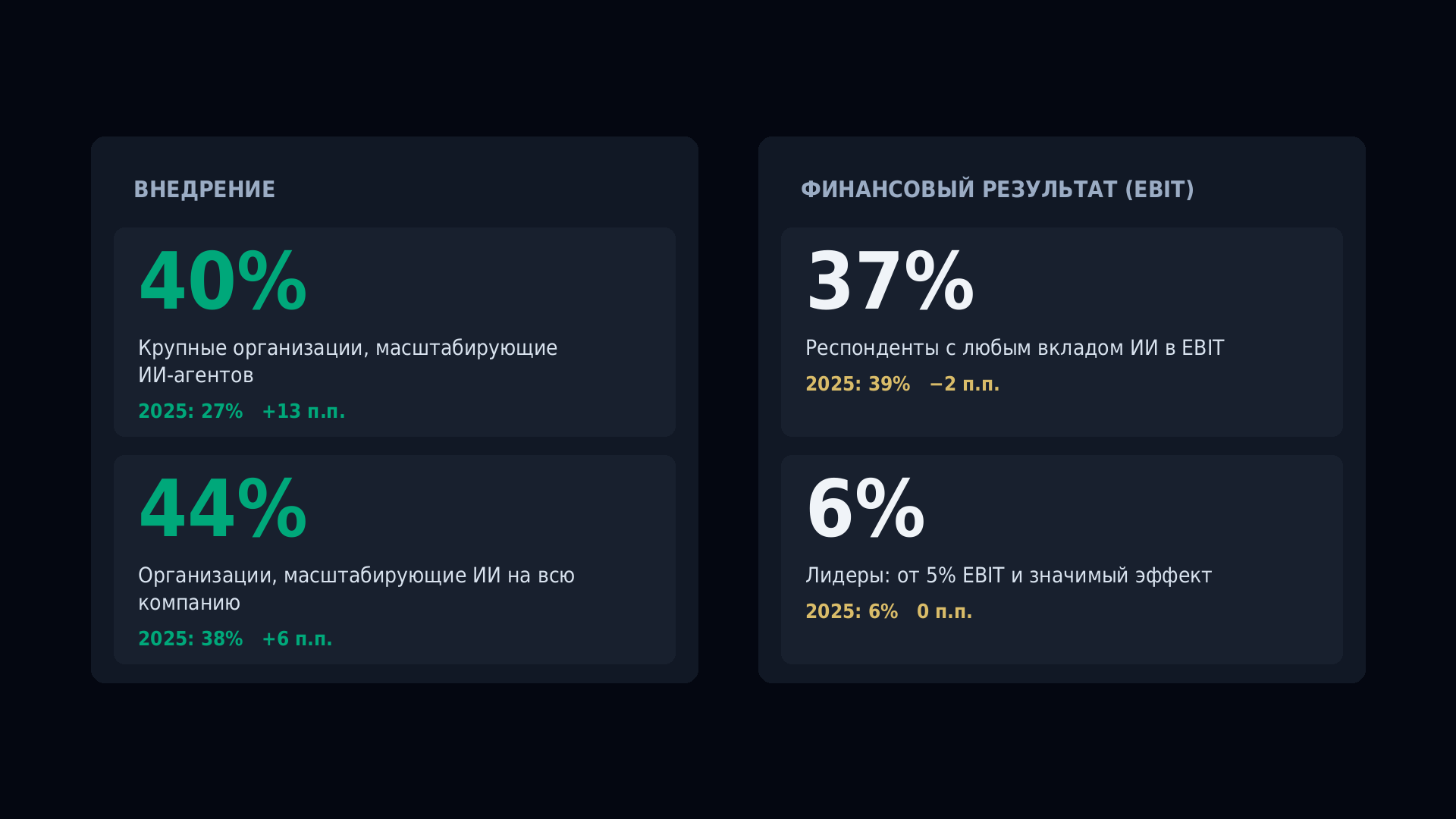
Illustration 1. AI deployment has grown over the year, the contribution to EBIT has remained in place. The share of large organizations scaling AI agents is given in terms of the full sample, as provided by the 2026 report. The share of organizations that scale AI to the entire company is calculated from the number of companies that already use AI. McKinsey survey data for 2025 and 2026.
Everything below is addressed to those who sell software products and AI solutions to a corporate customer.
Funding remains, but it will be more difficult to prove effectiveness.
Budgets are not being squeezed: 60% of respondents expect investments in AI to grow next year. The limitation is not about money. For the second year in a row, almost two-thirds do not record the contribution of AI to profits. ""The question of purchasing will shift from "is it useful" to "where is it visible in the reports".
There is also an indirect indication of where the winnings go. In 2025, 32% of respondents expected AI to lead to staff reductions within a year. In fact, only 14% noted a decrease in numbers due to AI. Two thirds reported that the number remained almost unchanged.
The survey does not explain why this happened. Perhaps the saved time remains within the organization itself. Employees prepare more interim versions of documents and presentations, launch more approvals, and the burden shifts to colleagues. The study did not verify this relationship. But it shows why the promise "our product saves four hours a week" has stopped working as a selling argument.
What distinguishes leaders
The same 6% and everyone else have the same basic goal. Efficiency, that is, cost reduction through automation of work processes, is the goal of 78% of the leaders and 82% of the rest. For this purpose, the leaders are no different from the rest.
The discrepancy starts further. About three quarters of the leaders have fundamentally redesigned their work processes for AI, and this figure has grown from 55% in 2025. Among the rest, only a quarter went to such a restructuring. Revenue growth is the goal of 74% of the leaders against 47% of the rest. 65% versus 49% are aiming to create new businesses or transform the business model.
Management discipline is added. Leaders are twice as likely as others to have formal processes for measuring the impact of AI initiatives and twice as likely to note the personal involvement of top management. Noticeably, although not twice, they more often manage the cost of solutions (tokens, calculations, storage) and determine where the result of the model should be checked by a person.
The payoff is not the one who bought an AI add-on over the old regulations, but the one who rewrote the regulations themselves for AI.
Three implications for product and sale
1. You are competing with the client's internal team, not with another vendor.
32% of respondents reported that their companies refused to purchase at least one product or a separate function, having assembled the functionality internally using agent-based development tools. There are 41% of them in the technology sector, and 39% for health insurers and clinics. The functionality that the internal team will assemble in a few days will not be bought.
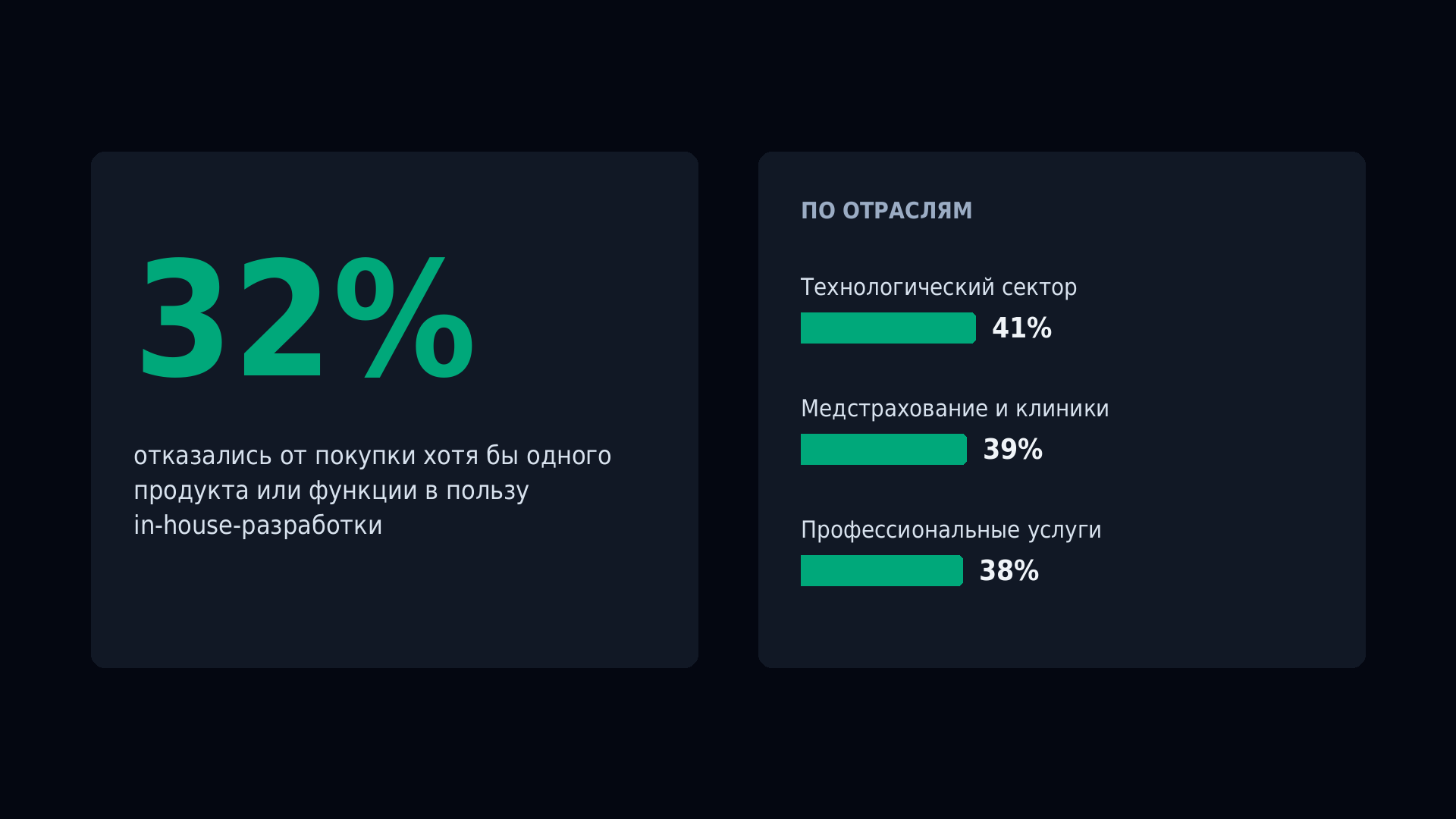
Figure 2. The percentage of respondents whose companies regularly use AI and refused to purchase at least one product or function in favor of in-house development with agent-based tools. McKinsey survey data for 2026.
You have a counterargument, and it's financial, not technical. The agent builds the prototype quickly. Architectural integration, bug fixes, vulnerability closure, and long-term support remain with full-time specialists. The survey does not measure this, but the economics here are predictable: the total cost of ownership over a two- to three-year horizon will be calculated by the CFO, not the author of the prototype.
2. You're embedding a process metric in the pilot, not a usage metric.
Engagement metrics are useless when protecting the budget. Neither the proportion of employees actually working with the product nor the Willingness to recommend index (NPS) are included in the customer's reports. Other things are included: cycle time, the proportion of returns for revision, the number of approvals on the route. Leaders are twice as likely as others to have formal processes for measuring returns. The pilot, who measures them from the first day, gives the customer the figures in the form required by his own evaluation procedure.
3. You consider the cost of inference before negotiations, not after.
One in five respondents from companies that regularly use AI reported that operating costs for AI, including the cost of tokens, limit the use of technology. Among the leaders, coding agents are three times more likely to rely on cost than others: 18% versus 6%. Michael Chewie, a senior researcher at McKinsey, notes that for agent-based development and tasks requiring complex reasoning, the calculation of "too cheap to meter" did not materialize. The price of the token is falling, but the volume of tokens consumed and generated is growing faster.
The productivity of an individual employee has ceased to be an argument. Almost everyone who works with AI has received it, and it no longer distinguishes one vendor from another. Now they are selling something that changes the way things work, and something that the customer will not reproduce with the help of an internal team.
Восемьдесят процентов респондентов, использующих AI в работе, отмечают рост личной продуктивности. Половина говорит, что решения стали качественнее. При этом доля респондентов, в чьих организациях AI дал любой вклад в EBIT, составляет 37%. В прошлогоднем опросе было 39%, и исследователи считают разницу несущественной.
Это данные глобального исследования McKinsey «The State of AI in 2026: On the road to ROI». Опрос шёл с 4 мая по 8 июня 2026 года, отчёт вышел в августе. В выборке 1 719 участников из 97 стран. В компаниях с выручкой выше миллиарда долларов работают 36% респондентов, то есть выборка не сводится к крупному бизнесу. Важна и вторая особенность выборки. Среди тех, кто отвечал на вопрос о личном эффекте, руководители высшего звена составляют около половины. Восемьдесят процентов отражают прежде всего самооценку менеджмента.
Разрыв виден и на другом срезе. По сравнению с прошлогодним опросом выросло и развёртывание автономных агентов в крупных организациях, и масштабирование AI на всю компанию. Финансовый результат при этом не сдвинулся: доля лидеров, у которых AI даёт от 5% EBIT и значимый эффект, осталась на уровне 6%, а доля респондентов, отмечающих вклад AI в прибыль, оказалась даже немного ниже прошлогодней.
Иллюстрация 1. Развёртывание AI за год выросло, вклад в EBIT остался на месте. Доля крупных организаций, масштабирующих AI-агентов, приведена в пересчёте на полную выборку, как её даёт отчёт 2026 года. Доля организаций, масштабирующих AI на всю компанию, считается от числа компаний, которые AI уже используют. Данные опросов McKinsey за 2025 и 2026 годы.
Всё, что ниже, адресовано тем, кто продаёт корпоративному заказчику программные продукты и AI-решения.
Финансирование сохраняется, но доказывать эффективность будет сложнее
Бюджеты не сжимаются: 60% респондентов рассчитывают на рост вложений в AI в следующем году. Ограничение не в деньгах. Почти две трети второй год подряд не фиксируют вклад AI в прибыль. Вопрос при закупке сместится с «полезно ли это» на «где это видно в отчётности».
Есть и косвенный признак того, куда уходит выигрыш. В 2025 году 32% респондентов ожидали, что AI приведёт к сокращению штата в течение года. По факту снижение численности из-за AI отметили только 14%. Две трети сообщили, что численность почти не изменилась.
Опрос не объясняет, почему так вышло. Возможно, сэкономленное время остаётся внутри самой организации. Сотрудники готовят больше промежуточных версий документов и презентаций, запускают больше согласований, и нагрузка перетекает на коллег. Исследование такую связь не проверяло. Но она показывает, почему обещание «наш продукт экономит четыре часа в неделю» перестало работать как аргумент продажи.
Что отличает лидеров
У тех самых 6% и у всех остальных одинаковая базовая цель. Эффективность, то есть снижение затрат за счёт автоматизации рабочих процессов, ставят целью 78% лидеров и 82% остальных. По этой цели лидеры от остальных не отличаются.
Расхождение начинается дальше. Около трёх четвертей лидеров фундаментально перестроили рабочие процессы под AI, и этот показатель вырос с 55% в 2025 году. Среди остальных на такую перестройку пошла лишь четверть. Рост выручки ставят целью 74% лидеров против 47% у остальных. На создание новых бизнесов или трансформацию бизнес-модели нацелены 65% против 49%.
Добавляется управленческая дисциплина. Лидеры вдвое чаще остальных имеют формальные процессы измерения отдачи от AI-инициатив и вдвое чаще отмечают личную вовлечённость топ-менеджмента. Заметно, хотя и не вдвое, чаще они управляют стоимостью решений (токены, вычисления, хранение) и определяют, где результат работы модели должен проверять человек.
Отдачу получает не тот, кто купил AI-надстройку над старым регламентом, а тот, кто переписал сам регламент под AI.
Три следствия для продукта и продажи
1. Вы конкурируете с внутренней командой клиента, а не с другим вендором.
32% респондентов сообщили, что их компании отказались от покупки хотя бы одного продукта или отдельной функции, собрав функционал внутри с помощью агентных инструментов разработки. В технологическом секторе таких 41%, у медицинских страховщиков и клиник 39%. Функционал, который внутренняя команда соберёт за несколько дней, покупать не станут.
Иллюстрация 2. Доля респондентов, чьи компании регулярно используют AI и отказались от покупки хотя бы одного продукта или функции в пользу in-house-разработки агентными инструментами. Данные опроса McKinsey за 2026 год.
Контраргумент у вас есть, и он финансовый, а не технический. Агент собирает прототип быстро. Архитектурная интеграция, исправление ошибок, закрытие уязвимостей и многолетняя поддержка остаются на штатных специалистах. Опрос этого не измеряет, но экономика здесь предсказуема: совокупную стоимость владения на горизонте двух-трёх лет будет считать финансовый директор, а не автор прототипа.
2. Вы встраиваете в пилот метрику процесса, а не метрику использования.
Метрики вовлечения бесполезны при защите бюджета. Ни доля сотрудников, реально работающих с продуктом, ни индекс готовности рекомендовать (NPS) в отчётность заказчика не попадают. Попадает другое: время цикла, доля возвратов на доработку, количество согласующих на маршруте. Лидеры вдвое чаще остальных имеют формальные процессы измерения отдачи. Пилот, который с первого дня меряет именно их, отдаёт заказчику цифры в том виде, в каком их требует его собственная процедура оценки.
3. Вы считаете себестоимость инференса до переговоров, а не после.
Каждый пятый респондент из компаний, регулярно использующих AI, сообщил, что операционные расходы на AI, включая стоимость токенов, ограничивают применение технологии. У лидеров кодинг-агенты упираются в стоимость втрое чаще, чем у остальных: 18% против 6%. Старший научный сотрудник McKinsey Майкл Чуи отмечает, что для агентной разработки и задач, требующих сложных рассуждений, расчёт на «слишком дёшево, чтобы считать» (too cheap to meter) не оправдался. Цена токена падает, но объём потребляемых и генерируемых токенов растёт быстрее.
Продуктивность отдельного сотрудника перестала быть аргументом. Её получили почти все, кто работает с AI, и она больше не отличает одного поставщика от другого. Теперь продаётся то, что меняет устройство работы, и то, что заказчик не воспроизведёт силами внутренней команды.
 Share