
The post has been translated automatically. Original language: Russian





If you think that political campaigns and product marketing work according to different laws, watch the movie "Our Brand Crisis". The plot centers on a Latin American country in deep economic decline and presidential candidate Castillo, who has a 9% rating and an anti-rating of a sociopath.
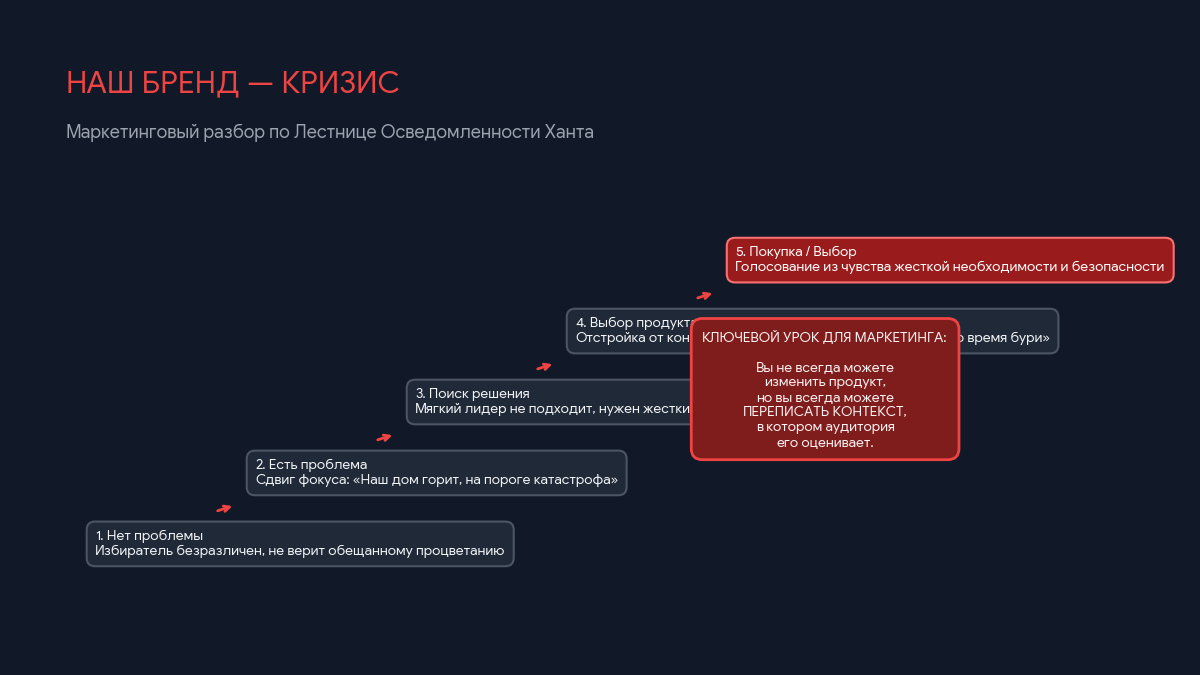
Political strategist Jane Boddin (Sandra Bullock) takes a losing product and reassembles all communication. From a marketing perspective, this is a flawless job with the rungs of Hunt's awareness ladder.
Let's look at how the audience's position has changed from stage to stage.:
1. Indifference (No problem)
- The state of the audience: Voters do not believe any politician, are tired of promises of economic growth and believe that the elections will not change anything.
- """" The team's mistake: Castillo tried to sell "stability" and "prosperity" (the classic "buy our product, you'll be happy" offer). But the audience was at ground zero: they didn't buy the idea that they needed another "good leader" at all.
2. Awareness of the problem
- The political strategist's move: Jane changes the introductory. It turns out that people do not believe in prosperity, but they are deeply afraid of an invisible crisis.
- "Marketing shift": Instead of "We will make your life better," a new context is being formulated: "Our house is on fire, a catastrophe is on the verge." The audience is highlighted not by the phantom benefit, but by the real, burning pain of the threat to their safety.
3. Awareness of the solution
- Marketing shift: When fear is actualized, the audience begins to look for an answer: "If everything collapses, what will save us?"
- Criteria formation: A soft, kind, democratic candidate is not suitable here. "We don"t need a "friend," but a "tough crisis manager." Castillo is no longer disguised as a "man of the people", he is made harsh, strict and even aggressive. The crisis requires a tough solution.
4. Product Awareness
- Marketing shift: There are several "products" (candidates) on the market. The main opponent is a charming, liberal leader who promises dialogue.
- Detuning from a competitor: Jane's team is not trying to be better than the competitor in his field. They position the opponent's softness as a weakness: "He's good for peacetime, but during a storm he'll sink the ship." Castillo's product is positioned as the only draconian tool capable of stopping the chaos.
5. Selection and purchase
Marketing shift: On election day, a targeted action is performed not out of love for the brand, but out of a sense of necessity. The result: The voter casts his vote (buys the product) not because they like Castillo as a person, but because in the created frame of perception he is the only valid answer to the formed fear.
The main lessons of the film for products and marketers:
- Don't sell "features" when a customer's house is on fire. If the market is in crisis or does not realize the value of the product, it is pointless to describe its advantages. Update the problem first.
- If the product is not perfect, make positioning out of it. Castillo was stern and arrogant. Instead of hiding it, political strategists have turned severity into "determination and strength."
- The context decides everything. In "stable" conditions, the same offer seems aggressive, but in "crisis" conditions, it seems to be the only right one.
The essence of hard marketing from the movie is simple: you can't always change the product, but you can always rewrite the context in which the audience evaluates it.
Have you seen the movie? Where do you think the line is between strong positioning and perception manipulation?
Если вы думаете, что политические кампании и продуктовый маркетинг работают по разным законам, посмотрите фильм «Наш бренд — кризис». В центре сюжета латиноамериканская страна в глубоком экономическом упадке и кандидат в президенты Кастильо, у которого рейтинг 9% и антирейтинг социопата.
Политтехнолог Джейн Боддин (Сандра Буллок) берет проигрышный продукт и пересобирает всю коммуникацию. С точки зрения маркетинга это безупречная работа со ступенями лестницы осведомленности Ханта.
Давайте разберем, как менялась позиция аудитории от ступени к ступени:
1. Безразличие (Нет проблемы)
- Состояние аудитории: Избиратели не верят ни одному политику, устали от обещаний роста экономики и считают, что выборы ничего не изменят.
- Ошибка команды: Кастильо пытался продавать «стабильность» и «процветание» (классический оффер «купи наш продукт, станешь счастливым»). Но аудитория находилась на нулевой ступени: она не покупала идею того, что ей вообще нужен еще один «хороший лидер».
2. Осведомленность о проблеме
- Ход политтехнолога: Джейн меняет вводные. Выясняется, что люди не верят в процветание, но они испытывают глубокий страх перед невидимым кризисом.
- Маркетинговый сдвиг: Вместо «Мы сделаем вашу жизнь лучше» формулируется новый контекст: «Наш дом горит, на пороге катастрофа». Аудитории подсвечивают не фантомную выгоду, а реальную, жгучую боль угрозу их безопасности.
3. Осведомленность о решении
- Маркетинговый сдвиг: Когда страх актуализирован, аудитория начинает искать ответ: «Если всё рушится, что нас спасет?»
- Формирование критериев: Мягкий, добрый, демократичный кандидат здесь не подходит. Нужен не «друг», а «жесткий кризис-менеджер». Кастильо перестают гримировать под «человека из народа», его делают резким, строгим и даже агрессивным. Кризис требует жесткого решения.
4. Осведомленность о продукте
- Маркетинговый сдвиг: На рынке есть несколько «продуктов» (кандидатов). Главный оппонент - обаятельный, либеральный лидер, который обещает диалог.
- Отстройка от конкурента: Команда Джейн не пытается быть лучше конкурента в его поле. Они позиционируют мягкость оппонента как слабость: «Он хорош для мирного времени, но во время бури он потопит корабль». Продукт Кастильо позиционируется как единственный драконовский инструмент, способный остановить хаос.
5. Выбор и покупка
Маркетинговый сдвиг: В день голосования целевое действие совершается не из любви к бренду, а из чувства необходимости. Результат: Избиратель отдает голос (покупает продукт) не потому, что Кастильо им нравится как человек, а потому что в созданной рамке восприятия он - единственный валидный ответ на сформированный страх.
Главные уроки фильма для продактов и маркетологов:
- Не продавайте «фичи», когда у клиента горит дом. Если рынок находится в кризисе или не осознает ценность продукта, бессмысленно расписывать его преимущества. Сначала актуализируйте проблему.
- Если продукт не идеален, сделайте из этого позиционирование. Кастильо был суровым и заносчивым. Вместо того чтобы спрятать это, политтехнологи превратили суровость в «решительность и силу».
- Контекст решает все. Один и тот же оффер в условиях «стабильности» кажется агрессивным, а в условиях «кризиса» - единственно верным.
Суть жесткого маркетинга из фильма проста: вы не всегда можете изменить продукт, но вы всегда можете переписать контекст, в котором аудитория его оценивает.
Смотрели фильм? Как считаете, где проходит грань между сильным позиционированием и манипуляцией восприятием?

 Share