
The post has been translated automatically. Original language: Russian




The strongest AI model alone does not make an AI system strong.
If several agents are simultaneously working on the same project area, their changes may conflict, and coordination may take longer than the task itself.
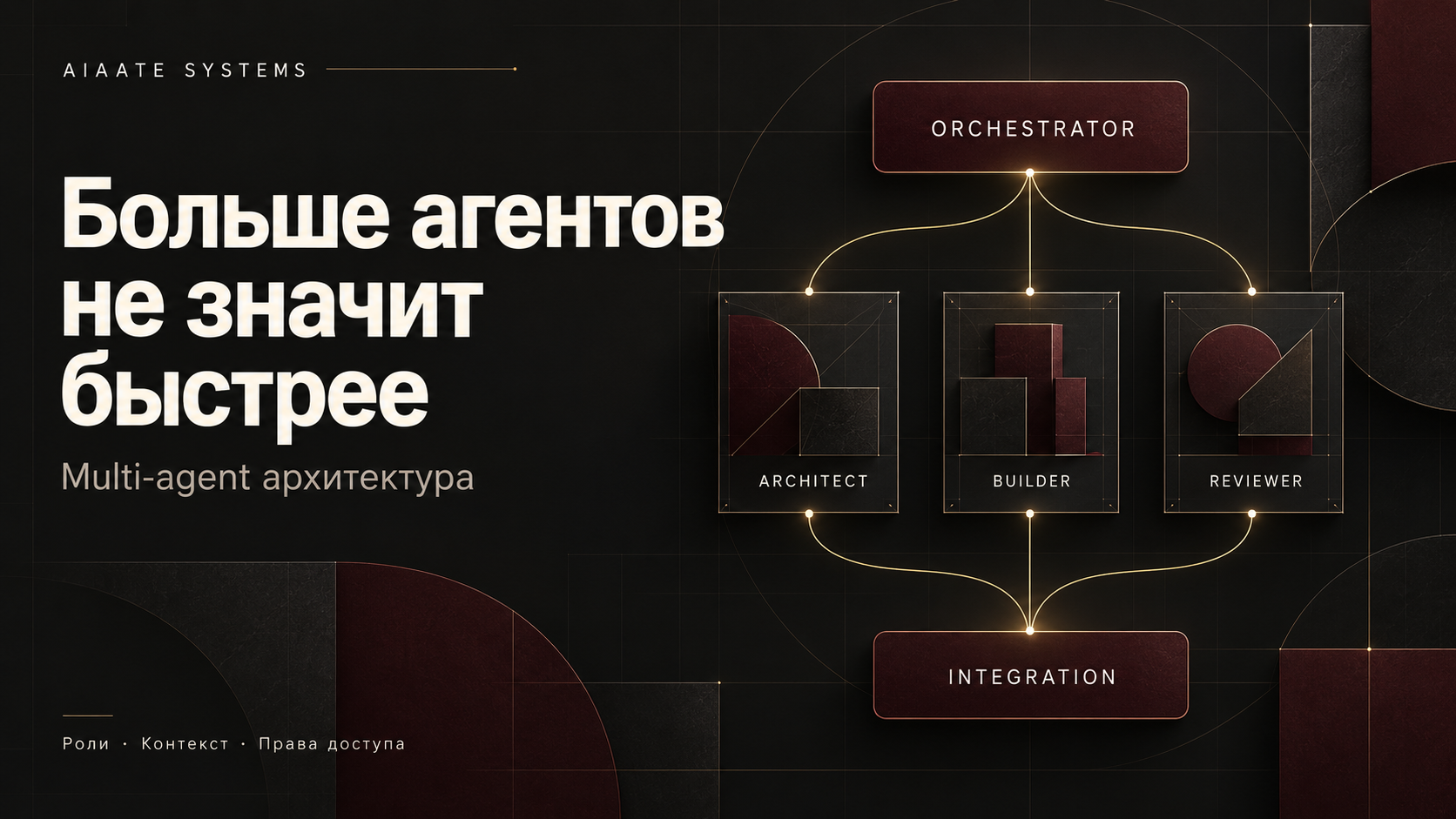
Therefore, in the development of Aiaate Systems, we are developing a multi-agent architecture with separation of roles and areas of responsibility.
One area of responsibility is one owner.
Roles and access boundaries
We share areas of responsibility: system architecture, implementation of isolated components, auditing and testing.
Each agent gets only the context, tools, and access level necessary for their task.
At the same time, the prompt sets the behavior, but by itself does not create technical limitations. The "do not change X" instruction must be supported by the boundaries of access and the work environment.
The context must survive the session
We fix architectural solutions, rules, and restrictions outside of dialogues with models.
This allows the new agent to restore the context of the project and continue working based on common solutions.
Otherwise, each participant gradually develops their own version of how the system works.
Parallelism should pay off.
Independent audit, documentation analysis, testing, and development of isolated components can be assigned to specialized subagents in parallel.
The final changes go through a single verification and integration process.
But a small edit doesn't always require multiple agents.
We test on real-world tasks where parallelism really speeds up work, and where coordination costs exceed the benefits.
For us, the multi-agent architecture does not start with the number of agents, but with specific questions — who makes the decision, who executes, who checks and who is responsible for the final state of the system.
The more autonomous an AI agent is, the more important it is to give it exactly as much freedom as it needs for the task - and no more.
In future publications, we will analyze the results of experiments with subagents, frontier models, and role allocation in the development of Aiaate Systems, including the limitations of this approach.Because the next stage of AI development is not just about stronger models.
This is the architecture of the systems that we build around them.
Самая сильная AI-модель сама по себе ещё не делает AI-систему сильной.
Если несколько агентов одновременно работают с одной областью проекта, их изменения могут конфликтовать, а координация — занимать больше времени, чем сама задача.
Поэтому в разработке Aiaate Systems мы развиваем мультиагентную архитектуру с разделением ролей и зон ответственности.
Одна зона ответственности — один владелец.
Роли и границы доступа
Разделяем зоны ответственности: системная архитектура, реализация изолированных компонентов, аудит и тестирование.
Каждый агент получает только тот контекст, инструменты и уровень доступа, которые необходимы для его задачи.
При этом промпт задаёт поведение, но сам по себе не создаёт технических ограничений. Инструкция «не изменяй X» должна подкрепляться границами доступа и рабочего окружения.
Контекст должен переживать сессию
Архитектурные решения, правила и ограничения фиксируем вне диалогов с моделями.
Это позволяет новому агенту восстановить контекст проекта и продолжить работу на основе общих решений.
Иначе у каждого участника постепенно появляется собственная версия того, как устроена система.
Параллельность должна окупаться
Независимый аудит, анализ документации, тестирование и разработку изолированных компонентов можно поручать специализированным субагентам параллельно.
Итоговые изменения при этом проходят через единый процесс проверки и интеграции.
Но небольшая правка не всегда требует нескольких агентов.
Мы проверяем на реальных задачах, где параллельность действительно ускоряет работу, а где затраты на координацию превышают выигрыш.
Для нас мультиагентная архитектура начинается не с количества агентов, а с конкретных вопросов — кто принимает решение, кто выполняет, кто проверяет и кто отвечает за итоговое состояние системы.
Чем автономнее AI-агент, тем важнее давать ему ровно столько свободы, сколько нужно для задачи — и не больше.
В следующих публикациях разберём результаты экспериментов с субагентами, передовыми моделями и распределением ролей в разработке Aiaate Systems — в том числе ограничения такого подхода. Потому что следующий этап развития AI — это уже не только более сильные модели.
Это архитектура систем, которые мы строим вокруг них.

 Share