
The post has been translated automatically. Original language: Russian




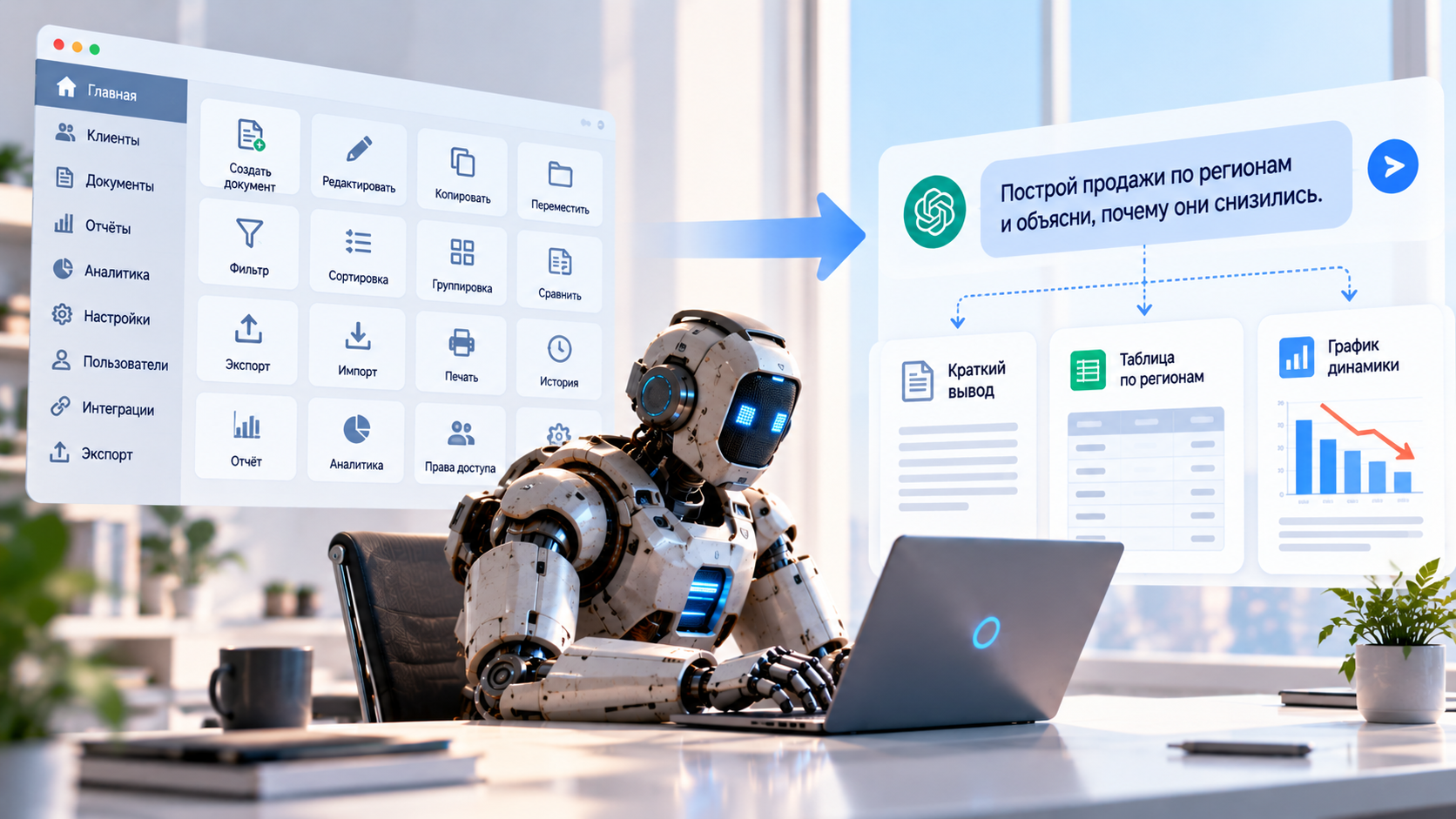
A regular program has a simple problem: every new feature must appear somewhere in the interface.
We added a report and need a new button. There is another way to filter — you need to configure it. We have added export, comparison, verification, forecast — new menu items, tabs and forms appear.
As long as the program is small, it's convenient. But the more she can do, the more difficult it becomes to use all her abilities.
Chat offers a completely different approach.
The interface usually grows with the program.
Let's imagine a typical corporate system.
At first, it has several screens: clients, documents, reports. Then there are additional parameters, user roles, change history, uploads, analytics, and new types of documents.
After a few years, the interface turns into a large tree of sections.
At the same time, developers can sincerely believe that everything is organized logically. They know the system and remember where each function is located.
The user sees something else.
To perform a rare operation, he has to remember which section it is in and what it is called.
It turns out to be a strange situation: the program can do more and more, but it is becoming more difficult for a person to use what it can do.
You can't draw a button for every question.
With AI, the problem becomes even more noticeable.
Let's say the system can work with documents. The user can ask her to translate the document, shorten the text, check for errors, find contradictions, compare two versions, highlight risks, make a summary, or rewrite the text in a different style.
You can create a button for each such operation.
But then the combinations appear:
"Compare these two contracts, find the differences only in financial terms and explain them in simple words."
Which button should I draw for this?
You can create a complex form with dozens of settings, but then the user has to learn the interface again.
The chat solves the problem differently.
He leaves one field.
One field does not mean one function.
This is perhaps the most unusual feature of the conversational interface.
Usually, one control is associated with one action. The "Print" button prints. The "Date" field accepts a date. The switch turns on or off a certain setting.
The chat field works differently.
Today you can write to it:
"Translate the text."
In a minute:
"Compare the two files."
Then:
"Build a table."
And then:
"Explain the error in the program."
The external interface does not change, although the task is completely different each time.
The number of system features no longer directly determines the number of items on the screen.
The complexity has not disappeared
Of course, this does not mean that chat has eliminated complexity.
He just moved her to another place.
In a regular program, the developer described all acceptable actions through the interface in advance. In an AI system, a person formulates a task in words, and the system itself must understand what action is required.
That is, it is not the screen that becomes more difficult.
The program itself becomes more complicated.
She must recognize the user's intention, understand the context, select the necessary tools and collect the result.
It looks very simple to the user. Things are getting a lot more complicated for the system inside.
It's like working with an assistant.
Here again, the analogy with a human works well.
If I have an assistant, I don't create a panel with a thousand buttons for it.
I'm just saying:
"Prepare a report by tonight."
The assistant already understands that it is necessary to open the data, check the figures, assemble the document and, possibly, clarify something with me.
AI chat uses the same model.
The user is no longer required to know the internal structure of the system.
It describes the expected result.
Why is this especially important for rare functions?
Most people use only a small part of the capabilities of complex programs.
The reason is not always that the functions are not needed. Often, the user simply does not know that they exist or where to look for them.
A rare feature is particularly affected by this. If a person uses it twice a year, they will almost certainly forget the way through the menu.
There is less of this problem in the chat.
You don't have to remember the function name.
It is enough to remember the task.
For example, instead of looking for where the document version comparison tool is located, you can write:
"Show me what has changed between these two files."
It's much closer to how a person thinks about their job.
But the buttons are still needed.
However, it would be a mistake to decide that any interface can now be replaced with an empty field.
There are operations where precise controls are much more convenient.
If you need to choose a date, a calendar is better than text. If you need to change the access rights of ten employees, the table is clearer than correspondence. If you need to monitor the status of hundreds of tasks, the dashboard is much more useful than a long conversation.
Chat is especially good where it is difficult to predict the user's request in advance.
Forms are better where the structure of the task is already known.
Therefore, the future most likely does not lie in the victory of chat over buttons.
They will work together.
The AI can choose the interface itself.
The most interesting opportunity comes next.
If the user writes:
"Show sales by region",
The system can not only respond with text, but also immediately plot a graph.
If he writes:
"Prepare the budget for next year",
a table may appear.
If you need to make an appointment, use the calendar.
In other words, the chat field becomes not the only interface, but the entrance to the system, which chooses the appropriate way to show the result.
This is already noticeably different from the usual program.
Previously, the developer decided in advance which screen the user would see.
Now the system itself can make part of this decision.
From a thousand buttons to one intent
It seems to me that this is one of the main reasons for the success of the conversational interface.
A person does not need to study a huge list of program features.
He can start by asking:
"What do I want to get?"
It was too vague a request for the old programs.
For AI, it becomes a normal way of working.
Therefore, one line of input can really replace hundreds of menu items.
Not because there are fewer functions.
Conversely.
There are so many of them that it is becoming less and less convenient to list them using buttons.
У обычной программы есть простая проблема: каждая новая возможность должна где-то появиться в интерфейсе.
Добавили отчёт — нужна новая кнопка. Появился ещё один способ фильтрации — нужна настройка. Добавили экспорт, сравнение, проверку, прогноз — появляются новые пункты меню, вкладки и формы.
Пока программа небольшая, это удобно. Но чем больше она умеет, тем сложнее становится пользоваться всеми её возможностями.
Чат предлагает совершенно другой подход.
Интерфейс обычно растёт вместе с программой
Представим обычную корпоративную систему.
Сначала в ней есть несколько экранов: клиенты, документы, отчёты. Потом появляются дополнительные параметры, роли пользователей, история изменений, выгрузки, аналитика и новые виды документов.
Через несколько лет интерфейс превращается в большое дерево разделов.
Разработчики при этом могут искренне считать, что всё организовано логично. Они знают систему и помнят, где находится каждая функция.
Пользователь видит другое.
Чтобы выполнить редкую операцию, ему приходится вспоминать, в каком разделе она находится и как называется.
Получается странная ситуация: программа умеет всё больше, а человеку всё труднее пользоваться тем, что она умеет.
Нельзя нарисовать кнопку на каждый вопрос
С ИИ проблема становится ещё заметнее.
Допустим, система умеет работать с документами. Пользователь может попросить её перевести документ, сократить текст, проверить ошибки, найти противоречия, сравнить две версии, выделить риски, составить краткое содержание или переписать текст другим стилем.
Для каждой такой операции можно сделать кнопку.
Но дальше появляются комбинации:
«Сравни эти два договора, найди различия только в финансовых условиях и объясни их простыми словами».
Какую кнопку рисовать для этого?
Можно создать сложную форму с десятками настроек, но тогда пользователь снова должен изучать интерфейс.
Чат решает проблему иначе.
Он оставляет одно поле.
Одно поле не означает одну функцию
Это, пожалуй, самое необычное свойство разговорного интерфейса.
Обычно один элемент управления связан с одним действием. Кнопка «Печать» печатает. Поле «Дата» принимает дату. Переключатель включает или выключает определённую настройку.
Поле чата работает иначе.
Сегодня в него можно написать:
«Переведи текст».
Через минуту:
«Сравни два файла».
Потом:
«Построй таблицу».
А затем:
«Объясни ошибку в программе».
Внешний интерфейс не меняется, хотя задача каждый раз совершенно другая.
Количество возможностей системы перестаёт напрямую определять количество элементов на экране.
Сложность никуда не исчезла
Конечно, это не означает, что чат уничтожил сложность.
Он просто перенёс её в другое место.
В обычной программе разработчик заранее описывал все допустимые действия через интерфейс. В системе с ИИ человек формулирует задачу словами, а система должна сама понять, какое действие требуется.
То есть сложнее становится не экран.
Сложнее становится сама программа.
Она должна распознать намерение пользователя, понять контекст, выбрать нужные инструменты и собрать результат.
Для пользователя это выглядит очень просто. Для системы внутри всё становится намного сложнее.
Это похоже на работу с помощником
Здесь снова хорошо работает аналогия с человеком.
Если у меня есть помощник, я не создаю для него панель с тысячей кнопок.
Я просто говорю:
«Подготовь отчёт к вечеру».
Помощник уже сам понимает, что нужно открыть данные, проверить цифры, собрать документ и, возможно, уточнить что-то у меня.
Чат с ИИ использует ту же модель.
Пользователь больше не обязан знать внутреннюю структуру системы.
Он описывает ожидаемый результат.
Почему это особенно важно для редких функций
Большинство людей используют только небольшую часть возможностей сложных программ.
Причина не всегда в том, что функции не нужны. Часто пользователь просто не знает, что они существуют или где их искать.
Редкая функция особенно страдает от этого. Если человек использует её два раза в год, он почти наверняка забудет путь через меню.
В чате такой проблемы меньше.
Не обязательно помнить название функции.
Достаточно помнить задачу.
Например, вместо того чтобы искать, где находится средство сравнения версий документа, можно написать:
«Покажи, что изменилось между этими двумя файлами».
Это намного ближе к тому, как человек думает о своей работе.
Но кнопки всё равно нужны
При этом было бы ошибкой решить, что теперь любой интерфейс можно заменить пустым полем.
Есть операции, где точные элементы управления намного удобнее.
Если нужно выбрать дату, календарь лучше текста. Если нужно изменить права доступа десяти сотрудников, таблица понятнее переписки. Если нужно следить за состоянием сотни задач, панель гораздо полезнее длинного разговора.
Чат особенно хорош там, где заранее трудно предсказать запрос пользователя.
Формы лучше там, где структура задачи уже известна.
Поэтому будущее, скорее всего, не в победе чата над кнопками.
Они будут работать вместе.
ИИ может выбирать интерфейс сам
Самая интересная возможность появляется дальше.
Если пользователь пишет:
«Покажи продажи по регионам»,
система может не только ответить текстом, но и сразу построить график.
Если пишет:
«Подготовь бюджет на следующий год»,
может появиться таблица.
Если нужно назначить встречу — календарь.
То есть поле чата становится не единственным интерфейсом, а входом в систему, которая сама выбирает подходящий способ показать результат.
Это уже заметно отличается от привычной программы.
Раньше разработчик заранее решал, какой экран увидит пользователь.
Теперь часть этого решения может принимать сама система.
От тысячи кнопок к одному намерению
Мне кажется, именно здесь находится одна из главных причин успеха разговорного интерфейса.
Человеку не нужно изучать огромный список возможностей программы.
Он может начать с вопроса:
«Что я хочу получить?»
Для старых программ это был слишком неопределённый запрос.
Для ИИ он становится нормальным способом работы.
Поэтому одна строка ввода действительно может заменить сотни пунктов меню.
Не потому, что функций стало меньше.
Наоборот.
Их стало настолько много, что перечислять их кнопками становится всё менее удобно.
 Share