
The post has been translated automatically. Original language: Russian




Announcement: On December 11, Custom GPTs will stop working. What will not move with them and why moving is not the main problem here.
Custom GPTs are closing. On December 11, 2026, they will stop working, and this date is the same for all tariffs. But the creation of new GPT stops at different times. For corporate and educational workspaces, it's September 25th. The general information for all tariffs has a different date, October 26, and a note "planned" next to it.
The transition will affect all ChatGPT tariffs, but the availability of migration and plug-ins may vary from account to account. And OpenAI calls the launch date of the migration itself a guideline and explicitly writes that it does not guarantee it for every workspace.
There is a nuance here that is worth keeping in mind. There are two schedules, and some of the publications include only corporate ones. Hence the discrepancy in the dates of the reviews. See the notifications in your workspace, not the dates from someone else's article. Including this one.
They suggest moving to one place: plugins. They have been working since July, they have their own catalog, and OpenAI previously transferred the application catalog there. Plug-ins are designed like this: a set of instructions plus connected applications. A separate instruction inside the plugin is called skill.
What is transferred and what is not
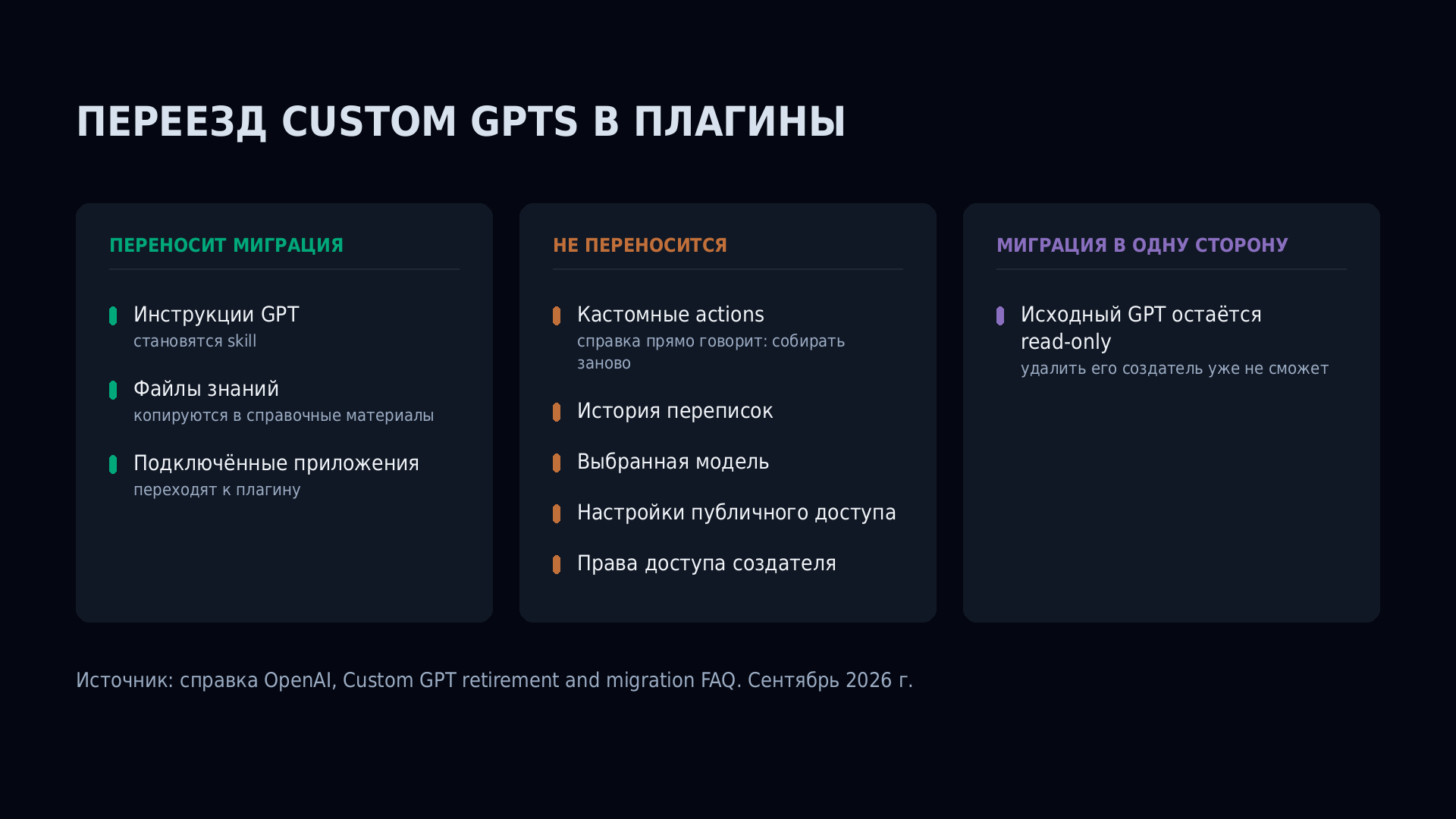
GPT instructions become skill. The knowledge files are being moved to the reference materials. The connected applications remain connected, already in the plugin.
Then the fun begins.
Custom actions, i.e. calls to external APIs, are not portable. They will have to be reassembled. And they were the basis of just all the essential things: if you were making more than just an assistant according to the instructions, your product lived right here.
The history of correspondence, public access settings, creator's access rights and the selected model are also not transferred, that is, an indication of which model your GPT is running on.
And one more thing. After migration, the original GPT becomes read-only, and the creator can no longer delete it.
Why isn't this a migration story?
The dates and lists above are taken from the OpenAI help, and plug-ins are described from reviews of relevant publications. What follows is my assessment, not the company's position.
Moving instructions have already been written by dozens of publications. It's more useful to understand what really happened here.
Custom GPTs appeared in November 2023. The GPT Store opened in January 2024. Together with him, OpenAI announced a payment program for authors, which was not yet operational at the time of launch. Many teams took this as a distribution channel and built products on it. Now the catalog is being minimized, links will lead to plugins for those who have access, and the entire structure will be replaced by another one.
None of these teams owned anything. Neither the abstraction, nor the sales channel, nor the relationship with the user. They rented a place inside someone else's product, and the landlord changed the layout.
There is no malicious intent here. OpenAI is rebuilding the platform and has the right to do so. The problem is for those who have mistaken someone else's cube for their own foundation.
Three conclusions for the founder
1. Consider what belongs to you and what is rented.
Divide your product into two piles. First, add up what you will take to another platform in a week: user data, domain knowledge, well-established promptings, and customer relationships. The second is what will disappear with someone else's solution: integration for a specific API, distribution through someone else's catalog, and the user's habit of accessing you through someone else's interface.
If the second part weighs more than the first, you are not building a company. You're taking a place in someone else's.
2. Look at the warning period, not the promises.
Corporate administrators received a notification on September 11. Full stop on December 11th. Exactly three months. For a product with paying customers, this is not enough. And no one gave any more guarantees.
There's one thing you should ask yourself about any platform you're standing on. What will happen to your revenue if it is closed after ninety days? If there is no answer, then there is a risk that you did not consider.
3. Abstraction is someone else's, the integration layer is yours.
Please note what exactly is moving. The text of instructions and files, that is, the cheapest. And the connections to the external systems that cost the most will have to be done all over again.
This is how any platform works, it's not about OpenAI. She tolerates only what is done by her means. You will write the rest over again. Therefore, integration should be kept at home, so that the provider change is reduced to replacing one module, and not to reassembling the product.
What to do this week
Take the instructions and knowledge files from each running GPT. Write out all the custom actions separately, you will have to restore them by hand. And take a look at your workspace's notifications: your dates may differ from corporate ones.
And answer yourself an unpleasant question. They would have given you three weeks instead of three months. Would the product have survived?
Sources
The dates, conditions of migration and the lists of the transferred are taken from the OpenAI reference materials.:
- Custom GPT retirement and migration FAQ, OpenAI Help Center
- ChatGPT Enterprise and Edu release notes, entry dated September 17, 2026
Description of plug-ins, the fate of the application catalog, and the history of payments to authors:
- OpenAI is retiring custom GPTs, here's what carries over to plugins, Mixed News
- The New ChatGPT Plugins: Apps, Skills and MCP Explained, Gradually (plug-ins launch on July 9, 2026)
- Custom GPTs in ChatGPT are going away, PCWorld
The dates are as of September 22, 2026 and may change.
Анонс: 11 декабря Custom GPTs перестанут работать. Что не переедет вместе с ними и почему переезд здесь не главная проблема.
Custom GPTs закрываются. 11 декабря 2026 года они перестанут работать, и эта дата одна для всех тарифов. А вот создание новых GPT прекращается в разные сроки. Для корпоративных и образовательных рабочих пространств это 25 сентября. В общей справке для всех тарифов названа другая дата, 26 октября, и рядом стоит пометка «планируется».
Переход коснётся всех тарифов ChatGPT, но доступность миграции и плагинов может отличаться от аккаунта к аккаунту. А дату запуска самой миграции OpenAI называет ориентиром и прямо пишет, что не гарантирует её для каждого рабочего пространства.
Здесь есть нюанс, который стоит держать в голове. Расписаний два, и часть изданий приводит только корпоративное. Отсюда разнобой в датах по обзорам. Смотрите уведомления в своём рабочем пространстве, а не даты из чужой статьи. Включая эту.
Переехать предлагают в одно место: в плагины. Они работают с июля, у них свой каталог, и туда же OpenAI ранее перевела каталог приложений. Устроены плагины так: набор инструкций плюс подключённые приложения. Отдельная инструкция внутри плагина называется skill.
Что переносится, а что нет
Инструкции GPT становятся skill. Файлы знаний переезжают в справочные материалы. Подключённые приложения остаются подключёнными, уже у плагина.
Дальше начинается интересное.
Кастомные actions, то есть вызовы внешних API, не переносятся. Их придётся собирать заново. А держалось на них как раз всё самое существенное: если вы делали не просто помощника по инструкции, ваш продукт жил именно здесь.
Не переносятся также история переписок, настройки публичного доступа, права доступа создателя и выбранная модель, то есть указание, на какой модели работает ваш GPT.
И ещё одно. После миграции исходный GPT становится read-only, и удалить его создатель уже не может.
Почему это не история про миграцию
Даты и перечни выше взяты из справки OpenAI, описание плагинов из обзоров профильных изданий. Дальше моя оценка, а не позиция компании.
Инструкции по переезду уже написаны десятком изданий. Полезнее разобраться, что здесь на самом деле произошло.
Custom GPTs появились в ноябре 2023 года. В январе 2024 открылся GPT Store. Вместе с ним OpenAI анонсировала программу выплат авторам, которая на момент запуска ещё не работала. Многие команды восприняли это как канал дистрибуции и построили на нём продукты. Сейчас каталог сворачивается, ссылки будут вести на плагины тем, у кого есть доступ, а вся конструкция заменяется другой.
Ни одна из этих команд не владела ничем. Ни абстракцией, ни каналом продаж, ни отношениями с пользователем. Они арендовали место внутри чужого продукта, и арендодатель сменил планировку.
Злого умысла тут нет. OpenAI перестраивает платформу и вправе это делать. Проблема у тех, кто принял чужой кубик за собственный фундамент.
Три вывода для основателя
1. Считайте, что вам принадлежит, а что арендовано.
Разложите свой продукт на две стопки. В первую сложите то, что унесёте на другую платформу за неделю: данные пользователей, доменные знания, отлаженные промпты, отношения с клиентом. Во вторую то, что исчезнет вместе с чужим решением: интеграции под конкретный API, дистрибуцию через чужой каталог, привычку пользователя заходить к вам через чужой интерфейс.
Если вторая часть весит больше первой, вы не строите компанию. Вы занимаете место в чужой.
2. Смотрите на срок предупреждения, а не на обещания.
Корпоративные администраторы получили уведомление 11 сентября. Полная остановка 11 декабря. Ровно три месяца. Для продукта с платящими клиентами это мало. А гарантий больше никто и не давал.
Про любую платформу, на которой вы стоите, стоит спросить себя об одном. Что станет с вашей выручкой, если её закроют через девяносто дней. Нет ответа, значит есть риск, который вы не считали.
3. Абстракция чужая, слой интеграции ваш.
Обратите внимание, что именно переезжает. Текст инструкций и файлы, то есть самое дешёвое. А подключения к внешним системам, которые стоили дороже всего, придётся делать заново.
Так устроена любая платформа, дело не в OpenAI. Она переносит только то, что сделано её средствами. Остальное вы напишете заново. Поэтому интеграции стоит держать у себя, чтобы смена провайдера сводилась к замене одного модуля, а не к пересборке продукта.
Что сделать на этой неделе
Заберите инструкции и файлы знаний из каждого работающего GPT. Отдельно выпишите все кастомные actions, восстанавливать их придётся руками. И загляните в уведомления своего рабочего пространства: ваши даты могут отличаться от корпоративных.
И ответьте себе на неприятный вопрос. Дали бы вам не три месяца, а три недели. Продукт бы выжил?
Источники
Даты, условия миграции и перечни переносимого взяты из справочных материалов OpenAI:
- Custom GPT retirement and migration FAQ, OpenAI Help Center
- ChatGPT Enterprise and Edu release notes, запись от 17 сентября 2026
Описание плагинов, судьба каталога приложений и история с выплатами авторам:
- OpenAI is retiring custom GPTs, here's what carries over to plugins, Mixed News
- The New ChatGPT Plugins: Apps, Skills and MCP Explained, Gradually (запуск плагинов 9 июля 2026)
- Custom GPTs in ChatGPT are going away, PCWorld
Даты приведены по состоянию на 22 сентября 2026 года и могут измениться.
 Share