
The post has been translated automatically. Original language: Russian





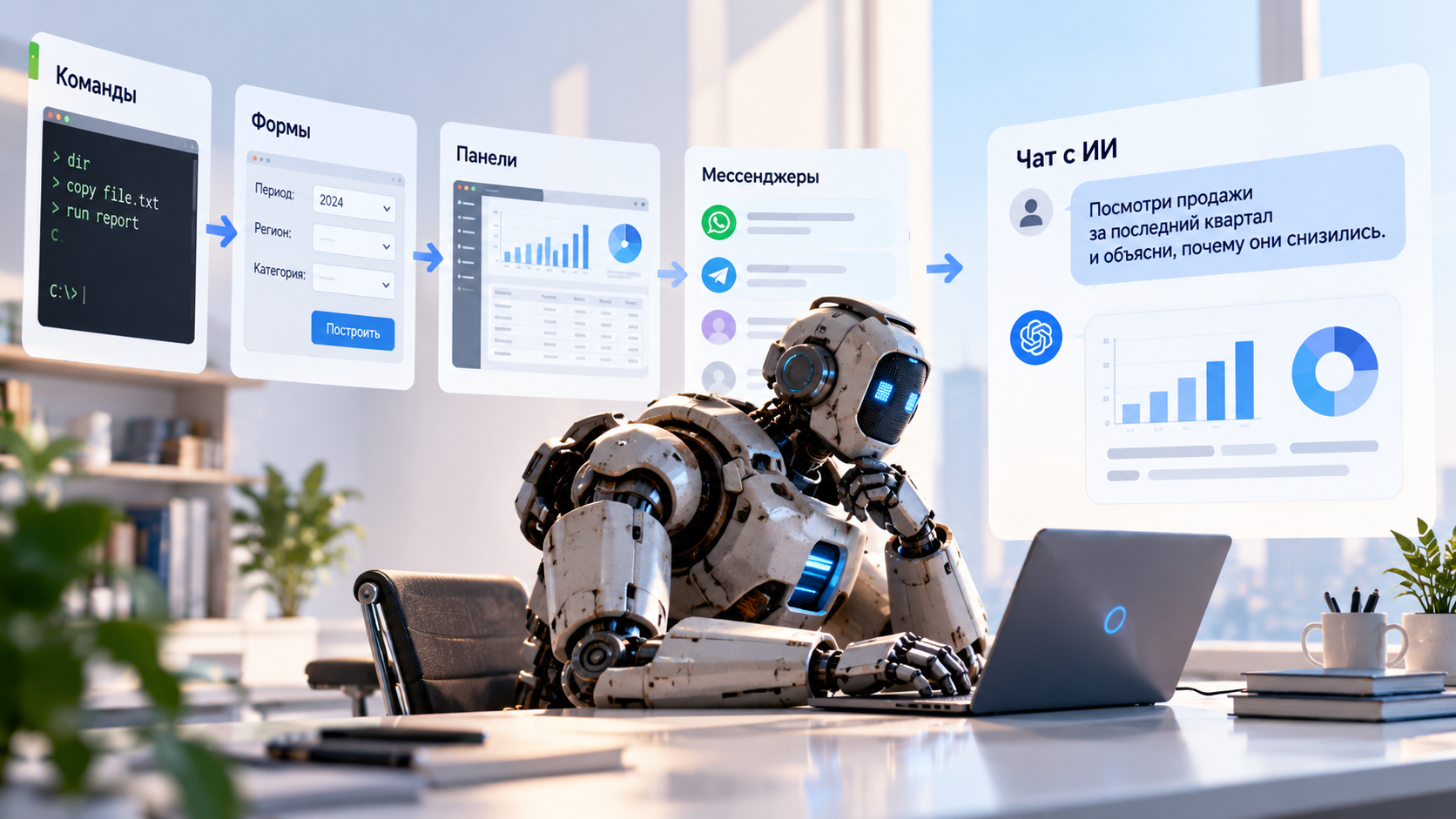
For a long time, the development of programs went in one clear direction. The more complex the system became, the more forms, menus, buttons, tables, and panels appeared in it. The developer decided in advance which actions the user could perform and created a separate path for each action.
This is how banking systems, accounting programs, enterprise management systems, and analytical panels appeared. The user had to learn the structure of the program: where to go, what to choose, which parameter to specify, and which button to press.
And then another familiar way of interacting appeared for us — chat.
At first, we used to write to people
WhatsApp and Telegram have changed more than just communication. They taught us to solve many everyday and work tasks with the same phrase: "Write to a person."
I need to find out if the document is ready," he wrote to the accountant. I need to clarify the meeting, I wrote to a colleague. I need to fix something in the program, I wrote to the developer.
At the same time, we don't think about how the other person will solve the problem. We don't need to know its internal working order. We just describe what we need, and the other person decides what actions to perform.
This is a very important difference from a regular program.
The program used to require the user to know their capabilities. The person had to understand where the necessary function was located and how to use it.
In correspondence, the opposite is true: the person describes the intention, and the performer himself determines the path to the result.
ChatGPT turned out to be a familiar interface
When ChatGPT appeared, the new technology took on a familiar form.
There was no huge set of new buttons in front of the person. There was no need to read the instructions and study the menu. There was a field on the screen that looked very much like a regular chat.
The man already knew what to do with it.
You can write: "explain this document," "translate the text," "fix the error in the program," "compare the two options," "prepare the letter."
There was no longer a person on the other side of the message, but a program, but the habit had already been formed by messengers.
I think that's why chat turned out to be such a successful first way to interact with AI.
We used to manage the program
Let's take an ordinary analytical system.
If a manager wants to understand why sales have fallen, they need to open reports, select a period, set filters, build several tables or graphs, and compare the results themselves.
Perhaps you should first ask the analyst to prepare the necessary report.
In other words, the user actually needs to know the sequence of actions.
With AI, the request may look different.:
"Look at the sales for the last quarter and explain why they decreased."
The man no longer describes the path.
He describes the goal.
This is perhaps one of the main changes in the way a person interacts with the program.
One line instead of multiple buttons
A regular application has a natural limitation. The more functions, the more complex its device is.
Each new feature needs to be placed somewhere: add a menu item, a button, a form, a setting, or a separate section. At some point, the user no longer knows where to look for the desired function.
With AI, a different approach arises.
The input field remains the same, regardless of the number of system features.
There is no need to create a separate button "explain the document", then "shorten the document", then "find contradictions", then "translate into Kazakh". The user just writes what he wants to do.
It turns out a very unusual thing: the capabilities of the system are growing, and the external management method is almost not complicated.
But the person stopped seeing the boundaries of the program.
There is a downside to this approach.
In a regular program, the buttons simultaneously show its capabilities. If there is a "Print" option, it means that the program can print. If there is no calculation function, the user usually understands it pretty quickly.
In the chat, such boundaries are almost invisible.
There is an empty field in front of the person.
He should figure out for himself what he can ask for.
It turns out to be a paradox: chat eliminates the need to study a complex menu, but at the same time hides the capabilities of the system.
Therefore, many users use ChatGPT only for a few familiar tasks, although the system is capable of much more.
We have removed the complexity from the screen, but some of this complexity has been transferred to the user's head.
The program has become like an assistant
There is another important change.
An ordinary program is perceived as a tool. The person himself performs actions through its functions.
The chat creates a different behavior model: I set a task, got a result, clarified it, and asked for a fix.
It's more like working with an assistant.
If the answer doesn't fit, you don't have to go back to the beginning and fill out the form again. You can write: "wrong", "make it shorter", "leave the first option, but change the second part."
The program begins to participate in the task refinement process.
It's very similar to a normal conversation between people.
What has ChatGPT actually changed?
It seems to me that the main change is not that the program has learned to respond with text.
The user's role itself has changed.
Previously, the user had to understand the program and adjust their actions to its device.
Now the program is trying to understand the user.
Of course, so far it's not working perfectly. The AI may misunderstand the request, make a mistake, or perform the wrong action.
But the direction has already changed.
We are gradually moving away from the model:
"Here are the features of the program. Choose the right one."
to the model:
"Tell me what you want to get."
The chat is probably just the beginning
I don't think the future of software is one endless chat.
For many tasks, a form, table, calendar, or graph is more convenient than text. Sometimes it's much easier to choose a date than to explain it in words, and it's better to see the status of a large project on the dashboard than to search in the history of correspondence.
But the chat has already changed the main thing.
It has become a universal entry point.
A person can start with a simple phrase, and then the system should already understand what they need: a document, a table, a graph, a calculation, or a specific action.
That's why I think the current transition is important.
For a long time, the developer created the interface in advance and forced the user to study its logic.
Now, more and more often, the user simply formulates the intention.
And the program must figure out how to turn this intention into a result.
Долгое время развитие программ шло в одном понятном направлении. Чем сложнее становилась система, тем больше в ней появлялось форм, меню, кнопок, таблиц и панелей. Разработчик заранее решал, какие действия может выполнить пользователь, и создавал для каждого действия отдельный путь.
Так появились банковские системы, бухгалтерские программы, системы управления предприятиями, аналитические панели. Пользователь должен был выучить структуру программы: куда зайти, что выбрать, какой параметр указать и какую кнопку нажать.
А потом появился другой привычный для нас способ взаимодействия — чат.
Сначала мы привыкли писать людям
WhatsApp и Telegram изменили не только общение. Они приучили нас решать множество бытовых и рабочих задач одной и той же фразой: «Напиши человеку».
Нужно узнать, готов ли документ, — написал бухгалтеру. Нужно уточнить встречу — написал коллеге. Нужно исправить что-то в программе — написал разработчику.
При этом мы не думаем, каким способом другой человек решит задачу. Нам не нужно знать его внутренний порядок работы. Мы просто описываем, что нам нужно, а собеседник сам решает, какие действия выполнить.
Это очень важное отличие от обычной программы.
Программа раньше требовала от пользователя знания своих возможностей. Человек должен был понимать, где находится нужная функция и как ей воспользоваться.
В переписке всё наоборот: человек описывает намерение, а исполнитель сам определяет путь к результату.
ChatGPT оказался знакомым интерфейсом
Когда появился ChatGPT, новая технология получила уже знакомую форму.
Перед человеком не оказалось огромного набора новых кнопок. Не нужно было читать инструкцию и изучать меню. На экране было поле, очень похожее на обычный чат.
Человек уже знал, что с ним делать.
Можно написать: «объясни этот документ», «переведи текст», «исправь ошибку в программе», «сравни два варианта», «подготовь письмо».
По другую сторону сообщения теперь находился не человек, а программа, но привычка уже была сформирована мессенджерами.
Мне кажется, именно поэтому чат оказался настолько удачным первым способом взаимодействия с ИИ.
Раньше мы управляли программой
Возьмём обычную аналитическую систему.
Если руководитель хочет понять, почему упали продажи, ему нужно открыть отчёты, выбрать период, поставить фильтры, построить несколько таблиц или графиков и самостоятельно сравнить результаты.
Возможно, сначала нужно попросить аналитика подготовить нужный отчёт.
То есть пользователь фактически должен знать последовательность действий.
С ИИ запрос может выглядеть иначе:
«Посмотри продажи за последний квартал и объясни, почему они снизились».
Человек больше не описывает путь.
Он описывает цель.
Это, пожалуй, одно из главных изменений в способе взаимодействия человека с программой.
Одна строка вместо множества кнопок
У обычного приложения есть естественное ограничение. Чем больше функций, тем сложнее его устройство.
Каждую новую возможность нужно куда-то поместить: добавить пункт меню, кнопку, форму, настройку или отдельный раздел. В какой-то момент пользователь уже не знает, где искать нужную функцию.
С ИИ возникает другой подход.
Поле ввода остаётся тем же, независимо от количества возможностей системы.
Не нужно создавать отдельную кнопку «объяснить документ», потом «сократить документ», потом «найти противоречия», потом «перевести на казахский». Пользователь просто пишет, что хочет сделать.
Получается очень необычная вещь: возможности системы растут, а внешний способ управления почти не усложняется.
Но человек перестал видеть границы программы
У такого подхода есть и обратная сторона.
В обычной программе кнопки одновременно показывают её возможности. Если есть пункт «Печать», значит, программа умеет печатать. Если нет функции расчёта, пользователь обычно довольно быстро это понимает.
В чате таких границ почти не видно.
Перед человеком пустое поле.
Он должен сам догадаться, что можно попросить.
Получается парадокс: чат избавляет от необходимости изучать сложное меню, но одновременно скрывает возможности системы.
Поэтому многие пользователи используют ChatGPT только для нескольких знакомых задач, хотя система способна на гораздо большее.
Мы убрали сложность с экрана, но часть этой сложности перенесли в голову пользователя.
Программа стала похожа на помощника
Есть ещё одно важное изменение.
Обычная программа воспринимается как инструмент. Человек сам выполняет действия через её функции.
Чат создаёт другую модель поведения: поставил задачу, получил результат, уточнил, попросил исправить.
Это уже больше похоже на работу с помощником.
Если ответ не подошёл, не нужно обязательно возвращаться в начало и заново заполнять форму. Можно написать: «не так», «сделай короче», «оставь первый вариант, но измени вторую часть».
Программа начинает участвовать в процессе уточнения задачи.
Это очень похоже на обычный разговор между людьми.
Что на самом деле изменил ChatGPT
Мне кажется, главное изменение не в том, что программа научилась отвечать текстом.
Изменилась сама роль пользователя.
Раньше пользователь должен был понимать программу и подстраивать свои действия под её устройство.
Теперь программа пытается понять пользователя.
Конечно, пока это работает далеко не идеально. ИИ может неправильно понять запрос, ошибиться или выполнить не то действие.
Но направление уже изменилось.
Мы постепенно переходим от модели:
«Вот возможности программы. Выбери нужную».
к модели:
«Скажи, чего ты хочешь получить».
Чат, возможно, только начало
Я не думаю, что будущее программ — это один бесконечный чат.
Для многих задач форма, таблица, календарь или график удобнее текста. Иногда гораздо проще выбрать дату, чем объяснять её словами, а состояние большого проекта лучше видеть на панели, чем искать в истории переписки.
Но чат уже изменил главное.
Он стал универсальной точкой входа.
Человек может начать с обычной фразы, а дальше система уже должна понять, что ему требуется: документ, таблица, график, расчёт или конкретное действие.
Именно поэтому мне кажется важным нынешний переход.
Долгое время разработчик заранее создавал интерфейс и заставлял пользователя изучать его логику.
Теперь пользователь всё чаще просто формулирует намерение.
А программа должна разобраться, как это намерение превратить в результат.
 Share