
The post has been translated automatically. Original language: Russian





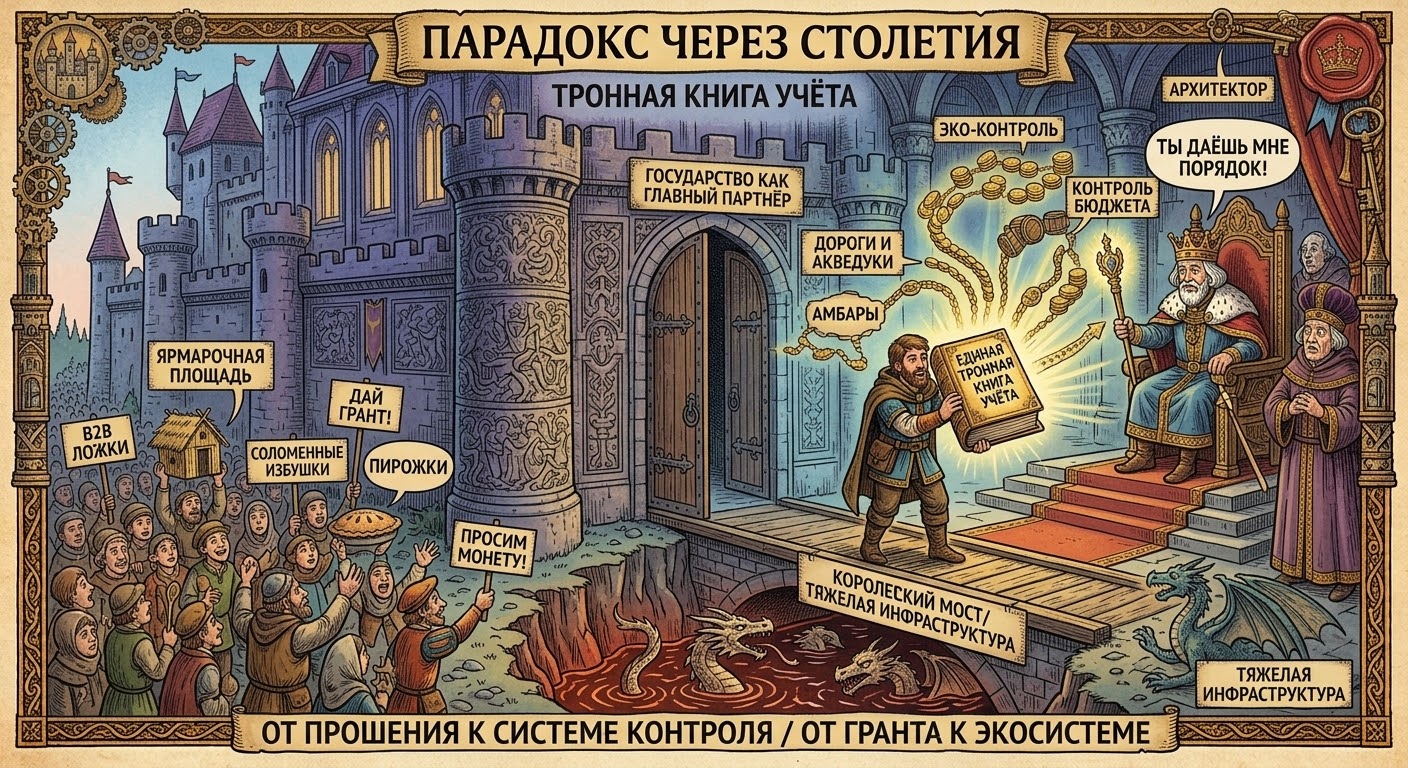
In old fairy tales, there is always a motley crowd under the windows of the Royal Castle. Some are asking for a coin for food, others are begging for subsidies to build a new cart, and others are thrusting tearful petitions at the guards asking them to evaluate their "straw hut."
This is how most novice artisans perceive the State.: like a generous but moody rich man who needs to beg for a grant, a bag of grain, or a discount store in the bazaar. They come with an outstretched hand, receive a one-time alms and leave, sincerely wondering why the Throne does not invite them to be permanent companions.
But the true Paradox, centuries later, is that the Kingdom does not need new petitioners. He needs those who will bring order.
Imagine an Architect who rises to the Throne not for a coin, but with a gift of a completely different kind. He brings the King a magical Optical Crystal, a Single Throne Ledger.
—Your Majesty,— says the Architect. "I didn't come here to ask for gold. I've come to show you where the Kingdom is losing it every day. This Crystal sees every unfinished bridge, every barrel of ale that bypassed the treasury, and every cartload of garbage dumped into a clear river. I am giving you a tool for full digital control over all Tron resources and expenses.
The Ruler's reaction changes instantly.
The State is turning from an object of begging into the Main Partner and a Single Customer. The King no longer needs to give out small coppers for fair experiments — he gives the Architect the keys to the Main Treasury and the right to manage the entire infrastructure, because in return he gets absolute transparency of his Empire.
Why is this the most important step in business architecture?
- Abandoning the role of the petitioner: when you offer the state not an "innovative toy", but a solution to its systemic headache, the conversation changes from asking for help to an equal deal.
- Transparency as the main commodity: the most valuable currency for a large structure is not saving a couple of coppers, but full control and the absence of blind spots in reports.
- An unattainable scale: no fairground merchant is able to provide a project with the volume and stability that a system built into government management mechanisms provides.
While thousands of small guilds continue to crowd at the foot of the Castle, begging for more grants for the construction of straw castles, real architects are creating a digital framework of the state.
The fairy tale ends where the foundation begins. Don't ask the Throne for a copper for food — offer the King a system that will preserve his Empire.
В старых сказках под окнами Королевского Замка всегда стоит пестрая толпа. Одни просят монету на пропитание, другие умоляют о субсидиях на постройку новой телеги, третьи суют стражникам ни слезливые прошения с просьбой оценить их «соломенную избушку».
Большинство начинающих ремесленников воспринимают Государство именно так: как щедрого, но капризного богача, у которого нужно выпросить грант, мешок зерна или льготную лавку на базаре. Они приходят с протянутой рукой, получают разовую милостыню и уходят, искренне удивляясь, почему Трон не зовёт их в постоянные соратники.
Но истинный Парадокс через столетия заключается в том, что Королевству не нужны новые просители. Ему нужны те, кто принесёт порядок.
Представьте Зодчего, который поднимется к Трону не за монетой, а с подарком совершенно иного толка. Он приносит Королю волшебный Оптический Кристалл — Единую Тронную Книгу Учёта.
— Ваше Величество, — говорит Зодчий. — Я пришёл не просить золота. Я пришёл показать, где Королевство теряет его каждый день. Этот Кристалл видит каждый недостроенный мост, каждую бочку эля, ушедшую в обход казны, и каждый воз с мусором, сброшенный в чистую реку. Я даю вам инструмент полного цифрового контроля над всеми ресурсами и расходами Трона.
Реакция Правителя меняется мгновенно.
Из объекта попрошайничества Государство превращается в Главного Партнёра и Единого Заказчика. Королю больше не нужно раздавать мелкие медяки на ярмарочные эксперименты — он отдаёт Зодчему ключи от Главной Казны и право на управление всей инфраструктурой, потому что взамен получает абсолютную прозрачность своей Империи.
Почему этот шаг — самый важный в архитектуре бизнеса?
- Отказ от роли просителя: когда вы предлагаете государству не «инновационную игрушку», а решение его системной головной боли, разговор меняется с просьбы о помощи на равноправную сделку.
- Прозрачность как главный товар: самая ценная валюта для крупной структуры — это не экономия пары медяков, а полный контроль и отсутствие слепых зон в отчетах.
- Недосягаемый масштаб: ни один ярмарочный купец не способен дать проект такого объема и стабильности, какой даёт система, встроенная в государственные механизмы управления.
Пока тысячи мелких гильдий продолжают толпиться у подножия Замка, выпрашивая очередные гранты на постройку соломенных замков, настоящие архитекторы создают цифровой каркас государства.
Сказка заканчивается там, где начинается фундамент. Не просите у Трона медяк на пропитание — предлагайте Королю систему, которая сохранит его Империю.

 Share