
The post has been translated automatically. Original language: Russian




In the comments to the post about the control panel, Galia suggested analyzing staff productivity and food waste. I'll start with the second one, because almost everything counts waste, but it's wrong.: they look at the total amount of write-offs for the month, and not at where it comes from.
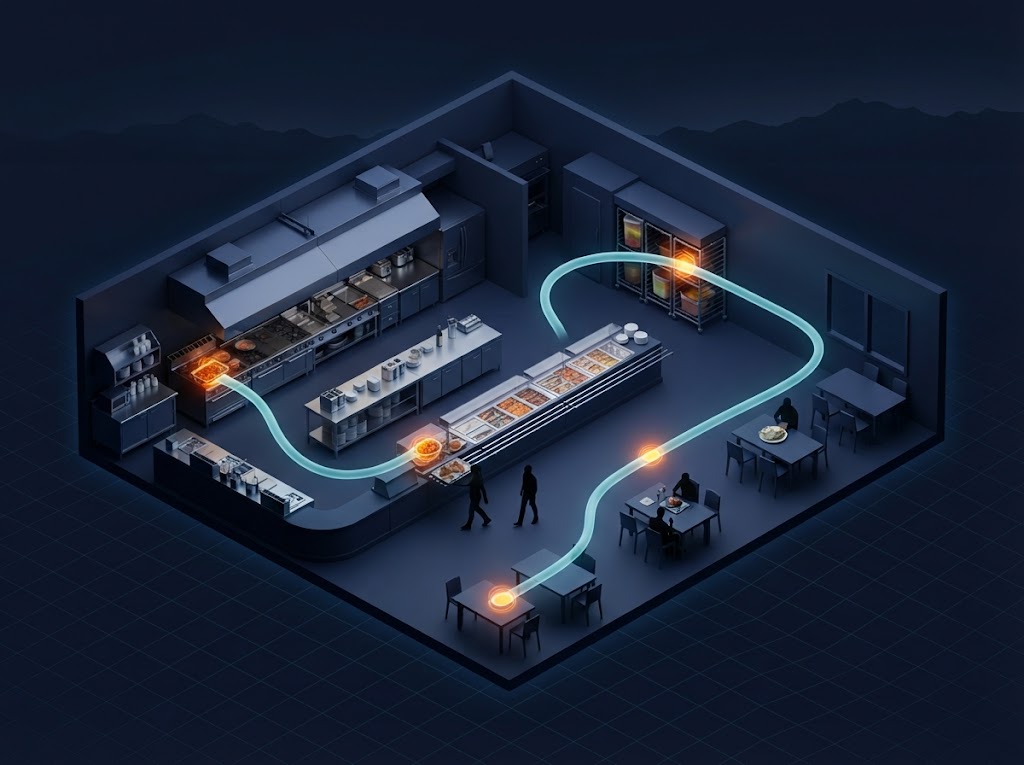
Write—offs in the dining room are not just one problem, but at least four different ones, and each one has its own control lever.
Four sources of waste — and they are not equal
Retraining. We cooked more than we ate. The reason is almost always the same — the flow forecast is made by eye or based on yesterday without adjusting for the day of the week, weather, or corporate events.
Portioning. The distributor puts more than the norm — out of habit, "with a slide" so that there are no complaints. The difference of 10-15 grams per serving is invisible to humans, but with a flow of 400 people per day, this is an extra supply of raw materials every week.
Storage and preparation. We did not have time to sell the prepared semi-finished product before the expiration date. This is not about the kitchen at the moment, but about the purchase and production plan for a few days ahead.
Refund from the guest. The guest did not finish or did not take what was provided by default. A separate category, because it cannot be solved by production — only by menu, portions to choose from, or pricing.
If we count only the total amount of write-offs, all four reasons are mixed into one number, and it is unclear what to fix: the purchase plan, the distributor's work, or the composition of the menu.
What to measure to make waste manageable
— charges per user, in tenge and in grams — the basic unit of comparison between days and objects;
— the share of write-offs in the revenue or in the budget of the dining room — the economic scale of the problem;
— deviation of the actual consumption of raw materials from the standard, for each menu item — where exactly do we lose;
— write—offs by menu item per shift compared to the same day - seasonality and one-time spikes are immediately visible;
— the proportion of write-offs due to the reason (re—preparation / portioning / storage / refund) - where to direct efforts first.
The last point is the main one. Without a breakdown of the reason, any discussion of waste turns into "we need to write off less," and this is not a decision, but a wish.
Example: one digit, three different diagnoses
Write-offs increased from 3% to 5% of revenue for the week. No one will figure it out further without a breakdown of the reason.
If the growth has given over—preparation, the problem is in the flow forecast, the manager and the chef are fixing it together, the horizon is tomorrow. If the growth is far away from the guests, the problem is in the default menu or portions, the solution is at the level of the owner and chef, the horizon is a week or two. If the growth has led to storage and procurement, the problem is in the procurement and production plan, the solution is at the owner's level, and the horizon is a revision of the procurement standard.
The same figure of "5% write—offs" is three different projects. Without breaking down the reason, the business is fixing the wrong thing.
Where is the AI here
— calculates the expense ratio for each item automatically, based on actual sales, rather than by eye;
— marks debits that are out of the normal range for human verification;
— breaks up write-offs for a reason without manually checking invoices and certificates;
— predicts the flow adjusted for the day of the week and history, reducing over-preparation at the entrance.
AI doesn't decide what to do with the write—off - it doesn't change the menu or cut the purchase itself. It removes the manual work of noting down the numbers and highlights where the deviation is systemic rather than one-time.
The main conclusion
The percentage of write—offs in itself is not an indicator, but a symptom. It becomes manageable only when it is decomposed for a reason: re-preparation, portioning, storage, return. Each reason is a separate decision and a separate person who makes it.
In the next publication, I will analyze staff productivity: portions per person-hour, how to calculate the output standard and by what signs it is clear that it is not a matter of a person, but of the organization of the process.
Do you agree that four reasons are enough, or is there a waste source in your practice that doesn't fit here?
В комментариях к посту про панель управления Галия предложила разобрать производительность персонала и пищевые отходы. Начну со второго — потому что отходы считают почти все, но считают неправильно: смотрят на итоговую сумму списаний за месяц, а не на то, откуда она берётся.
Списания в столовой — это не одна проблема, а минимум четыре разных, и у каждой свой рычаг управления.
Четыре источника отходов — и они не равны
Переготовка. Приготовили больше, чем съели. Причина почти всегда одна — прогноз потока сделан на глаз или по вчерашнему дню без поправки на день недели, погоду, корпоративные события.
Порционирование. Раздатчик кладёт больше нормы — по привычке, "с горкой", чтобы не было жалоб. Разница в 10–15 г на порцию незаметна человеку, но на потоке 400 человек в день — это лишний завоз сырья каждую неделю.
Хранение и заготовка. Не успели продать заготовленный полуфабрикат до истечения срока годности. Это не про кухню в моменте, а про закупку и производственный план на несколько дней вперёд.
Возврат от гостя. Гость не доел или не взял то, что положили по умолчанию. Отдельная категория, потому что её нельзя решить производством — только меню, порциями на выбор или ценообразованием.
Если считать только общую сумму списаний, все четыре причины смешиваются в одно число, и непонятно, что чинить: план закупки, работу раздатчика или состав меню.
Что мерить, чтобы отходы стали управляемыми
— списания на одного посетителя, в тенге и в граммах — базовая единица сравнения между днями и объектами;
— доля списаний в выручке или в бюджете столовой — экономический масштаб проблемы;
— отклонение фактического расхода сырья от нормативного, по каждой позиции меню — где именно теряем;
— списания по позиции меню за смену в сравнении с аналогичным днём — сезонность и разовые всплески видно сразу;
— доля списаний по причине (переготовка / порционирование / хранение / возврат) — куда направлять усилия в первую очередь.
Последний пункт — главный. Без разбивки по причине любое обсуждение отходов превращается в "надо меньше списывать", а это не решение, а пожелание.
Пример: одна цифра, три разных диагноза
Списания выросли с 3% до 5% от выручки за неделю. Дальше без разбивки по причине не разберётся никто.
Если рост дал переготовку — проблема в прогнозе потока, чинит управляющий и шеф-повар вместе, горизонт — завтра. Если рост дал возврат от гостей — проблема в меню или порциях по умолчанию, решение на уровне владельца и шеф-повара, горизонт — неделя-две. Если рост дал хранение и заготовку — проблема в закупке и производственном плане, решение на уровне владельца, горизонт — пересмотр норматива закупки.
Одна и та же цифра "5% списаний" — три разных проекта. Без разбивки по причине бизнес чинит не ту вещь.
Где здесь AI
— считает норматив расхода по каждой позиции автоматически, на основе фактических продаж, а не на глаз;
— помечает списания, которые выбиваются из обычного диапазона, для проверки человеком;
— разбивает списания по причине без ручной сверки накладных и актов;
— прогнозирует поток с поправкой на день недели и историю, снижая переготовку на входе.
AI не решает, что делать со списанием — не меняет меню и не режет закупку сам. Он убирает ручную работу по сведению цифр и подсвечивает, где отклонение системное, а не разовое.
Главный вывод
Процент списаний сам по себе — не показатель, а симптом. Управляемым он становится только тогда, когда разложен по причине: переготовка, порционирование, хранение, возврат. Каждая причина — отдельное решение и отдельный человек, который его принимает.
В следующей публикации разберу производительность персонала: порции на человеко-час, как считать норматив выработки и по каким признакам видно, что дело не в человеке, а в организации процесса.
Согласны, что четырёх причин достаточно, или в вашей практике есть источник отходов, который сюда не укладывается?

 Share