
The post has been translated automatically. Original language: Russian





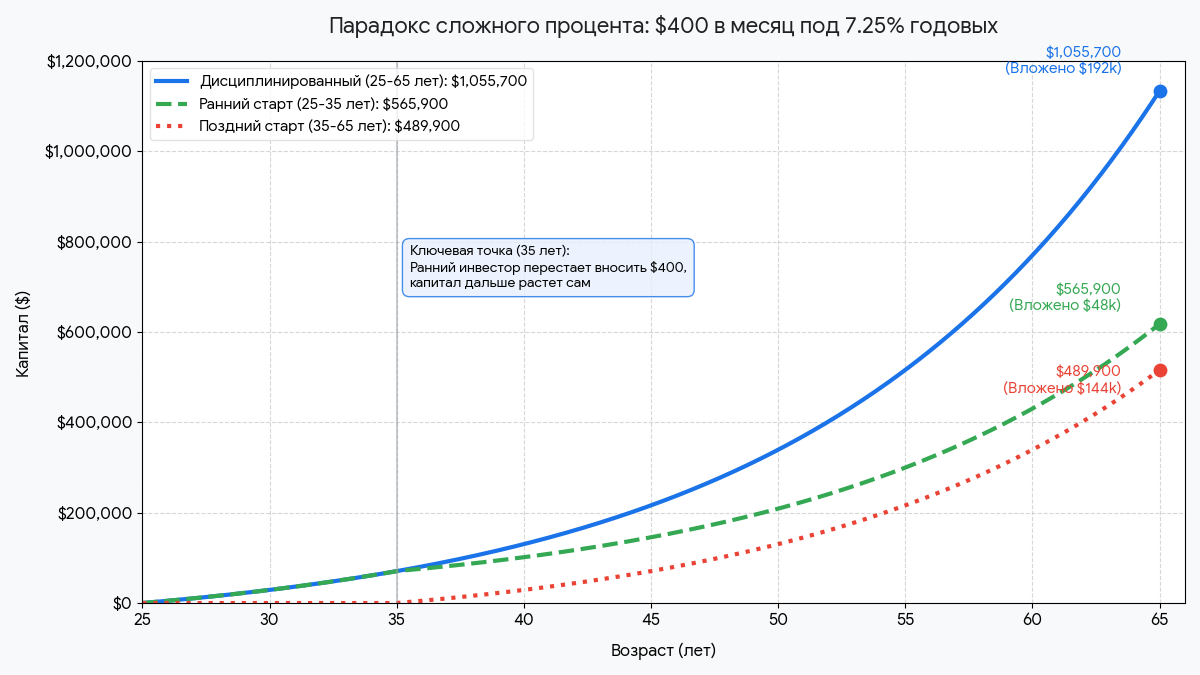
Recently, I came across one of the most revealing charts from the field of personal finance. At first glance, it seems like a logical mistake: a person who has invested money for only 10 years is richer at the finish line than someone who has continuously invested for 30 years in a row and invested three times as much.
As an analyst and product manager, it became interesting for me to translate this financial mathematics into the language of IT, career and product creation. Let's look first at the numbers, and then at why the same principle ruins the usual business strategies.
What is the essence of the experiment?
Imagine two people with the same income who decided to save $400 per month at 7.25% per annum (real return adjusted for inflation):
- Investor A ("Early Start"): Starts at age 25 and puts aside $400/month for only 10 years (up to 35 years). In total, he invested $48,000 and never replenished the account again. By the age of 65, he had $565,900 in his account.
- Investor B ("Late Start"): Starts only at age 35, but consistently saves $400/month for all 30 years in a row (up to age 65). In total, he invested $144,000. By the age of 65, his capital was only $489,900.
Bottom line: The early investor invested 3 times less personal money, finished investing 30 years earlier, but eventually outperformed the competitor by almost $ 76,000.
(The third scenario on the chart is "Disciplined", when investments go from 25 to 65 years without interruption: with investments of $192,000, the total capital exceeds $1,055,700, where 82% of the amount is purely accumulated interest).
Product and Strategic analysis: A lesson for IT and career
This financial chart is a perfect illustration of the three fundamental laws of product development and personal effectiveness.:
- System operating time > The amount of resources injected In business, this is called First-Mover Advantage and cumulative network effect. A simple product or skill launched today and systematically improving by 7% per year will break the gigantic budgets of a competitor who started later with millions of dollars and a large team in 10 years.
- The Cost of Delay Every year in the "I'll start doing a project / blog / show up later when I get another diploma" mode costs a lot of resources at a distance. In our example, 10 years of waiting at the start "costs" more than $500,000 in lost capital.
- A compound interest in knowledge and personal publicity We often wait for the "perfect moment" and more resources to make a breakthrough. But exponential growth only works where there is a long distance. Expertise and a personal brand develop in the same way: regular small actions have a multiplier effect after a few years.
The length of the distance and the starting point always decide more than the amount of starting resource or one-time labor feats "to wear out".
Start launching your "compound interest" in finance, products, and public expertise right now, even if the starting resource seems modest.
How do you feel about this concept? What is the main point of investment for you now, remote work or one-time spurts?
Недавно мне попался один из самых показательных графиков из сферы личных финансов. На первый взгляд он кажется логической ошибкой: человек, который вкладывал деньги всего 10 лет, на финише оказывает богаче того, кто непрерывно инвестировал 30 лет подряд и вложил в три раза больше.
Как аналитику и продуктовому менеджеру, мне стало интересно переложить эту финансовую математику на язык IT, карьеры и создания продуктов. Посмотрим сначала на цифры, а затем на то, почему этот же принцип рушит привычные стратегии в бизнесе.
В чем суть эксперимента?
Представьте двух людей с одинаковым доходом, которые решили откладывать по 400 долл. США в месяц под 7.25% годовых (реальная доходность с поправкой на инфляцию):
- Инвестор A («Ранний старт»): Начинает в 25 лет и откладывает по 400 долл. США/мес всего 10 лет (до 35 лет). Суммарно он вложил 48 000 долл. США и больше никогда не пополнял счет. К 65 годам на его счету - 565 900 долл. США.
- Инвестор B («Поздний старт»): Начинает только в 35 лет, но дисциплинированно откладывает по 400 долл. США/мес все 30 лет подряд (до 65 лет). Суммарно он вложил 144 000 долл. США. К 65 годам его капитал — всего 489 900 долл. США.
Ранний инвестор вложил в 3 раза меньше личных денег, закончил инвестировать на 30 лет раньше, но в итоге опередил конкурента почти на 76 000 долл. США.
Продуктовый и стратегический разбор: Урок для IT и карьеры
Этот финансовый график - идеальная иллюстрация трех фундаментальных законов продуктовой разработки и личной эффективности:
- Время работы системы > Объем влитых ресурсов В бизнесе это называют First-Mover Advantage и накопительным сетевым эффектом. Простой продукт или навык, запущенный сегодня и системно улучшающийся на 7% в год, через 10 лет разобьет гигантские бюджеты конкурента, который стартовал позже с миллионами долларов и большой командой.
- Цена промедления (Cost of Delay) Каждый год в режиме «начну делать проект / вести блог / проявляться позже, когда получу еще один диплом» стоит колоссальных ресурсов на дистанции. 10 лет ожидания на старте в нашем примере «стоят» более 500 000 долл. США упущенного капитала.
- Сложный процент в знаниях и личной публичности Мы часто ждем «идеального момента» и больших ресурсов для рывка. Но экспоненциальный рост работает только там, где есть длинная дистанция. Экспертиза и личный бренд развиваются точно так же: регулярные небольшие действия дают мультипликативный эффект через несколько лет.
Длина дистанции и точка старта всегда решают больше, чем объём стартового ресурса или разовые трудовые подвиги «на износ».
Начните запускать ваш «сложный процент» в финансах, продуктах и публичной экспертизе прямо сейчас, даже если стартовый ресурс кажется скромным.
А как вы относитесь к этой концепции? Что для вас сейчас является главной точкой инвестиций, работа на дистанцию или разовые рывки?

 Share