
The post has been translated automatically. Original language: Russian





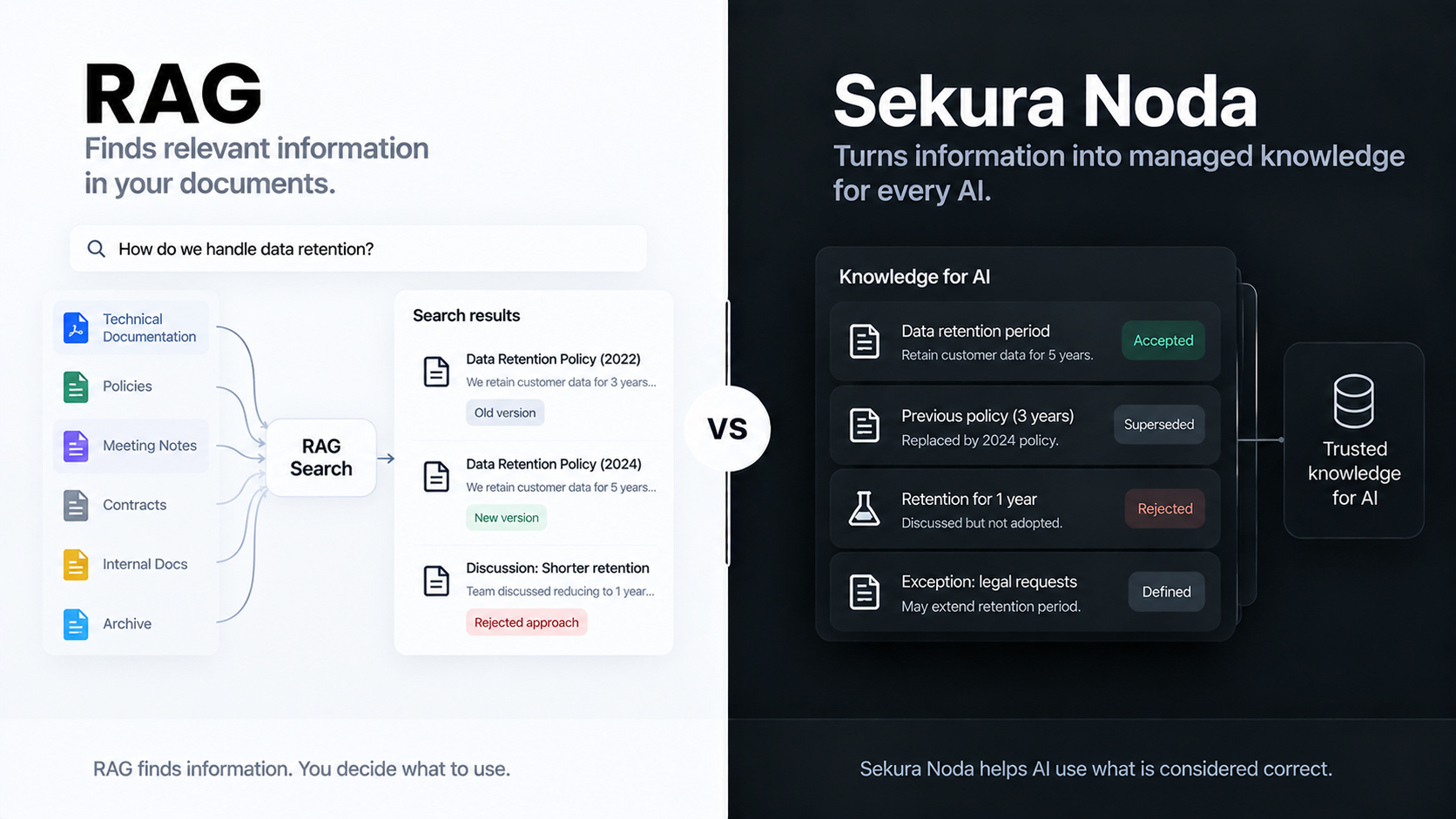
RAG finds the desired fragment well. But the found fragment does not necessarily contain the correct solution.
The RAG approach allows AI to search for information in an external set of documents and use the found materials when forming a response.
This is useful when there is too much data for a single query.:
- Technical documentation;
- Instructions;
- contracts;
- internal documents;
- archive of solutions;
- a large database of materials.
The main task here is to find the most appropriate context.
But let's imagine that the search found three documents at once:
- The old rule;
- new instructions;
- the protocol where the option was discussed, which was later rejected.
In terms of meaning, all three relate to the question.
Therefore, a good search can honestly return them all.
And then the problem begins.:
which document should the AI consider correct?
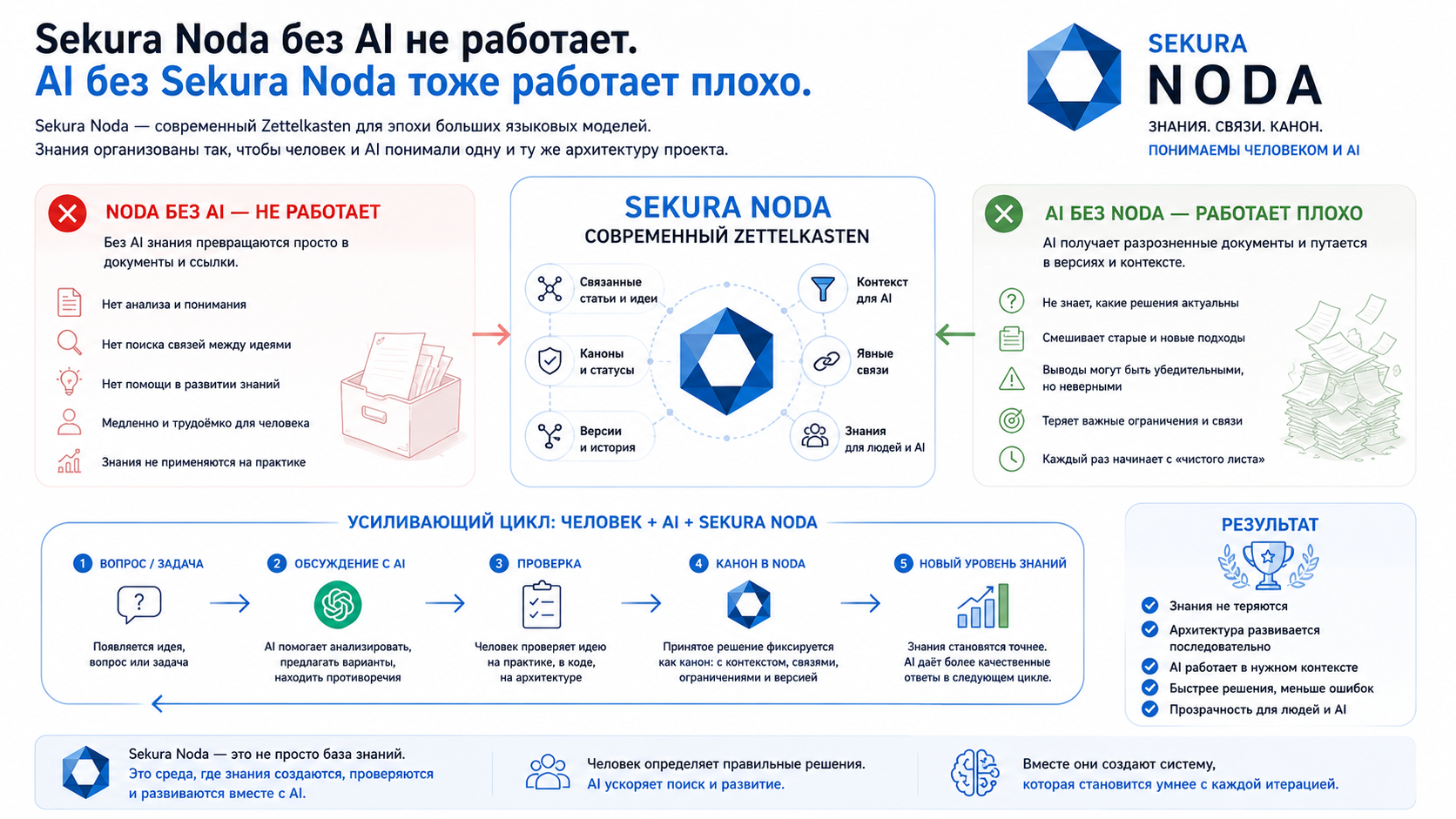
Sekura Noda solves another level of problem
In Sekura Noda, not only the text of knowledge is important, but also its state.
You can explicitly fix:
it has been accepted; it has been rejected; it is still a hypothesis; this solution has been replaced by a new one.
Therefore, the task is not only to find similar material.
It is important to determine in advance which knowledge is allowed to control the work of AI.
RAG helps to answer:
What kind of material is relevant to this issue?
Sekura Noda answers another question:
Which of the found knowledge is considered valid?
Where is RAG better
When you need to search for facts and fragments in a large array of documents.
This is a strong and practical approach for searching through archives, reference materials, and documentation.
Where is Sekura Noda better
When it's not enough to just find information.
When the status of the solution, exceptions, rejected options, and changes in professional approach are important.
These approaches can be used together.
RAG can find materials.
Sekura Noda is to determine which professional conclusions from them are considered valid.
RAG finds knowledge. Sekura Noda defines what AI should trust.
RAG хорошо находит нужный фрагмент. Но найденный фрагмент не обязательно содержит правильное решение.
Подход RAG позволяет ИИ искать информацию во внешнем наборе документов и использовать найденные материалы при формировании ответа.
Это полезно, когда данных слишком много для одного запроса:
- техническая документация;
- инструкции;
- договоры;
- внутренние документы;
- архив решений;
- большая база материалов.
Главная задача здесь — найти наиболее подходящий контекст.
Но представим, что поиск нашёл сразу три документа:
- старое правило;
- новую инструкцию;
- протокол, где обсуждался вариант, который позже отклонили.
По смыслу все три относятся к вопросу.
Поэтому хороший поиск может честно вернуть их все.
И тут начинается проблема:
какой документ ИИ должен считать правильным?
Sekura Noda решает другой уровень задачи
В Sekura Noda важен не только текст знания, но и его состояние.
Можно явно зафиксировать:
это принято;это отклонено;это пока гипотеза;это решение заменено новым.
Поэтому задача состоит не только в том, чтобы найти похожий материал.
Важно заранее определить, какому знанию разрешено управлять работой ИИ.
RAG помогает ответить:
Какой материал относится к этому вопросу?
Sekura Noda отвечает на другой вопрос:
Какое из найденных знаний считается действующим?
Где RAG лучше
Когда нужно искать факты и фрагменты в большом массиве документов.
Для поиска по архивам, справочным материалам и документации это сильный и практичный подход.
Где Sekura Noda лучше
Когда недостаточно просто найти информацию.
Когда важны статус решения, исключения, отклонённые варианты и изменения профессионального подхода.
Эти подходы могут использоваться вместе.
RAG может находить материалы.
Sekura Noda — определять, какие профессиональные выводы из них считаются действующими.
RAG находит знание. Sekura Noda определяет, чему ИИ должен доверять.

 Share