
The post has been translated automatically. Original language: Russian





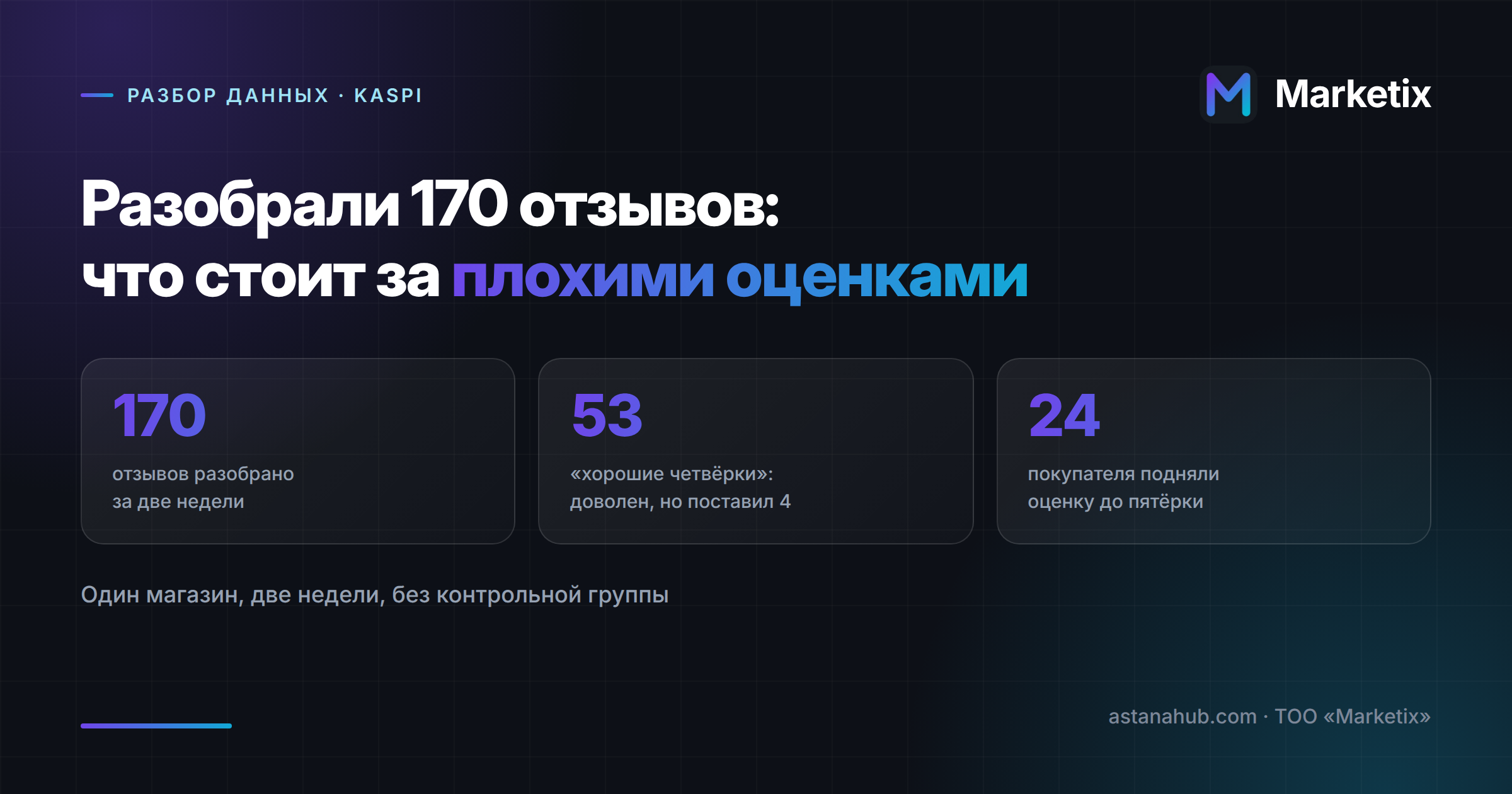
Sellers on Kaspi usually react to a bad review in the same way: they saw the rating, apologized, and offered a refund. We decided to check how much this fits into the real reason, and for two weeks we analyzed the reviews of one store by content, not by stars. There were 170 analyses and several conclusions that change the order of actions.
As considered
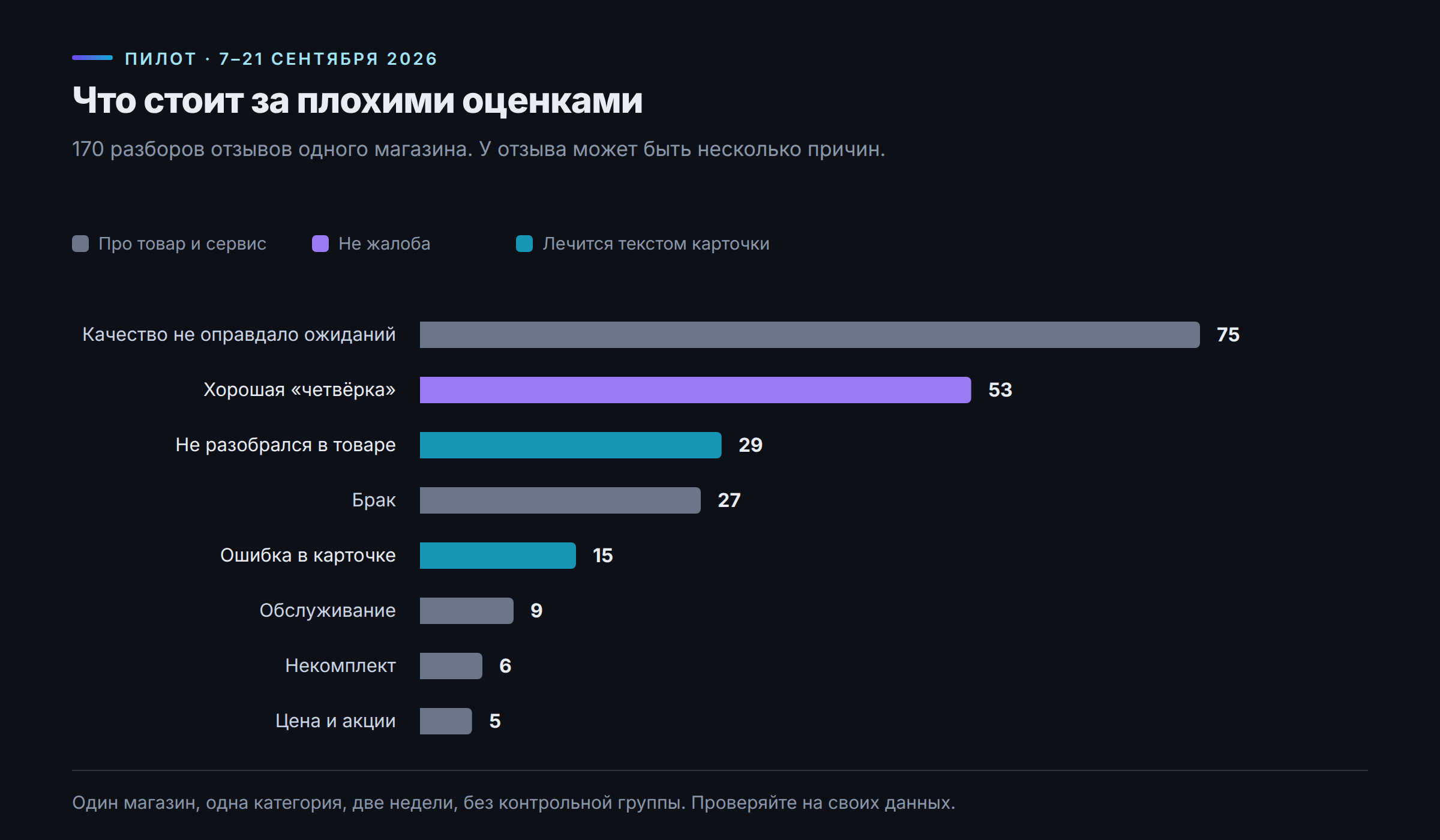
The period is from September 7 to September 21, 2026, one store on Kaspi, 170 reviews. Each review was marked up for a reason: what exactly did not suit the buyer. There may be several reasons for one review, so the total by category is more than 170.
There are reservations right away, without which the numbers below should not be read.: This is one store, one product category, and two weeks. There was no control group. Consider this not a market research, but a reason to calculate the same thing for yourself — the technique is simple and is reproduced manually on a sample of a hundred reviews.
Distribution of causes
- The quality did not meet expectations — 75 mentions
- "Good four" (the buyer is satisfied, but put 4) — 53
- I did not understand the product — 29
- Marriage — 27
- Error in the card — 15
- Maintenance — 9
- Incomplete — 6
- Price and shares — 5
Then the fun begins
Finding 1. One third of "bad" grades are not a complaint at all
53 parsing out of 170 is a "good four": the buyer is satisfied with the text, there are no complaints, and the rating is 4. The reasons are different: someone puts 5 only for something outstanding, someone presses without looking, someone considers a four a polite assessment.
For a seller, this is a fundamentally different situation than a marriage. Responding to such a review with an apology and an offer of a refund means looking weird. But the short "thank you, tell me what was missing before the top five" works, and below you can see how much.
Finding 2. 44 mentions are treated with text, not money
Add up "I didn't figure out the product" (29) and "error in the card" (15) — you get 44 mentions where the problem is not in the product or delivery, but in the information. The buyer did not understand how to use it; he did not expect what was written; the description on the card did not match reality.
This is the cheapest category to fix and the most offensive for those who ignore it: it costs money to refund every time, and editing the description only once. At the same time, such reviews in reports are indistinguishable from quality complaints: both have low ratings.
A practical move: once a month, upload reviews with a rating of 1-3 for top products and see how many of them are removed by a paragraph in the description. This is usually seen in one evening.
Finding 3. Contact with the buyer changes the assessment — but not any
24 customers out of 170 reviewed reviews raised their rating to five after they were contacted. It's more interesting how these 24 were distributed.:
- 4 → 5: 18 cases
- 3 → 5: 4 cases
- 1 → 5: 2 cases
Three quarters of all changes occurred in the fours. The conclusion is unpleasant for intuition: efforts are usually thrown at ones and twos, which are the loudest, but it is fours that convert best, where the buyer is already satisfied and needs one short contact.
This does not mean that units can be ignored.: there may be a marriage that is worth sorting out for the sake of the product, not for the sake of evaluation. But if the resource is limited and the manager manages to process ten reviews a day, you should start not from the top of the list in terms of volume, but from the top four.
What can you take away from this
- Mark up reviews based on a reason, not just a rating. Eight categories are enough, hand-marking on a hundred reviews takes a couple of hours.
- Separate the "good four" from the complaints. These are different processes and different response texts.
- Calculate the proportion of causes that are treated by the product description. This is your cheapest backup.
- Contact the authors of the fours and see the conversion to the top five in two weeks. This is the only way to check the numbers above on your data.
- Don't count the number of reviews that have been answered, but the number of ratings that have been changed. The first is the activity, the second is the result.
What we haven't checked
There was no control group, so we cannot say that some of the buyers would not have raised the rating themselves. ""There is one category, and the distribution of reasons in other categories is probably different: in electronics, the proportion of "did not understand the product" is higher, in clothing, the proportion of "did not meet expectations." And two weeks is a short time: seasonality in such data is not visible at all.
If you have a similar sample in your category, it will be interesting to compare the distribution of causes. We suspect that the proportion of "good fours" will turn out to be stable, but everything else will disperse strongly.
Продавцы на Kaspi обычно реагируют на плохой отзыв одинаково: увидели оценку, извинились, предложили возврат. Мы решили проверить, насколько это попадает в реальную причину, и две недели разбирали отзывы одного магазина по содержанию, а не по звёздам. Получилось 170 разборов и несколько выводов, которые меняют порядок действий.
Как считали
Период — с 7 по 21 сентября 2026 года, один магазин на Kaspi, 170 отзывов. Каждый отзыв размечался по причине: что именно не устроило покупателя. У одного отзыва может быть несколько причин, поэтому сумма по категориям больше 170.
Сразу оговорки, без которых цифры ниже читать не стоит: это один магазин, одна товарная категория и две недели. Контрольной группы не было. Считайте это не исследованием рынка, а поводом посчитать то же самое у себя — методика простая и воспроизводится вручную на выборке в сотню отзывов.
Распределение причин
- Качество не оправдало ожиданий — 75 упоминаний
- «Хорошая четвёрка» (покупатель доволен, но поставил 4) — 53
- Не разобрался в товаре — 29
- Брак — 27
- Ошибка в карточке — 15
- Обслуживание — 9
- Некомплект — 6
- Цена и акции — 5
Дальше начинается интересное
Находка 1. Треть «плохих» оценок — вообще не жалоба
53 разбора из 170 — это «хорошая четвёрка»: в тексте покупатель доволен, претензий нет, а оценка стоит 4. Причины бывают разные: кто-то ставит 5 только за что-то выдающееся, кто-то жмёт не глядя, кто-то считает четвёрку вежливой оценкой.
Для продавца это принципиально другая ситуация, чем брак. Отвечать на такой отзыв извинением и предложением возврата — значит выглядеть странно. А вот короткое «спасибо, подскажите, чего не хватило до пятёрки» работает, и ниже видно, насколько.
Находка 2. 44 упоминания лечатся текстом, а не деньгами
Сложите «не разобрался в товаре» (29) и «ошибка в карточке» (15) — получится 44 упоминания, где проблема не в товаре и не в доставке, а в информации. Покупатель не понял, как пользоваться; ожидал не то, что написано; характеристика в карточке не совпала с реальностью.
Это самая дешёвая категория для исправления и самая обидная для тех, кто её игнорирует: возврат стоит денег каждый раз, а правка описания — один раз. При этом в отчётах такие отзывы неотличимы от жалоб на качество: и там, и там стоит низкая оценка.
Практический ход: раз в месяц выгружать отзывы с оценкой 1–3 по топовым товарам и смотреть, сколько из них снимается абзацем в описании. Обычно это видно за один вечер.
Находка 3. Контакт с покупателем меняет оценку — но не любой
24 покупателя из 170 разобранных отзывов подняли оценку до пятёрки после того, как с ними связались. Интереснее, как эти 24 распределились:
- 4 → 5: 18 случаев
- 3 → 5: 4 случая
- 1 → 5: 2 случая
Три четверти всех изменений пришлись на четвёрки. Вывод неприятный для интуиции: усилия обычно бросают на единицы и двойки — там громче всего, — но конвертируются лучше всего именно четвёрки, где покупатель и так доволен и ему нужен один короткий контакт.
Это не значит, что единицы можно игнорировать: там может быть брак, который стоит разобрать ради товара, а не ради оценки. Но если ресурс ограничен и менеджер успевает обработать десять отзывов в день, начинать стоит не сверху списка по громкости, а с четвёрок.
Что из этого можно забрать себе
- Размечайте отзывы по причине, а не только по оценке. Восьми категорий хватает, разметка руками на сотне отзывов занимает пару часов.
- Отделите «хорошие четвёрки» от жалоб. Это разные процессы и разные тексты ответов.
- Посчитайте долю причин, которые лечатся описанием товара. Это ваш самый дешёвый резерв.
- Свяжитесь с авторами четвёрок и посмотрите конверсию в пятёрку за две недели. Это единственный способ проверить цифры выше на своих данных.
- Считайте не количество отвеченных отзывов, а количество изменённых оценок. Первое — активность, второе — результат.
Чего мы не проверили
Контрольной группы не было, поэтому мы не можем утверждать, что часть покупателей не подняла бы оценку сама. Категория одна, и в других категориях распределение причин наверняка другое: в электронике доля «не разобрался в товаре» выше, в одежде — доля «не оправдало ожиданий». И две недели — короткий срок: сезонность в таких данных не видна совсем.
Если у вас есть похожая выборка по своей категории — будет интересно сравнить распределение причин. Подозреваем, что доля «хороших четвёрок» окажется устойчивой величиной, а вот всё остальное разойдётся сильно.

 Share