
The post has been translated automatically. Original language: Russian



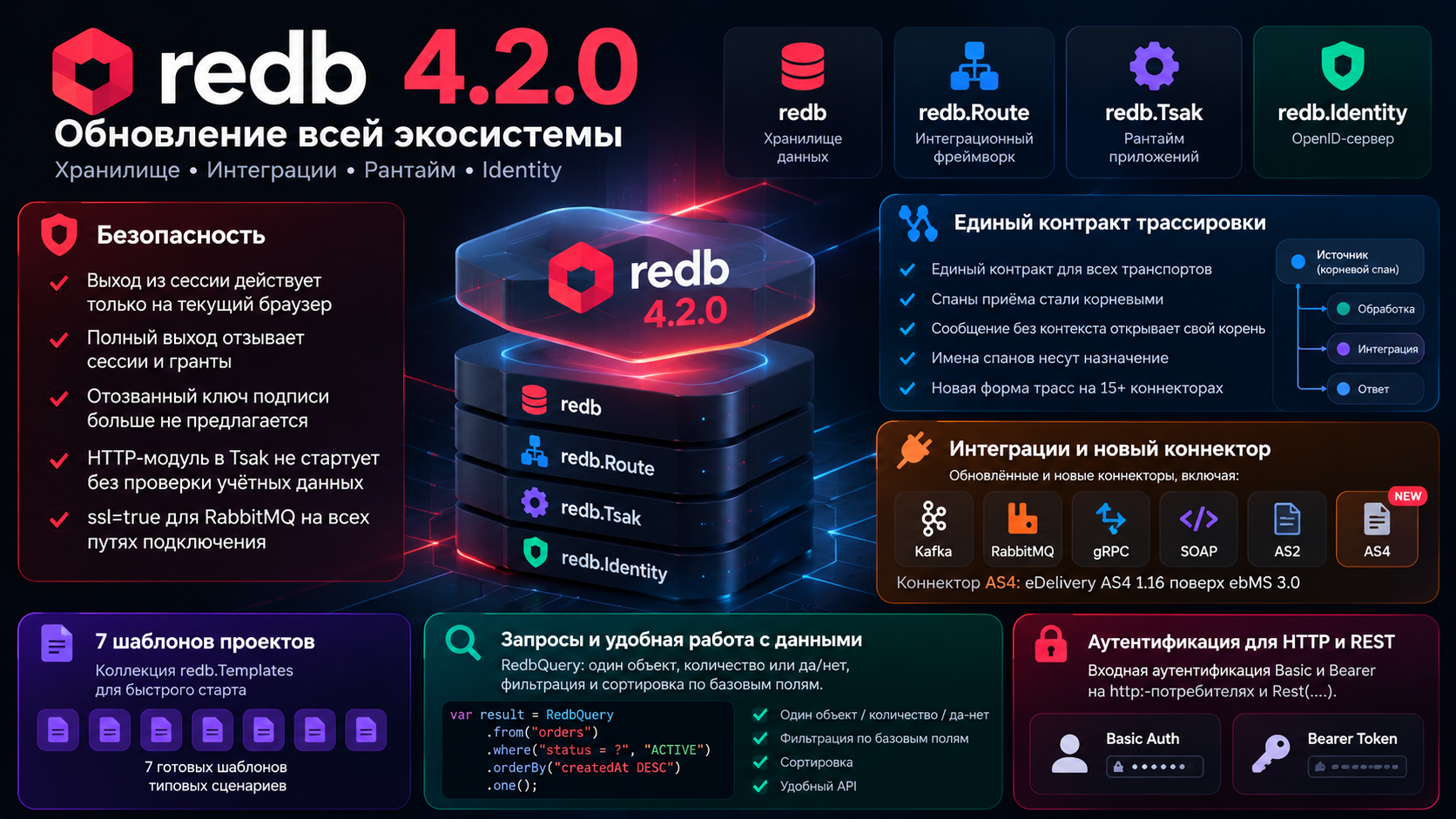
The redb ecosystem has released version 4.2.0, which simultaneously affected several key components of the platform.The redb repository and the redb integration framework have received an update.Route, redb runtime.Tsak and the redb OpenID server.Identity.One of the main directions of the release was the changes related to security.In redb.The Identity logout mechanism now only works with the session of the browser from which the request is being made.The userId parameter can no longer be used to select another user to be logged out.When fully logged out, the system revokes not only user sessions, but also related grants.The logic of working with signature keys has also been changed: the revoked key is no longer offered to other participants, regardless of the order of its registration.In redb.The Tsak module with HTTP login now does not start if no one has configured credential verification for it.In redb.The Route ssl=true parameter for RabbitMQ is now taken into account on all connection options, including named factories.Significant changes in version 4.2.0 also affected the tracing system.
The trace is now described by a single contract in the kernel, which must be followed by all supported transports.The message receiving spans have become rooted, which changes the structure of the generated routes.If an incoming message does not contain a trace context, its own root span is created for it.The span names now contain information about the purpose of the operation, which makes the tracks more informative when analyzing.The changes affect about one and a half dozen connectors, including Kafka, RabbitMQ, gRPC, SOAP, AS2 and the new AS4. Another change was the limitation of the seda: and vm: queues to a thousand elements by default, similar to the behavior of Apache Camel.The typed reading of the headers and body of the message now fails if it is impossible to convert the value instead of imperceptibly returning the default value.A separate AS4 connector has appeared among the new release features.It implements eDelivery AS4 1.16 on top of EBMs 3.0 and complements the already existing AS2 support.The redb collection has also appeared.Templates, which contains seven project templates for quick launch of typical scenarios.
For HTTP consumers and Rest constructs(...) Input authentication using Basic and Bearer has been added. RedbQuery can now return a single object, a number of records, or a yes/no boolean value, as well as filter and sort data by basic fields.Thus, version 4.2.0 combines changes in security, integrations, diagnostics, and tools to launch new projects.When updating existing solutions, it is especially important for developers to take into account the new tracing contract, queue constraints, and the changed behavior of typed reads.You can start exploring the platform through Quick Start, and the full list of changes and links to individual releases is published in the description of redb 4.2.0.
В экосистеме redb вышла версия 4.2.0, которая одновременно затронула сразу несколько ключевых компонентов платформы.Обновление получили хранилище redb, интеграционный фреймворк redb.Route, рантайм redb.Tsak и OpenID-сервер redb.Identity.Одним из основных направлений релиза стали изменения, связанные с безопасностью.В redb.Identity механизм выхода из системы теперь работает только с сессией браузера, из которого выполняется запрос.Параметр userId больше нельзя использовать для выбора другого пользователя, которого необходимо разлогинить.При полном выходе система отзывает не только пользовательские сессии, но и связанные с ними гранты.Также изменена логика работы с ключами подписи: отозванный ключ больше не предлагается другим участникам независимо от порядка его регистрации.В redb.Tsak модуль с HTTP-входом теперь не запускается, если для него никто не настроил проверку учётных данных.В redb.Route параметр ssl=true для RabbitMQ теперь учитывается на всех вариантах подключения, включая именованные фабрики.Существенные изменения в версии 4.2.0 коснулись и системы трассировки.
Теперь трассировка описывается единым контрактом в ядре, которому должны следовать все поддерживаемые транспорты.Спаны приёма сообщений стали корневыми, что меняет структуру формируемых трасс.Если входящее сообщение не содержит контекста трассировки, для него создаётся собственный корневой спан.Имена спанов теперь содержат информацию о назначении операции, что делает трассы более информативными при анализе.Изменения затрагивают около полутора десятков коннекторов, включая Kafka, RabbitMQ, gRPC, SOAP, AS2 и новый AS4.Ещё одним изменением стало ограничение очередей seda: и vm: значением в тысячу элементов по умолчанию, аналогично поведению Apache Camel.Типизированное чтение заголовков и тела сообщения теперь завершается ошибкой при невозможности преобразовать значение вместо незаметного возврата значения по умолчанию.Среди новых возможностей релиза появился отдельный коннектор AS4.Он реализует eDelivery AS4 1.16 поверх ebMS 3.0 и дополняет уже существующую поддержку AS2.Также появилась коллекция redb.Templates, содержащая семь шаблонов проектов для быстрого запуска типовых сценариев.
Для HTTP-потребителей и конструкций Rest(...) добавлена входная аутентификация с использованием Basic и Bearer.RedbQuery теперь может возвращать один объект, количество записей или логическое значение «да/нет», а также фильтровать и сортировать данные по базовым полям.Таким образом, версия 4.2.0 объединяет изменения в безопасности, интеграциях, диагностике и инструментах для запуска новых проектов.При обновлении существующих решений разработчикам особенно важно учитывать новый контракт трассировки, ограничения очередей и изменившееся поведение типизированного чтения.Начать знакомство с платформой можно через Quick Start, а полный перечень изменений и ссылок на отдельные релизы опубликован в описании redb 4.2.0.

 Share