
The post has been translated automatically. Original language: Russian




In the comments to the post about the transfer of the forecast to the agent, one of the readers wrote an exact thing: the system should not only form a plan, but also "check the accuracy of the forecast itself after the fact of the day." This is a correct remark, and it points to a hole in the methodology that I didn't write about: an agent who calculates a forecast every day but never checks it against the fact is a system that can quietly degrade for months without anyone noticing.
Why is a forecast without self—verification a risk rather than a ready-made solution?
The technique (moving average + three corrections + 70/30 rule) gives 85-90% accuracy at the moment when you set it up. But demand is changing: a new corporate client arrives, the season changes, and a competitor opens next door. The moving average adjusts slowly and with a lag. If no one checks the forecast against the fact, the accuracy can drop to 60% in two months — and the chef and the owner continue to trust the figure, because "the agent thinks the same." An error without feedback is not a one—time failure, it is a system that systematically lies and no one knows about it.
What an agent should do — Step 5
1. Every day (or the next morning, along with a new forecast), the agent compares yesterday's forecast with the actual sales for each of the 7 categories.
2. Counts the deviation for each category — for example, |fact − forecast| / fact — and stores the history of deviations, not just the sales history.
"3". If the deviation in one category is systematic (for example, 3 consecutive days above ± 15%), the agent does not remain silent and does not "digest" this into a moving average — he explicitly marks the category and names the probable reason ("demand is growing faster than the average of 8 weeks has time to adjust").
4. Once a week, he sends a summary of accuracy in all 7 categories — not to control the cook, but so that the owner or the operating room can see where the technique is "going blind" and when it's time to review the amendments, rather than the technique itself manually once a year.
Example in numbers: "Loaf"
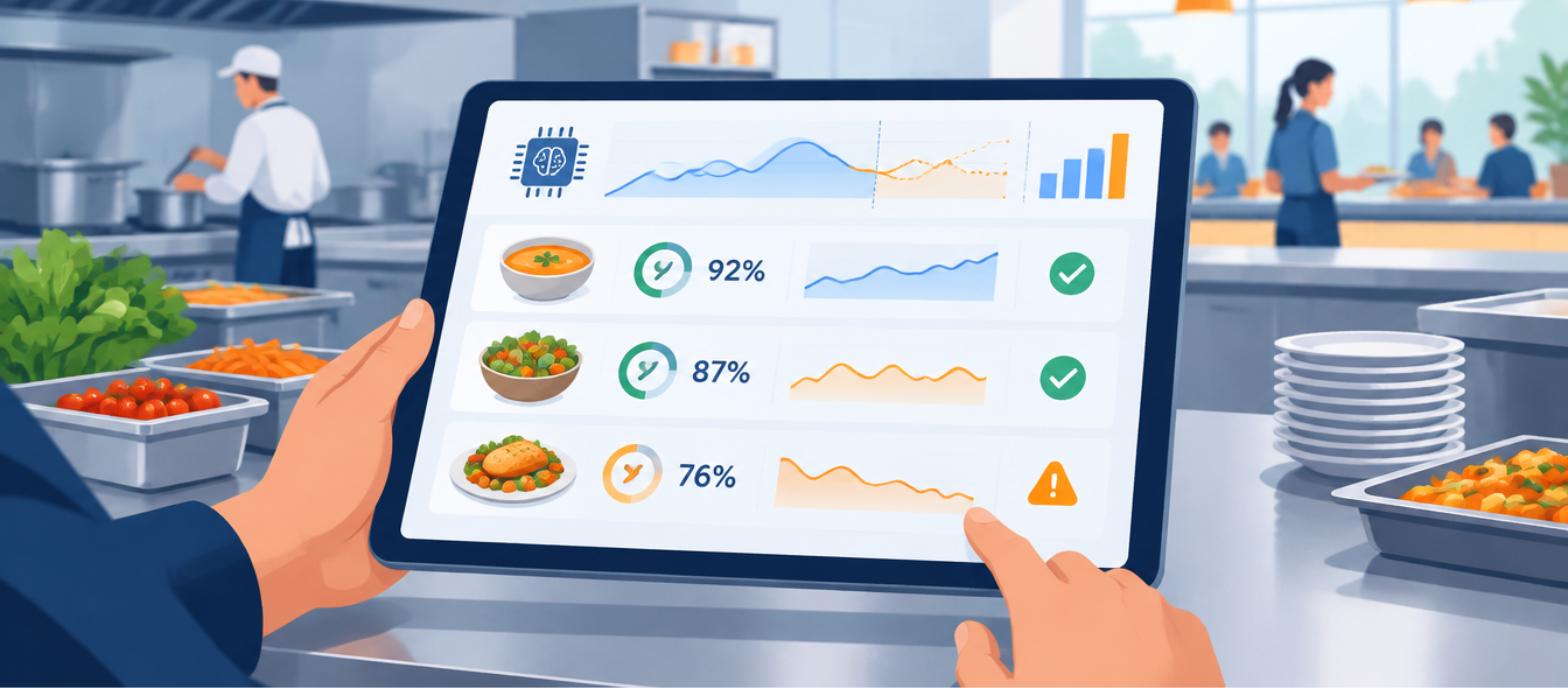
With a flow of ~400 servings/day, the average accuracy of the method is kept at 87%. But it is heterogeneous by category: soups — 92% (stable demand, easy to predict), hot dishes with meat — 81% (sensitive to one-time corporate events), salads — 89%. Without categorization, only the average figure of 87% is visible, which masks the fact that one category is performing poorly. With step 5, this is immediately visible — and it is adjusted point-by-point, rather than "by eye" across the entire ruler.
The main conclusion
"Forecasting" without ""self—checking" is a system that can work "roughly" for years, and no one will know that "approximately" it has become "bad" until it results in write-offs or a deficit. "The difference"between "we have an agent who calculates the forecast" and "we have a system that knows when it starts to make mistakes" is the difference between automation and reliable automation.
Who in the canteen or in production is already monitoring not only the forecast itself, but also its accuracy in fact — what did they stumble upon during implementation?
В комментариях к посту про перевод прогноза в агента один из читателей написал точную вещь: система должна не только формировать план, но и «сама проверять точность прогноза по факту дня». Это правильное замечание, и оно указывает на дыру в методике, о которой я не писал: агент, который считает прогноз каждый день, но никогда не сверяет его с фактом — это система, которая может тихо деградировать месяцами, и никто этого не заметит.
Почему прогноз без самопроверки — это риск, а не готовое решение
Методика (скользящее среднее + три поправки + правило 70/30) даёт 85–90% точности в момент, когда вы её настроили. Но спрос меняется: приходит новый корпоративный клиент, меняется сезон, конкурент открывается по соседству. Скользящее среднее подстраивается медленно и с лагом. Если никто не сверяет прогноз с фактом, точность может упасть до 60% за два месяца — а шеф-повар и владелец продолжают доверять цифре, потому что «агент же считает». Ошибка без обратной связи — это не разовый сбой, это система, которая систематически ошибается, и никто об этом не знает.
Что должен делать агент — шаг 5
1. Каждый день (или на следующее утро вместе с новым прогнозом) агент сравнивает вчерашний прогноз с фактическими продажами по каждой из 7 категорий.
2. Считает отклонение по каждой категории — например, |факт − прогноз| / факт — и хранит историю отклонений, а не только историю продаж.
3. Если отклонение по одной категории систематическое (например, 3 дня подряд выше ±15%), агент не молчит и не «переваривает» это в скользящее среднее — он явно помечает категорию и называет вероятную причину («спрос растёт быстрее, чем успевает подстроиться среднее за 8 недель»).
4. Раз в неделю присылает сводку точности по всем 7 категориям — не для контроля повара, а чтобы владелец или операционный видел, где методика «слепнет», и когда пора пересматривать поправки, а не саму методику раз в год вручную.
Пример на цифрах: «Каравай»
При потоке ~400 порций/день средняя точность по методике держится на уровне 87%. Но по категориям она неоднородна: супы — 92% (стабильный спрос, легко предсказать), горячее с мясом — 81% (чувствительно к разовым корпоративам), салаты — 89%. Без разбивки по категориям видна только средняя цифра 87%, которая маскирует то, что одна категория работает плохо. С шагом 5 это видно сразу — и корректируется точечно, а не «на глаз» по всей линейке.
Главный вывод
Прогноз без самопроверки — это система, которая может годами работать «примерно», и никто не узнает, что «примерно» стало «плохо», пока это не выльется в списания или дефицит. Разница между «у нас есть агент, который считает прогноз» и «у нас есть система, которая знает, когда сама начинает ошибаться» — это разница между автоматизацией и надёжной автоматизацией.
У кого в столовой или на производстве уже отслеживают не только сам прогноз, но и его точность по факту — на чём споткнулись при внедрении?
 Share