
The post has been translated automatically. Original language: Russian




About seven years ago, I read Lee Kuan Yew's famous autobiography "From the Third World to the First." The book made a strong impression on me at the time, but the most interesting thing began later, when I began to notice its traces in our real lives.
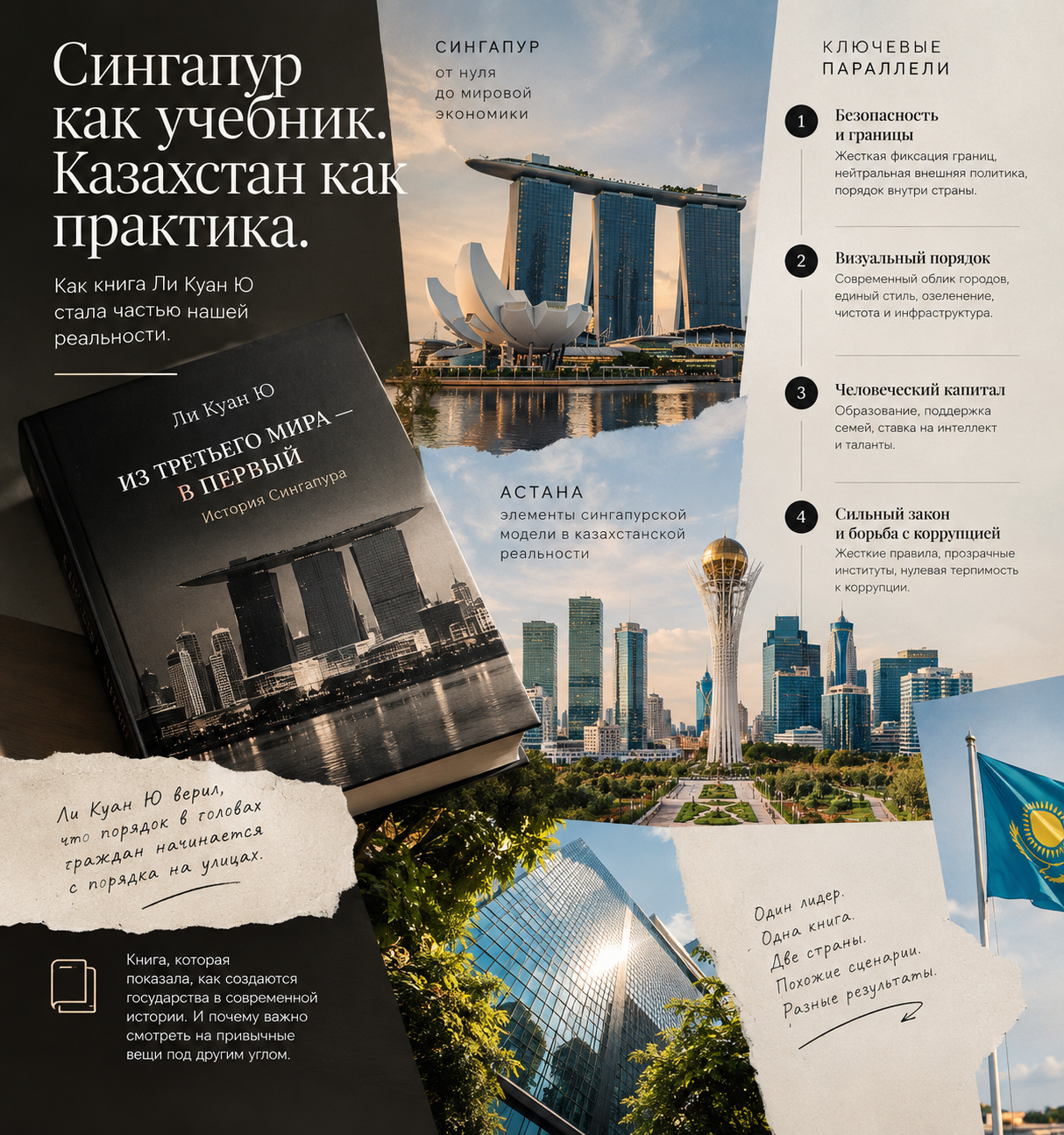
If you look into the logic of Kazakhstan's development in the 90s and 2000s, you get the feeling that Nazarbayev read this book as a step-by-step guide. Moreover, everything was copied, from large-scale geopolitical steps to amazing small details of the urban environment.
Base first: security and borders
Lee Kuan Yew started Singapore in conditions of absolute vulnerability. There weren't the friendliest neighbors around, and there was a zero economy inside. What is the first thing he does? It rigidly fixes borders, builds a neutral but pragmatic foreign policy, and puts internal institutions in order so that the state does not simply collapse.
We repeated this scenario one-on-one. Remember the early years of independence: the demarcation of the vast border with China and its neighbors, the abandonment of the nuclear arsenal in exchange for security guarantees, and the building of that very multi-vector approach. The first priority was to outline the outline and negotiate with all the major players while the country gets back on its feet.
Even architecture: visual order
There are interesting points in the book about how Lee Kuan Yew paid attention to the appearance of the city. He believed that order in the minds of citizens begins with order in the streets. Singapore was carefully trimmed, landscaped, eliminated from chaotic buildings and brought to a single visual code.
When you look at how Astana was improved, with this unified facade cladding, bringing old districts to a common style, and planting green belts around the capital, the recognizable Singaporean handwriting is visible to the naked eye. This is an attempt to create a sense of stability through the external discipline of space.
An engineering approach to society
But the most unusual thing about Lee Kuan Yew is his work with human capital. The Singaporean leader thought like a tough pragmatist. Noticing that educated women rarely marry or have fewer children, he launched government programs to encourage smart and successful people to start families and give birth to more. Special allowances and benefits were given because Singapore relied on the only available resource, the nation's intelligence.
Our emphasis on education has manifested itself through the "Bolashak" program and the creation of technological institutes, an attempt to artificially, at an accelerated pace, grow a new critical mass of managers and techies.
The difference is in the foundation
However, if the Singapore model worked to the end in Singapore, with uncompromising support for laws and burning out corruption at all levels, then in our country this experience rather lay on the external form and decorations. The model was adopted, but adapted to our realities.
Nevertheless, "From the Third World to the First" is an amazing guide to how states are created in modern history. When you read such books, you begin to look at familiar streets, urban reforms and government programs from a completely different angle.
Have you noticed how much influence Singapore has had on the development of our capital and institutions?
Лет семь назад я прочла знаменитую автобиографию Ли Куан Ю «Из третьего мира в первый». Книга тогда произвела на меня сильное впечатление, но самое интересное началось позже, когда я стала подмечать её следы в нашей реальной жизни.
Если вчитаться в логику развития Казахстана 90-х и 2000-х, создается стойкое ощущение, что Назарбаев читал эту книгу как пошаговый мануал. Причем копировалось все, от масштабных геополитических шагов до удивительных мелких деталей городской среды.
Сначала база: безопасность и границы
Ли Куан Ю начинал Сингапур в условиях абсолютной уязвимости. Вокруг были не самые дружелюбные соседи, а внутри - нулевая экономика. Что он делает первым делом? Жестко фиксирует границы, выстраивает нейтральную, но прагматичную внешнюю политику и наводит порядок во внутренних институтах, чтобы государство просто не развалилось.
У нас этот сценарий повторился один в один. Вспомните первые годы независимости: демаркация огромной границы с Китаем и соседями, отказ от ядерного арсенала в обмен на гарантии безопасности, выстраивание той самой многовекторности. Первоочередной задачей было очертить контур и договориться со всеми крупными игроками, пока страна встает на ноги.
Даже архитектура: визуальный порядок
В книге есть любопытные моменты о том, как Ли Куан Ю уделял внимание внешнему виду города. Он верил, что порядок в головах граждан начинается с порядка на улицах. Сингапур аккуратно подравнивали, озеленяли, избавляли от хаотичной застройки и приводили к единому визуальному коду.
Когда смотришь на то, как у нас благоустраивали Астану, с этой единой облицовкой фасадов, приведением старых районов к общему стилю, высаживанием зелёных поясов вокруг столицы, узнаваемый сингапурский почерк виден невооруженным глазом. Это попытка через внешнюю дисциплину пространства заложить ощущение стабильности.
Инженерный подход к обществу
Но самое необычное у Ли Куан Ю - это его работа с человеческим капиталом. Сингапурский лидер мыслил как жесткий прагматик. Заметив, что образованные женщины редко выходят замуж или рожают меньше детей, он запустил государственные программы, чтобы стимулировать умных и успешных людей создавать семьи и рожать больше. Выдавались специальные пособия и льготы, потому что Сингапур сделал ставку на единственный имеющийся ресурс - интеллект нации.
У нас ставка на образование проявилась через программу «Болашак» и создание технологических институтов, попытка искусственно, в ускоренном темпе вырастить новую критическую массу управленцев и технарей.
Разница в фундаменте
Правда, если в Сингапуре сингапурская модель сработала до конца — с бескомпромиссной поддержкой законов и выжиганием коррупции на всех уровнях, то у нас этот опыт скорее лег на внешнюю форму и декорации. Модель переняли, но адаптировали под наши реалии.
Тем не менее «Из третьего мира в первый» - это потрясающее пособие по тому, как создаются государства в современной истории. Когда читаешь такие книги, начинаешь смотреть на привычные улицы, городские реформы и государственные программы совсем под другим углом.
А вы замечали, насколько сильное влияние Сингапур оказал на развитие нашей столицы и институтов?

 Share