
The post has been translated automatically. Original language: Russian





Today, at the Startup Orda team building workshop, we discussed co-founders, roles, responsibilities, and how to get the right people around ideas in general.
And after that, there was only one question left in my head.:
Does every startup even need a cofounder?
There is a feeling that in a startup environment, a team of several founders is perceived almost as a standard.
One is responsible for the product. The second one is for technology. The third one is for sales.
It sounds logical.
But there is another way.:
one founder does not mean one person in a company.
You can be a solofounder and still build a strong team.
Hire developers, designers, and marketers. Transfer entire directions to people. Look for those who are much stronger than you in their field.
And for some reason, this approach has always been closer to me.
Over the past 6 years, there have been several attempts to build various small businesses and projects.
Something was working. Something was failing. And some ideas now come to mind with a question: "Why was that at all?" 😂
But I went through almost all of this on my own.
This is probably why business partnerships still raise more questions than the desire to urgently find a co-founder.
Shares.
Responsibility.
Who makes the final decision?
What happens if one works harder than the other?
What if the company's vision diverges in two years?
Of course, solofounder has its own list of problems, no less.
When the decision is wrong, there is no one to share responsibility with.
When everything is on fire, you can put it out too.
And if the product, team, money and deadlines are burning at the same time…
Congratulations, the firefighter position is also open.
Well, no one canceled burnout.
But past projects have taught us one thing.:
An entrepreneur is shaped not only by successful projects. Sometimes he is much more strongly shaped by failures - if he continues to create after them anyway.
This is probably why the first IT startup no longer feels like the first business at all.
The industry is new. There are a lot of terms. There are even more questions.
But mistakes, uncertainty, responsibility, and the need to constantly figure out what I didn't know yesterday are all familiar.
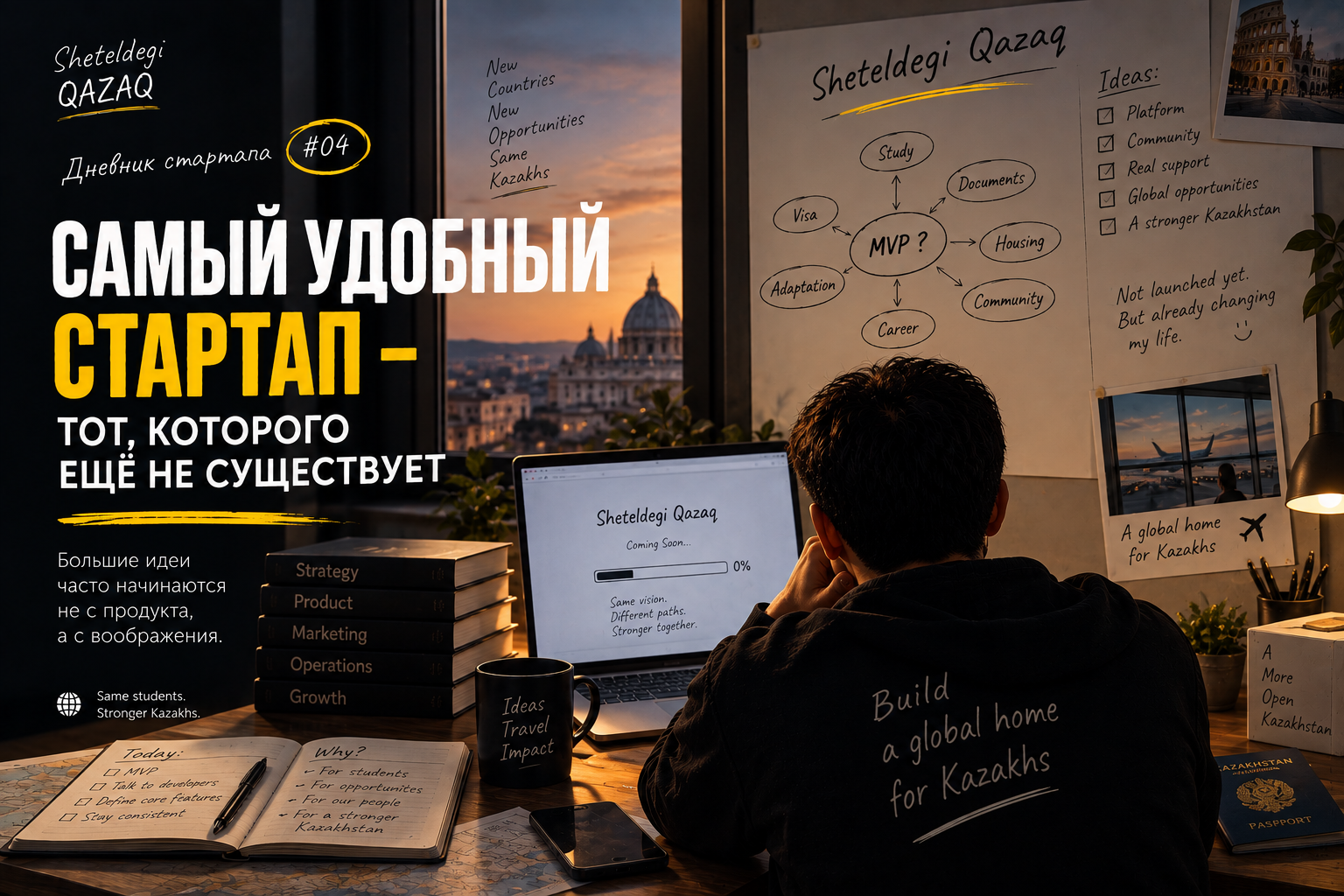
So far, the formula for Sheteldegi Qazaq looks like this:
solo founder + a strong team.
Not because it's the right way for everyone. It just seems like the most appropriate one right now.
But here it is really interesting to hear from those who have already passed on. Solofounders, what is it like in practice? What turned out to be the most difficult thing that no one warned about? And if you had to start your startup all over again today, would you go alone again or would you still be looking for a co—founder?
Сегодня на воркшопе по построению команды в Startup Orda обсуждали кофаундеров, роли, ответственность и то, как вообще собирать вокруг идеи правильных людей.
И после него в голове остался один вопрос:
А каждому стартапу вообще нужен кофаундер?
Есть ощущение, что в стартап-среде команда из нескольких основателей воспринимается почти как стандарт.
Один отвечает за продукт. Второй - за технологии. Третий - за продажи.
Звучит логично.
Но ведь существует и другой путь:
один основатель - не значит один человек в компании.
Можно быть солофаундером и при этом строить сильную команду.
Нанимать разработчиков, дизайнеров, маркетологов. Передавать людям целые направления. Искать тех, кто в своей области намного сильнее тебя.
И вот этот подход мне почему-то всегда был ближе.
За последние 6 лет было несколько попыток построить разные небольшие бизнесы и проекты.
Что-то получалось. Что-то проваливалось. А некоторые идеи сейчас вспоминаются с вопросом: «Зачем это вообще было?» 😂
Но почти весь этот путь проходил самостоятельно.
Наверное, поэтому партнёрство в бизнесе до сих пор вызывает больше вопросов, чем желание срочно найти кофаундера.
Доли.
Ответственность.
Кто принимает последнее решение?
Что происходит, если один работает больше другого?
А если через два года видение компании разойдётся?
Конечно, у солофаундерства свой список проблем ничуть не меньше.
Когда решение неправильное - ответственность не с кем разделить.
Когда всё горит - тушить тоже тебе.
А если одновременно горят продукт, команда, деньги и дедлайны…
Поздравляю, должность пожарного тоже открыта 😂
Ну и выгорание никто не отменял.
Но прошлые проекты научили одной вещи:
предпринимателя формируют не только успешные проекты. Иногда гораздо сильнее его формируют провальные - если после них он всё равно продолжает создавать.
Наверное, поэтому первый IT-стартап уже не ощущается как первый бизнес вообще.
Индустрия новая. Терминов куча. Вопросов ещё больше.
Но ошибки, неопределённость, ответственность и необходимость постоянно разбираться в том, чего вчера не знал, - всё это уже знакомо.
Пока формула для Sheteldegi Qazaq выглядит так:
solo founder + сильная команда.
Не потому что это правильный путь для всех. Просто сейчас он кажется наиболее подходящим.
А вот здесь действительно интересно услышать тех, кто уже прошёл дальше. Солофаундеры, каково это на практике? Что оказалось самым сложным из того, о чём никто не предупреждал? И если бы пришлось начинать свой стартап сегодня заново — снова пошли бы одни или всё-таки искали кофаундера?

 Share