
The post has been translated automatically. Original language: Russian




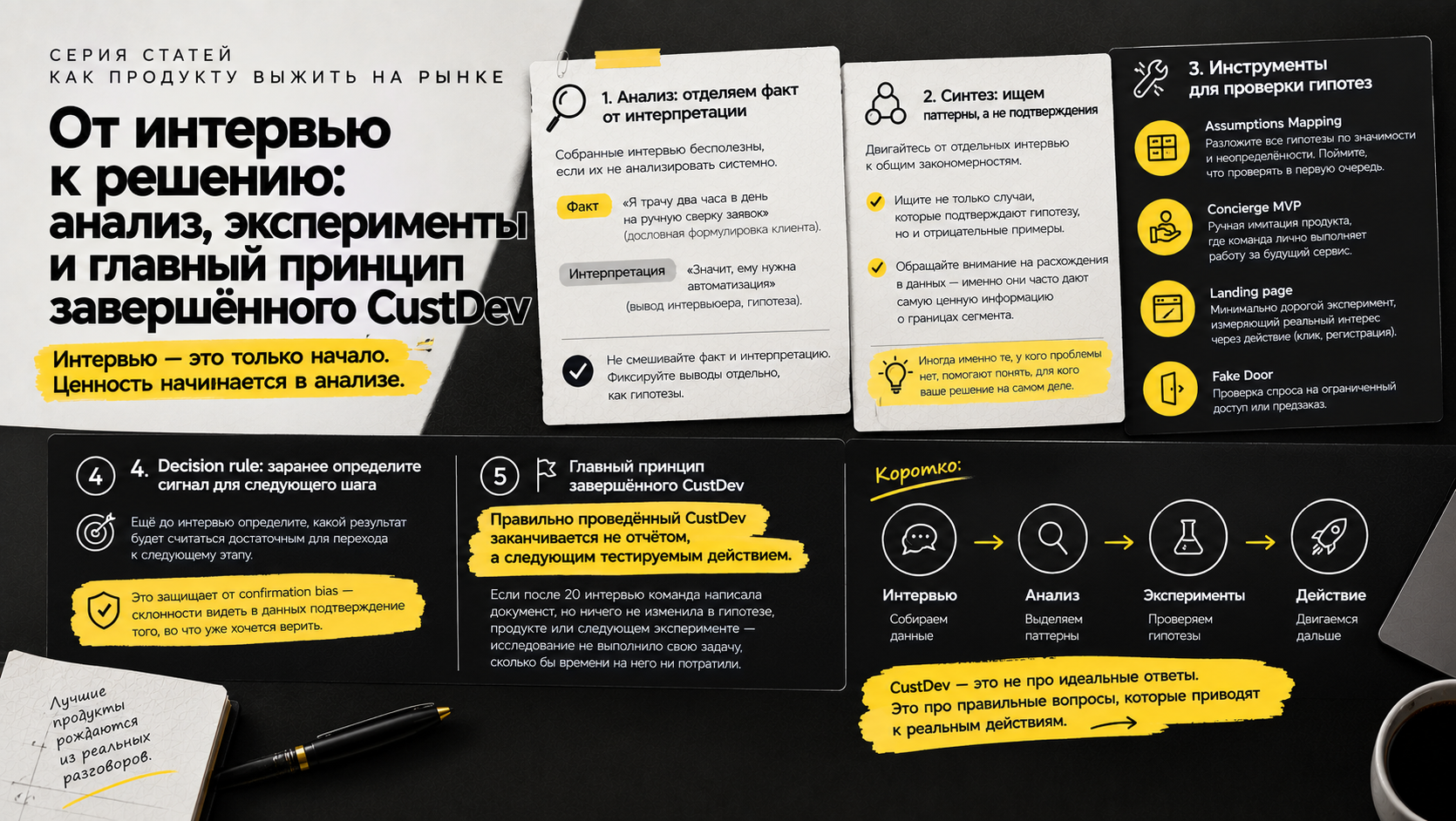
The collected interviews are useless if they are not systematically analyzed. The first rule of analysis is not to confuse fact and interpretation. The client's literal wording ("I spend two hours a day manually verifying applications") is a fact. The interviewer's conclusion ("so he needs automation") is already an interpretation, and it needs to be recorded separately, marking it as a hypothesis, not as data.
The synthesis of the results proceeds from individual interviews to patterns: it is important to look not only for cases that confirm the hypothesis, but also for negative examples - those who did not have a problem at all. It is the discrepancies in the data that often provide the most valuable information about segment boundaries.
Next, tools that go beyond a single interview come into play: Assumptions Mapping is a way to decompose all project hypotheses by significance and uncertainty and understand which ones to check first. Concierge MVP is a manual imitation of a product, where the team personally performs work for a future service in order to verify people's willingness to pay for the result. Landing page and Fake Door are minimally expensive experiments that measure real interest through action (click, registration, pre-order), rather than through words.
The key point is to determine the decision rule in advance: what exactly will be considered a sufficient signal to move on to the next step, even before the interviews begin. This protects against confirmation bias, the tendency to see data as confirmation of what you already wanted to believe.
And the final principle that should be kept in mind at any stage: a properly conducted CustDev does not end with a report, but with the next test action. If, after twenty interviews, the team wrote a document, but did not change anything about the hypothesis, product, or the next experiment, the study did not accomplish its task, no matter how much time was spent on it.
Собранные интервью бесполезны, если их не анализировать системно. Первое правило анализа - не смешивать факт и интерпретацию. Дословная формулировка клиента («я трачу два часа в день на ручную сверку заявок») - это факт. Вывод интервьюера («значит, ему нужна автоматизация») - это уже интерпретация, и её нужно фиксировать отдельно, помечая как гипотезу, а не как данные.
Синтез результатов идёт от отдельных интервью к паттернам: важно искать не только случаи, подтверждающие гипотезу, но и отрицательные примеры - тех, у кого проблема не проявилась вовсе. Именно расхождения в данных часто дают самую ценную информацию о границах сегмента.
Дальше в игру вступают инструменты, которые выходят за пределы одного интервью: Assumptions Mapping - способ разложить все гипотезы проекта по значимости и неопределённости и понять, какие проверять в первую очередь. Concierge MVP - ручная имитация продукта, где команда лично выполняет работу за будущий сервис, чтобы проверить готовность людей платить за результат. Landing page и Fake Door - минимально дорогие эксперименты, измеряющие реальный интерес через действие (клик, регистрацию, предзаказ), а не через слова.
Ключевой момент - заранее определить decision rule: что именно будет считаться достаточным сигналом для перехода к следующему шагу, ещё до того как начнутся интервью. Это защищает от confirmation bias - склонности видеть в данных подтверждение того, во что и так хотелось верить.
И финальный принцип, который стоит держать перед глазами на любом этапе: правильно проведённый CustDev заканчивается не отчётом, а следующим тестируемым действием. Если после двадцати интервью команда написала документ, но ничего не изменила в гипотезе, продукте или следующем эксперименте - исследование не выполнило свою задачу, сколько бы времени на него ни потратили.

 Share