
The post has been translated automatically. Original language: Russian




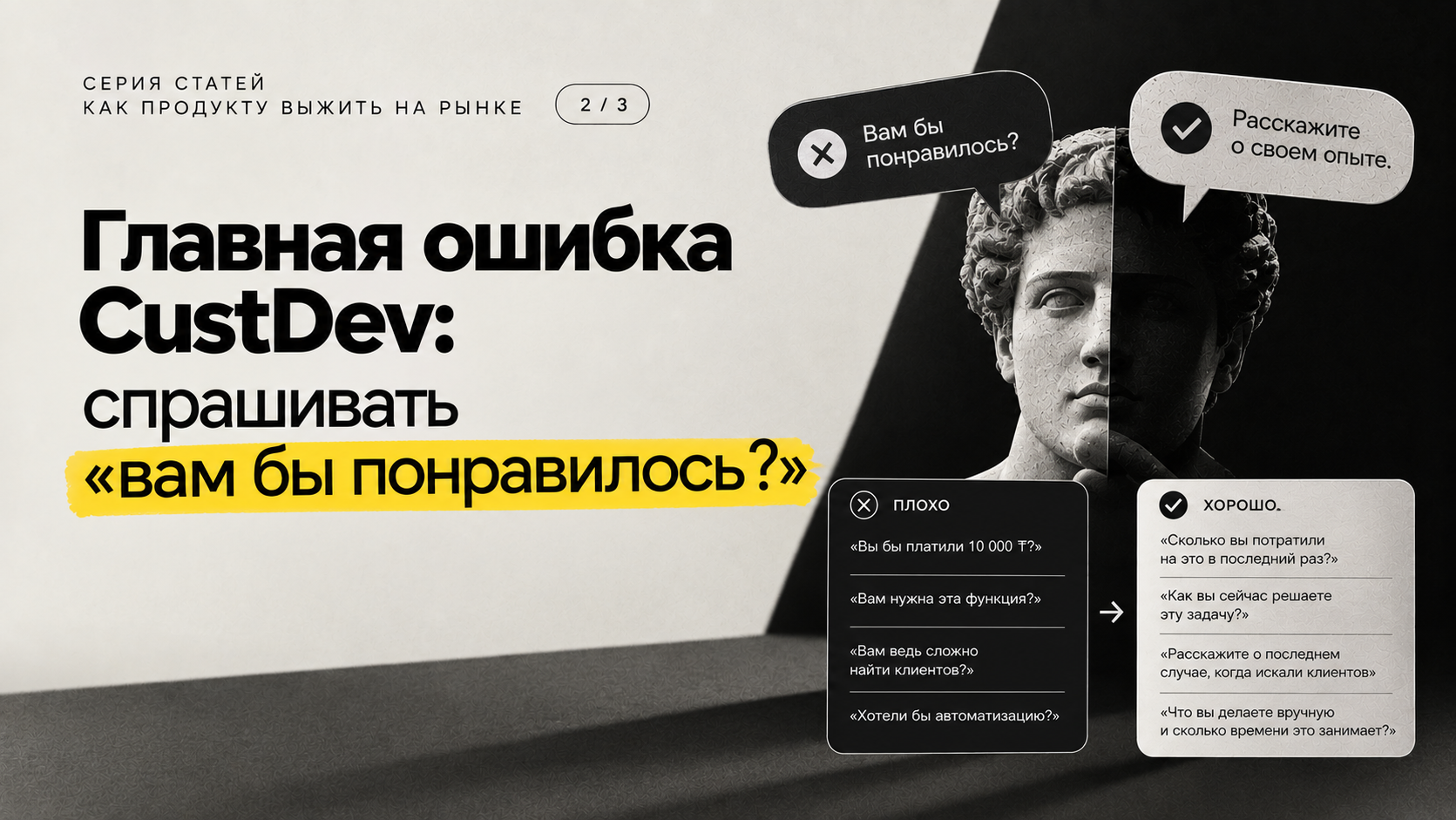
There is one question that kills the benefit of almost any client interview: "We are making an X application. Would you use it?" The problem is not in the question itself, but in human nature - people easily agree with a hypothetical scenario. They don't want to argue, they want to be polite, and most of the time they don't know how they will behave in a real situation.
Strategyzer's methodology explicitly advises against replacing facts with opinions: instead of "would you buy?" it is more useful to ask about a specific past experience - when was the last time a person bought something similar or solved a similar problem. The Nielsen Norman Group adds a second important principle: leading questions and suggested formulations distort the data. Neutral open-ended questions allow a person to describe their experience in their own words rather than confirm someone else's version.
Here are typical examples of bad questions and their working alternatives.:
| Badly | Well |
| "Would you pay 10,000??" | "How much did you spend on this last time?" |
| "Do you need this feature?" | "How do you solve this problem now?" |
| "It's hard for you to find clients, isn't it?" | "Tell us about the last time you were looking for clients" |
| "Would you like automation?" | "What do you do manually and how long does it take?" |
The difference between the columns is not stylistic - it is the difference between opinion and fact. An opinion can be obtained in one minute of polite conversation. The fact requires that a person remembers a specific episode from his life. It is the second data that protects the project from costly errors.
Есть один вопрос, который убивает пользу почти любого клиентского интервью: «Мы делаем приложение X. Пользовались бы вы им?» Проблема не в самом вопросе, а в человеческой природе - люди легко соглашаются с гипотетическим сценарием. Они не хотят спорить, хотят быть вежливыми и чаще всего сами не знают, как поведут себя в реальной ситуации.
Методология Strategyzer прямо советует не подменять факты мнениями: вместо «купили бы вы?» полезнее спросить о конкретном прошлом опыте - когда человек в последний раз покупал что-то подобное или решал похожую задачу. Nielsen Norman Group добавляет второй важный принцип: ведущие вопросы и подсказанные формулировки искажают данные. Нейтральные открытые вопросы позволяют человеку описать свой опыт своими словами, а не подтвердить чужую версию.
Вот характерные примеры плохих вопросов и их рабочих альтернатив:
| Плохо | Хорошо |
| «Вы бы платили 10 000 ₸?» | «Сколько вы потратили на это в последний раз?» |
| «Вам нужна эта функция?» | «Как вы сейчас решаете эту задачу?» |
| «Вам ведь сложно найти клиентов?» | «Расскажите о последнем случае, когда искали клиентов» |
| «Хотели бы автоматизацию?» | «Что вы делаете вручную и сколько времени это занимает?» |
Разница между колонками не стилистическая - это разница между мнением и фактом. Мнение можно получить за одну минуту вежливого разговора. Факт требует, чтобы человек вспомнил конкретный эпизод из своей жизни. Именно вторые данные защищают проект от дорогостоящей ошибки.
 Share