

The post has been translated automatically. Original language: Russian





Part 3 of 3
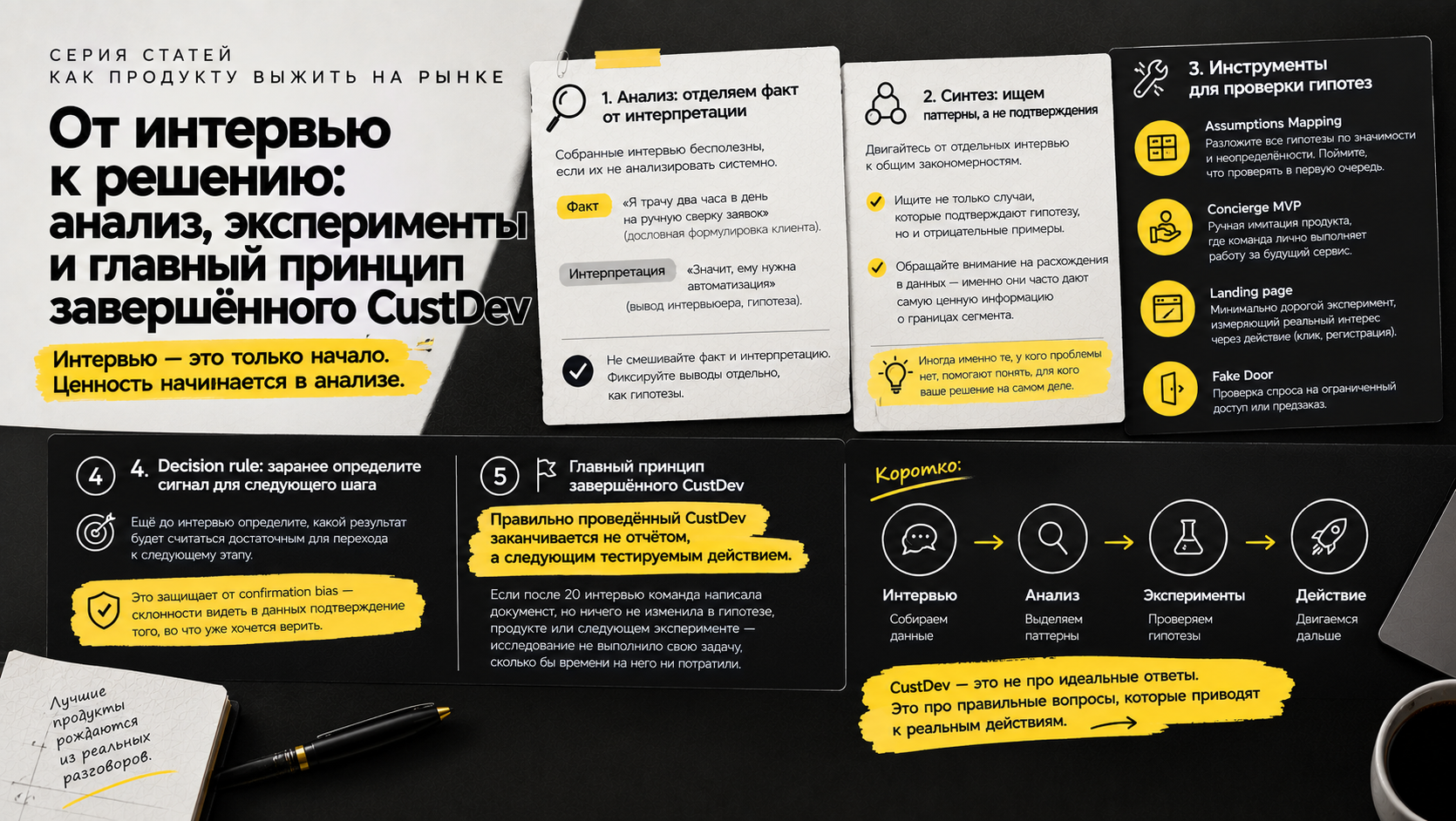
Let's say you conducted twenty interviews, collected answers, and saw a pattern. The temptation is great: take what has been said at face value and start developing. This is the last and perhaps the most insidious trap on the way to a viable product.
People almost never formulate their real problem directly — not because they want to deceive, but because they themselves are not fully aware of it. The client complains about the symptom, not the cause.
The difference between a stated need and a true need. A classic example from business literature: a customer says, "I need a drill." In fact, he doesn't need a device, but a hole in the wall. And if you dig even deeper, he doesn't need a hole, but a hanging shelf. And if he goes even further, he needs order in the house and a feeling that life is under control. A product that solves the "drill need" competes with other drills. A product that solves the "feeling of control over everyday life" may not be a drill at all.
The same thing happens in B2B and digital products. The client says, "I want the X function." This is almost always based not on the desire to get the X function, but on the desire to get rid of anxiety, save time, or reduce the risk that this function seems to cover. If you implement literally what you asked for, you risk building a solution for the symptom rather than the disease.
How to get to the bottom of it. The "five" why technique helps here. After each respondent's answer, ask the clarifying question "why is this important to you" until you come up against an emotion or a basic goal, rather than a functional requirement. Another working technique is to pay attention not to what a person says, but to what they are doing: by what roundabout methods, crutches and Excel spreadsheets they are already solving their problem. Behavior lies much less often than words.
The result of the whole series. The viability of the project is based on three consecutive filters: whether there is money on the market, whether there is real, not imaginary demand, and whether you understand what the client really hurts behind his words. Skip any of the three, and even an impeccable technical implementation won't save the product. Complete all three and you will build not what seems like a good idea, but what the market is willing to pay for.
Часть 3 из 3
Допустим, вы провели двадцать интервью, собрали ответы, увидели закономерность. Соблазн велик: взять сказанное за чистую монету и приступить к разработке. Это последняя и, пожалуй, самая коварная ловушка на пути к жизнеспособному продукту.
Люди почти никогда не формулируют свою настоящую проблему напрямую — не потому, что хотят обмануть, а потому что сами до конца её не осознают. Клиент жалуется на симптом, а не на причину.
Разница между высказанной и истинной потребностью. Классический пример из бизнес-литературы: клиент говорит «мне нужна дрель». На деле ему нужно не устройство, а отверстие в стене. А если копнуть ещё глубже - ему нужна не дыра, а повешенная полка. А если ещё дальше - ему нужен порядок в доме и ощущение, что жизнь под контролем. Продукт, который решает «потребность в дрели», конкурирует с другими дрелями. Продукт, который решает «ощущение контроля над бытом», может оказаться вообще не дрелью.
То же происходит и в B2B, и в цифровых продуктах. Клиент говорит: «хочу функцию Х». За этим почти всегда стоит не желание получить именно функцию Х, а стремление избавиться от тревоги, сэкономить время или снизить риск, который эта функция вроде бы закрывает. Если вы реализуете буквально то, что попросили, вы рискуете построить решение для симптома, а не для болезни.
Как докопаться до сути. Здесь помогает техника «пяти почему» - после каждого ответа респондента задавайте уточняющий вопрос «почему это важно для вас», пока не упрётесь в эмоцию или базовую цель, а не в функциональное требование. Ещё один рабочий приём - обращать внимание не на то, что человек говорит, а на то, что он делает: какими окольными способами, костылями и таблицами в Excel он уже сейчас решает свою проблему. Поведение врёт куда реже, чем слова.
Итог всей серии. Жизнеспособность проекта строится на трёх последовательных фильтрах: есть ли на рынке деньги, есть ли реальный, а не выдуманный спрос, и понимаете ли вы, что на самом деле болит у клиента за его словами. Пропустите любой из трёх - и даже безупречная техническая реализация не спасёт продукт. Пройдите все три - и вы будете строить не то, что кажется хорошей идеей, а то, за что рынок готов платить.
 Share