
The post has been translated automatically. Original language: Russian




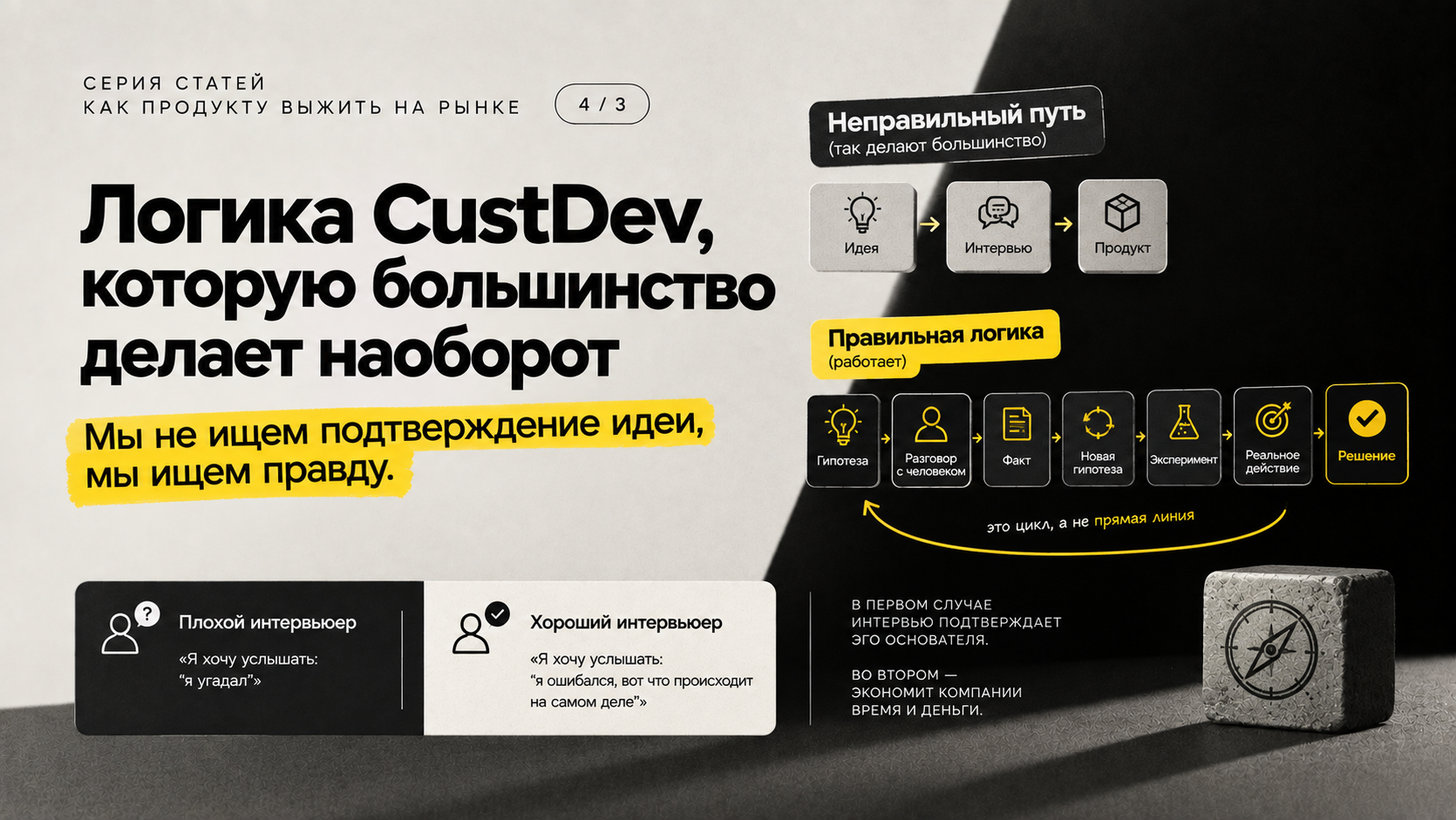
The natural but erroneous path looks like this: idea → interview → building a product. The interview in this scheme turns into a formality - the team has already decided what to build and is looking for confirmation.
The correct logic looks different: hypothesis → conversation with a real person → fact → new hypothesis → experiment → real action → solution. This is not a linear process with a single entry and exit point, but a cycle in which each new knowledge changes the next step.
In short, this idea can be formulated as follows: we are not looking for confirmation of an idea, we are looking for the truth that can refute it.
This setting changes the interviewer's behavior on a physical level. A person who is looking for confirmation unconsciously asks leading questions, rejoices when the respondent says "yes, it would be convenient," and ignores doubts. A person who is looking for the truth, on the contrary, is wary of too easy agreement and listens especially attentively to objections and inconsistencies.
The main principle of the interviewer is formulated very clearly: a bad interviewer wants to hear "I guessed right." A good one wants to hear "I was wrong, that's what's really going on." In the first case, the interview confirms the founder's ego. In the second case, it saves the company time and money.
Естественный, но ошибочный путь выглядит так: идея → интервью → строим продукт. Интервью в этой схеме превращается в формальность - команда уже решила, что строить, и ищет подтверждения.
Правильная логика выглядит иначе: гипотеза → разговор с реальным человеком → факт → новая гипотеза → эксперимент → реальное действие → решение. Это не линейный процесс с одной точкой входа и выхода, а цикл, в котором каждое новое знание меняет следующий шаг.
Ещё короче эту идею можно сформулировать так: мы не ищем подтверждение идеи, мы ищем правду, которая может её опровергнуть.
Эта установка меняет поведение интервьюера на физическом уровне. Человек, который ищет подтверждение, неосознанно задаёт наводящие вопросы, радуется, когда респондент говорит «да, было бы удобно», и игнорирует сомнения. Человек, который ищет правду, наоборот - насторожённо относится к слишком лёгкому согласию и особенно внимательно слушает возражения и нестыковки.
Главный принцип интервьюера формулируется предельно чётко: плохой интервьюер хочет услышать «я угадал». Хороший - хочет услышать «я ошибался, вот что происходит на самом деле». В первом случае интервью подтверждает эго основателя. Во втором - экономит компании время и деньги.
 Share