
The post has been translated automatically. Original language: Russian




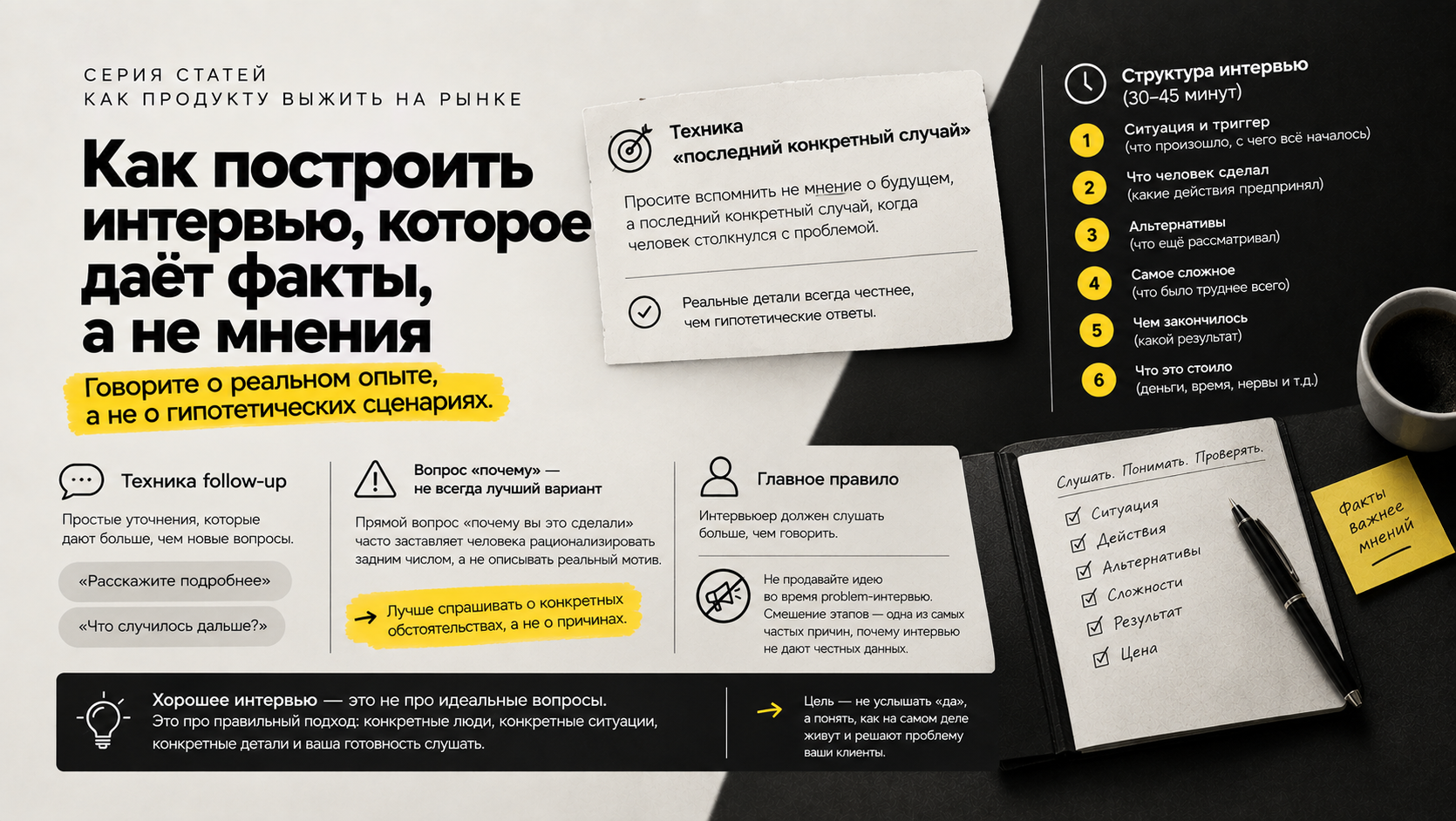
The main technique of a high-quality CustDev interview is story-based interview, that is, building a conversation around a specific story rather than abstract reasoning. Instead of asking for an opinion about the future, the interviewer asks you to recall the last specific case when the person was faced with the situation under study.
This technique is called "the last concrete case" - and it works because it forces a person to remember real details, rather than constructing a hypothetical answer on the fly. Remembering a particular episode is much more honest than predicting your own behavior.
The structure of a good 30-45-minute interview usually moves from the general context to the details: first, the situation and the trigger, then what the person did at that moment, what alternatives they considered, what was the most difficult, what ended up and what it cost them.
The universal follow-up technique also works here - a simple clarification like "tell us more" or "what happened next", which almost always reveals more than the next prepared question from the script. At the same time, the word "why" is useful, but dangerous: a direct question "why did you do that" often forces a person to rationalize in hindsight, rather than describe the real motive. A more honest result is often a question about specific circumstances rather than the reasons.
And the main rule that is easy to forget in a conversation is that the interviewer should listen more than talk, and never sell an idea during a problem interview. Mixing stages - an attempt to simultaneously explore a problem and present a solution - is one of the most common reasons why interviews do not provide honest data.
author @zhenis_bekbayev
Главный приём качественного CustDev-интервью - story-based interview, то есть построение разговора вокруг конкретной истории, а не абстрактных рассуждений. Вместо того чтобы спрашивать мнение о будущем, интервьюер просит вспомнить последний конкретный случай, когда человек столкнулся с исследуемой ситуацией.
Эта техника называется «последний конкретный случай» - и она работает потому, что заставляет человека вспоминать реальные детали, а не конструировать гипотетический ответ на ходу. Память о конкретном эпизоде куда честнее, чем прогноз собственного поведения.
Структура хорошего интервью на 30-45 минут обычно движется от общего контекста к деталям: сначала - ситуация и триггер, затем - что человек сделал в тот момент, какие альтернативы рассматривал, что было самым сложным, чем закончилось и что это ему стоило.
Здесь же работает универсальная техника follow-up - простое уточнение вроде «расскажите подробнее» или «что случилось дальше», которое почти всегда раскрывает больше, чем следующий заготовленный вопрос из сценария. При этом слово «почему» полезно, но опасно: прямой вопрос «почему вы это сделали» часто заставляет человека рационализировать задним числом, а не описывать реальный мотив. Более честный результат часто даёт вопрос о конкретных обстоятельствах, а не о причинах.
И главное правило, которое легко забыть в разговоре: интервьюер должен слушать больше, чем говорить, и ни в коем случае не продавать идею во время problem-интервью. Смешение этапов - попытка одновременно исследовать проблему и презентовать решение - одна из самых частых причин, почему интервью не дают честных данных.
автор @zhenis_bekbayev
 Share