
The post has been translated automatically. Original language: Russian





In business, a strategy is often referred to as a long-term plan.
First, enter one market. Then launch the second product. In a year to open a new direction. Then scale up.
Such a document may be useful.
But this is not a strategy yet.
The plan answers the question:
What are we going to do?
The strategy responds to another one:
What will we do if the situation changes?
The plan likes a predictable world
A plan works well where the sequence of events is more or less known.
If we are building a house, we can define the stages in advance.
Foundation. Walls. Roof. Finishing.
The problem in business is that new players, technologies, limitations, and opportunities are constantly emerging between these stages.
You were planning to sell to large companies.
But suddenly, individual specialists start buying the product.
You were going to earn money by subscribing.
And the market shows the demand for a different format.
You were counting on one sales channel.
After six months, it becomes too expensive.
The plan remains the same.
The position is already different.
In chess, too, it is impossible to schedule the entire game in advance.
Before starting a party, you can have an idea.
You can know the opening.
You can understand what position you want to get.
But it is impossible to write seriously:
On the 17th move, I'll move the knight here, and on the 23rd move, I'll put the rook there.
Because there is a rival.
He's making moves too.
And after each of his decisions, the situation changes.
Therefore, the chess player does not work according to a detailed scenario.
He constantly evaluates a new position.
The same thing happens in business.
Only a "rival" can be more than just a competitor.
It can be a market, a customer, a government, a technology, or its own product.
Musashi does not teach a sequence of techniques
This is one of the strengths of his approach.
It is not enough to learn the correct stroke.
You need to understand the distance, the moment, the opponent's position and the rhythm.
Technique without understanding the situation becomes mechanics.
It's easy to fall into the same trap in business.
The company learned:
We need freemium.
And freemium does.
Or:
Enterprise needs to be sold through the sales team.
Creates a sales department.
Or:
We need to go to the USA.
And it starts going to the USA.
Every piece of advice can be reasonable.
But only in a certain position.
Strategy begins with observation
A good strategic question often sounds very simple.:
What has changed?
For example, a year ago, the price was important to customers.
Safety is more important now.
Previously, the director bought the product.
Now the solution is blocking IT.
Previously, the competitor was expensive and complex.
Now he has released a simple version.
If you don't notice this, the company can follow the old plan with great discipline.
And it's very disciplined to lose.
Good plans are especially dangerous.
It's easy to abandon a bad plan.
A good one is much more difficult.
Money has already been invested in it.
People have been hired for him.
A budget has been agreed upon for it.
The management has publicly announced the goals.
Now the change of course is perceived almost as an admission of error.
And the company begins to protect not the result, but its own document.
Phrase:
But that was in the strategy.
it becomes an argument in itself.
Although the strategy should allow you to change actions when the position changes.
This does not mean that there is no need to plan.
Without a plan, a business quickly turns into a set of reactions.
Strategy does not mean:
We will look at the situation.
It's too convenient.
We need a goal.
We need a direction.
We need to understand what advantage we are trying to create.
But specific actions should not become sacred.
You can save the goal and change the path.
That's exactly the difference.
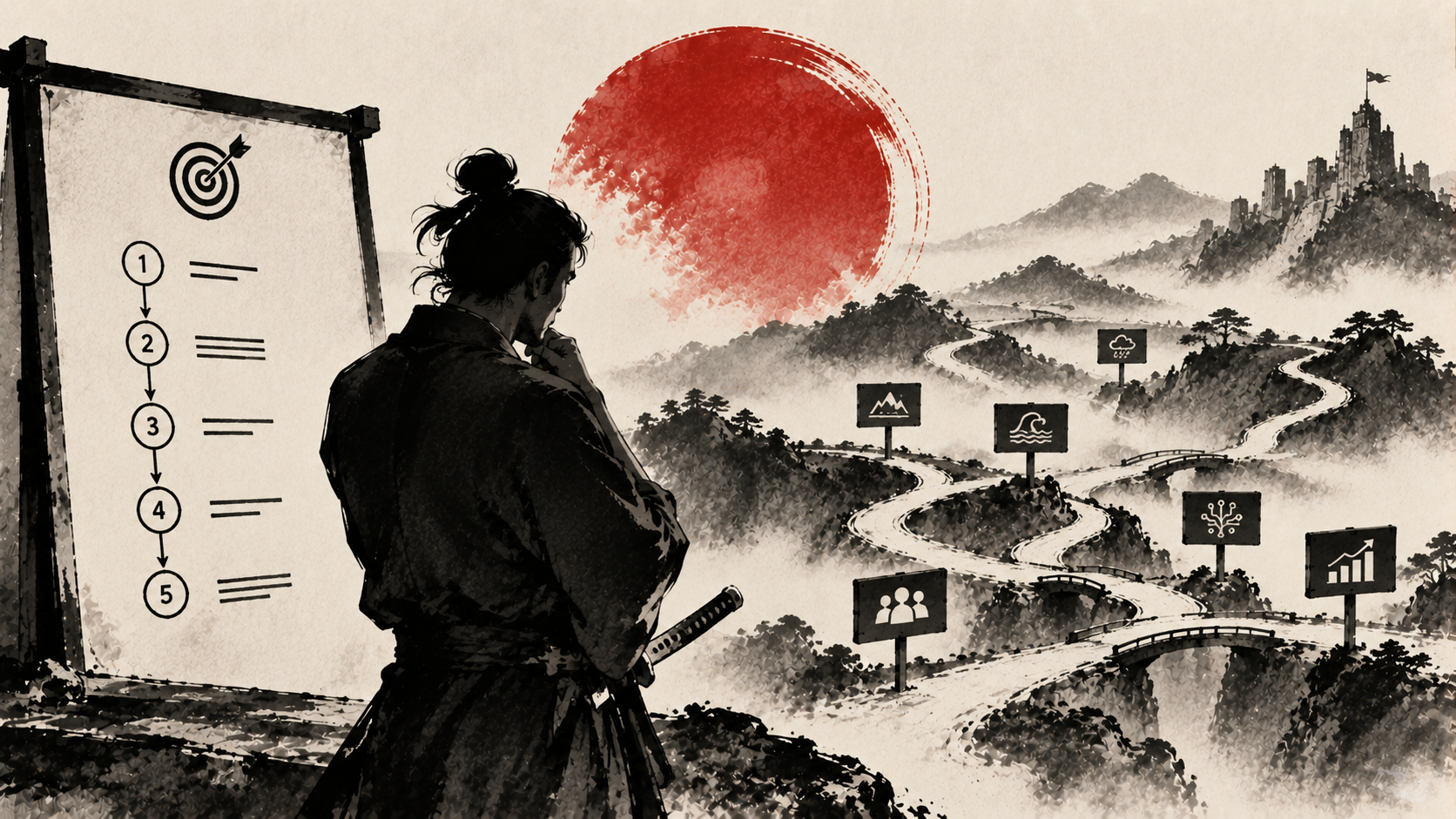
The goal may be stable, but the route may not
Let's imagine that a company wants to occupy a certain market.
This is the direction.
Initially, she expects to achieve this through direct sales.
But the sales turn out to be too expensive.
It becomes possible to distribute the product through partners.
If a company continues direct sales just because it was written down a year ago, it follows the plan.
If he changes the way he achieves his goal after changing his position, he acts strategically.
The strategy does not require a constant change of direction.
It requires the ability to change the course.
Sometimes the right move goes against the plan.
The most interesting features were often not provided at all.
A new type of client is coming.
There is an unexpected application of the product.
A technology is emerging that dramatically reduces the cost.
The competitor is leaving the market.
It is impossible to schedule such moments in advance in the roadmap.
But they can be noticed.
And use it.
Therefore, strategic flexibility is not a lack of discipline.
It's the discipline of constantly looking at the board, not just at your own plan.
Rhythm matters again
Even the right change can be made too soon.
Or it's too late.
The company saw the first weak signals and immediately abandoned its previous strategy.
It could be a panic attack.
The company has been seeing market changes for a year, but continues to implement the approved plan.
This is inertia.
Musashi brings us back to the rhythm again.
You don't just need to see the change.
It is necessary to understand whether it is strong enough to change the action.
The plan says what we wanted to do
The strategy says what makes sense to do now.
And this is perhaps the main difference.
The plan can be written once.
The strategy has to be constantly applied.
Because the market is not obligated to follow your document.
The client is not obligated to behave the way you intended.
The competitor does not have to wait.
Therefore, a good strategy is not an attempt to guess the whole game in advance.
This is the ability to look at the board again after each change and choose the next move.
В бизнесе стратегией часто называют длинный план.
Сначала выйти на один рынок. Потом запустить второй продукт. Через год открыть новое направление. Затем масштабироваться.
Такой документ может быть полезен.
Но это ещё не стратегия.
План отвечает на вопрос:
Что мы собираемся делать?
Стратегия отвечает на другой:
Что мы будем делать, если ситуация изменится?
План любит предсказуемый мир
План хорошо работает там, где последовательность событий более-менее известна.
Если мы строим дом, можно заранее определить этапы.
Фундамент. Стены. Крыша. Отделка.
В бизнесе проблема в том, что между этими этапами постоянно появляются новые игроки, технологии, ограничения и возможности.
Вы планировали продавать крупным компаниям.
Но неожиданно продукт начинают покупать отдельные специалисты.
Вы собирались зарабатывать на подписке.
А рынок показывает спрос на другой формат.
Вы рассчитывали на один канал продаж.
Через полгода он становится слишком дорогим.
План остаётся прежним.
Позиция уже другая.
В шахматах тоже невозможно заранее расписать всю партию
Перед началом партии можно иметь идею.
Можно знать дебют.
Можно понимать, какую позицию хочется получить.
Но невозможно серьёзно написать:
На 17-м ходу я передвину коня сюда, а на 23-м поставлю ладью туда.
Потому что существует соперник.
Он тоже делает ходы.
И после каждого его решения ситуация меняется.
Поэтому шахматист работает не по подробному сценарию.
Он постоянно оценивает новую позицию.
В бизнесе происходит то же самое.
Только «соперником» может оказаться не только конкурент.
Им может стать рынок, клиент, государство, технология или собственный продукт.
Мусаси не учит последовательности приёмов
В этом одна из сильных сторон его подхода.
Недостаточно выучить правильный удар.
Нужно понимать дистанцию, момент, положение противника и ритм.
Техника без понимания ситуации становится механикой.
В бизнесе легко попасть в ту же ловушку.
Компания выучила:
Нам нужен freemium.
И делает freemium.
Или:
Enterprise нужно продавать через sales team.
Создаёт отдел продаж.
Или:
Нужно идти в США.
И начинает идти в США.
Каждый совет может быть разумным.
Но только в определённой позиции.
Стратегия начинается с наблюдения
Хороший стратегический вопрос часто звучит очень просто:
Что изменилось?
Например, год назад клиентам была важна цена.
Теперь важнее безопасность.
Раньше продукт покупал директор.
Теперь решение блокирует IT.
Раньше конкурент был дорогим и сложным.
Теперь он выпустил простую версию.
Если этого не заметить, компания может очень дисциплинированно выполнять старый план.
И очень дисциплинированно проигрывать.
Особенно опасны хорошие планы
Плохой план легко бросить.
Хороший — намного сложнее.
В него уже вложены деньги.
Под него наняты люди.
На него согласован бюджет.
Руководство публично объявило цели.
Теперь изменение курса воспринимается почти как признание ошибки.
И компания начинает защищать не результат, а собственный документ.
Фраза:
Но это же было в стратегии
становится аргументом сама по себе.
Хотя стратегия как раз и должна позволять менять действия, когда меняется позиция.
Это не означает, что планировать не нужно
Без плана бизнес быстро превращается в набор реакций.
Стратегия не означает:
Будем смотреть по ситуации.
Это слишком удобно.
Нужна цель.
Нужно направление.
Нужно понимать, какое преимущество мы пытаемся создать.
Но конкретные действия не должны становиться священными.
Можно сохранять цель и менять путь.
Именно в этом разница.
Цель может быть стабильной, маршрут — нет
Представим, что компания хочет занять определённый рынок.
Это направление.
Изначально она рассчитывает добиться этого через прямые продажи.
Но продажи оказываются слишком дорогими.
Появляется возможность распространять продукт через партнёров.
Если компания продолжает прямые продажи только потому, что так было записано год назад, она следует плану.
Если меняет способ достижения цели после изменения позиции — действует стратегически.
Стратегия не требует постоянного изменения направления.
Она требует способности менять ход.
Иногда правильный ход противоречит плану
Самые интересные возможности часто вообще не были предусмотрены.
Приходит новый тип клиента.
Возникает неожиданное применение продукта.
Появляется технология, которая резко снижает стоимость.
Конкурент уходит с рынка.
Такие моменты невозможно заранее расписать в дорожной карте.
Но их можно заметить.
И использовать.
Поэтому стратегическая гибкость — это не отсутствие дисциплины.
Это дисциплина постоянно смотреть на доску, а не только в собственный план.
Ритм снова имеет значение
Даже правильное изменение можно сделать слишком рано.
Или слишком поздно.
Компания увидела первые слабые сигналы и мгновенно бросила прежнюю стратегию.
Это может быть паникой.
Компания год видит изменение рынка, но продолжает выполнять утверждённый план.
Это уже инерция.
Мусаси снова возвращает нас к ритму.
Нужно не просто увидеть изменение.
Нужно понять, достаточно ли оно сильное, чтобы менять действие.
План говорит, что мы хотели сделать
Стратегия говорит, что имеет смысл делать сейчас.
И в этом, пожалуй, главное различие.
План можно написать один раз.
Стратегию приходится постоянно применять.
Потому что рынок не обязан следовать вашему документу.
Клиент не обязан вести себя так, как вы предполагали.
Конкурент не обязан ждать.
И поэтому хорошая стратегия — это не попытка заранее угадать всю партию.
Это способность после каждого изменения снова посмотреть на доску и выбрать следующий ход.

 Share