

The post has been translated automatically. Original language: Russian





Based on the article "Introducing System One Models & Jev". The original author is Diogo Almeida, founder of TypeSafe AI.
TypeSafe AI has introduced the Jev, the first model of the new System One Models class. Unlike the usual large language models, it is designed not for conducting a dialogue or writing texts, but for quick structured solutions that can be directly used in software.
Regular LLMs generate the response sequentially, token by token. The resulting text has to be additionally checked, converted to the desired format and processed in case of an error. Jev works differently: the system receives unstructured data, such as a text description of a situation, and returns predefined typed values along with probabilities and a confidence score.
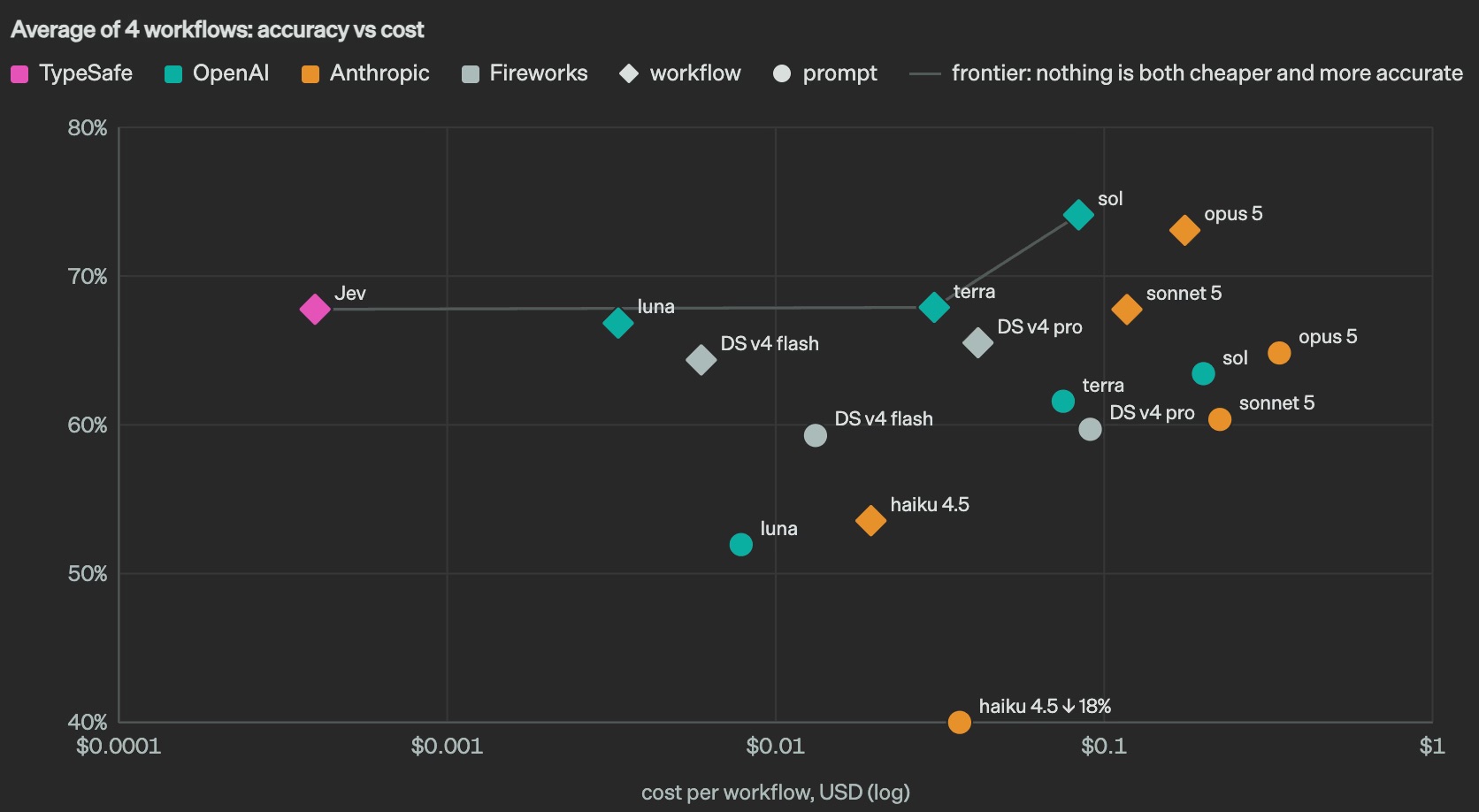
Such a model can be represented as an intelligent function inside the application: data is received at the input, and at the output the program receives a classification, risk assessment, selected route or other specific solution. This allows Jev to be used in automated processes, processing large amounts of data, systems for verifying the results of other models, and applications where minimal latency is important.
TypeSafe AI has developed the Reinforcement Learning for Calibrated Decisions, or RLCD, approach for training. His task is to teach the model not only to choose an answer, but also to honestly assess the probability of its correctness. According to the company, Jev processes requests in 70-500 milliseconds and in some tests turns out to be significantly faster and cheaper than traditional LLMs of a comparable level.
At the same time, Jev is not a universal replacement for language models. It does not create free text and is best suited for tasks in which the possible answers and the structure of the result are determined in advance. The typed format excludes non—existent fields and incorrect response structure, but the model's decision itself may still be erroneous, which is why the returned probabilities and confidence indicators play an important role.
The name System One refers to the "System 1" described by Daniel Kahneman — fast and intuitive thinking. The name Jev is associated with the economist William Stanley Jevons and his observation: increasing the efficiency of resource use may not decrease, but increase demand for it. TypeSafe AI expects that reducing the cost of machine intelligence will similarly open up new automation scenarios.
Jev is currently available in Early Access format. Its appearance shows the possible direction of AI development: from models that talk to humans to specialized systems capable of making decisions quickly and predictably inside software products.
По материалам статьи «Introducing System One Models & Jev». Автор оригинала — Диогу Алмейда (Diogo Almeida), основатель TypeSafe AI.
Компания TypeSafe AI представила Jev — первую модель нового класса System One Models. В отличие от привычных больших языковых моделей, она предназначена не для ведения диалога или написания текстов, а для быстрых структурированных решений, которые можно напрямую использовать в программном обеспечении.
Обычные LLM генерируют ответ последовательно — токен за токеном. Полученный текст приходится дополнительно проверять, преобразовывать в нужный формат и обрабатывать на случай ошибки. Jev работает иначе: система получает неструктурированные данные, например текстовое описание ситуации, и возвращает заранее определённые типизированные значения вместе с вероятностями и оценкой уверенности.
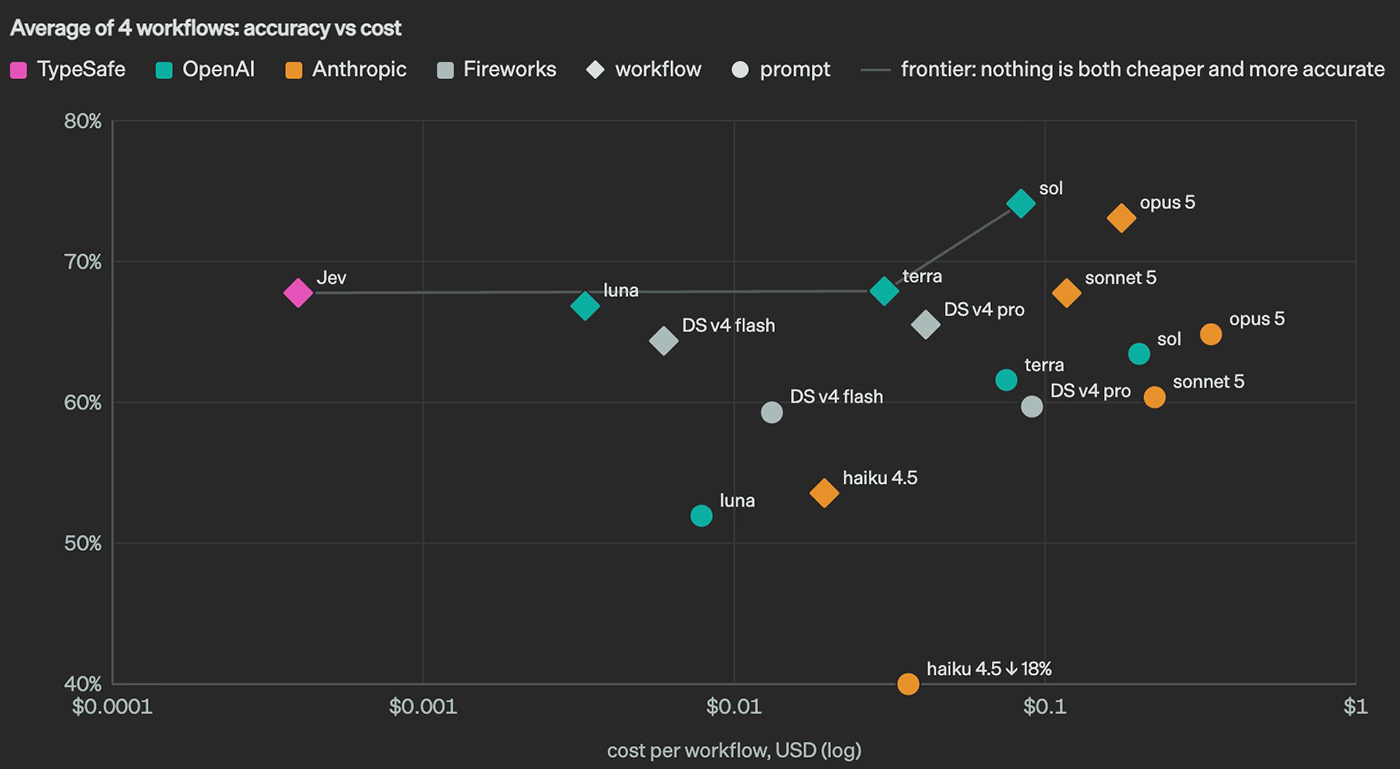
Такую модель можно представить как интеллектуальную функцию внутри приложения: данные поступают на вход, а на выходе программа получает классификацию, оценку риска, выбранный маршрут или другое конкретное решение. Это позволяет использовать Jev в автоматизированных процессах, обработке больших массивов данных, системах проверки результатов других моделей и приложениях, где важна минимальная задержка.
Для обучения TypeSafe AI разработала подход Reinforcement Learning for Calibrated Decisions, или RLCD. Его задача — научить модель не только выбирать ответ, но и честно оценивать вероятность его правильности. По заявлению компании, Jev обрабатывает запросы за 70–500 миллисекунд и в отдельных тестах оказывается значительно быстрее и дешевле традиционных LLM сопоставимого уровня.
При этом Jev не является универсальной заменой языковых моделей. Она не создаёт свободный текст и лучше всего подходит для задач, в которых возможные варианты ответа и структура результата определены заранее. Типизированный формат исключает несуществующие поля и неправильную структуру ответа, однако само решение модели всё равно может оказаться ошибочным — поэтому важную роль играют возвращаемые вероятности и показатели уверенности.
Название System One отсылает к описанной Даниэлем Канеманом «Системе 1» — быстрому и интуитивному мышлению. Название Jev связано с экономистом Уильямом Стэнли Джевонсом и его наблюдением: повышение эффективности использования ресурса может не уменьшать, а увеличивать спрос на него. TypeSafe AI рассчитывает, что снижение стоимости машинного интеллекта похожим образом откроет новые сценарии автоматизации.
Сейчас Jev доступна в формате раннего доступа. Её появление показывает возможное направление развития ИИ: от моделей, которые разговаривают с человеком, к специализированным системам, способным быстро и предсказуемо принимать решения внутри программных продуктов.

 Share