

The post has been translated automatically. Original language: Russian





Based on the article "Introducing System One Models & Jev". The original author is Diogo Almeida, founder of TypeSafe AI.
TypeSafe AI has introduced the Jev, the first model of the new System One Models class. Unlike the usual large language models, it is designed not for conducting a dialogue or writing texts, but for quick structured solutions that can be directly used in software.
Regular LLMs generate the response sequentially, token by token. The resulting text has to be additionally checked, converted to the desired format and processed in case of an error. Jev works differently: the system receives unstructured data, such as a text description of a situation, and returns predefined typed values along with probabilities and a confidence score.
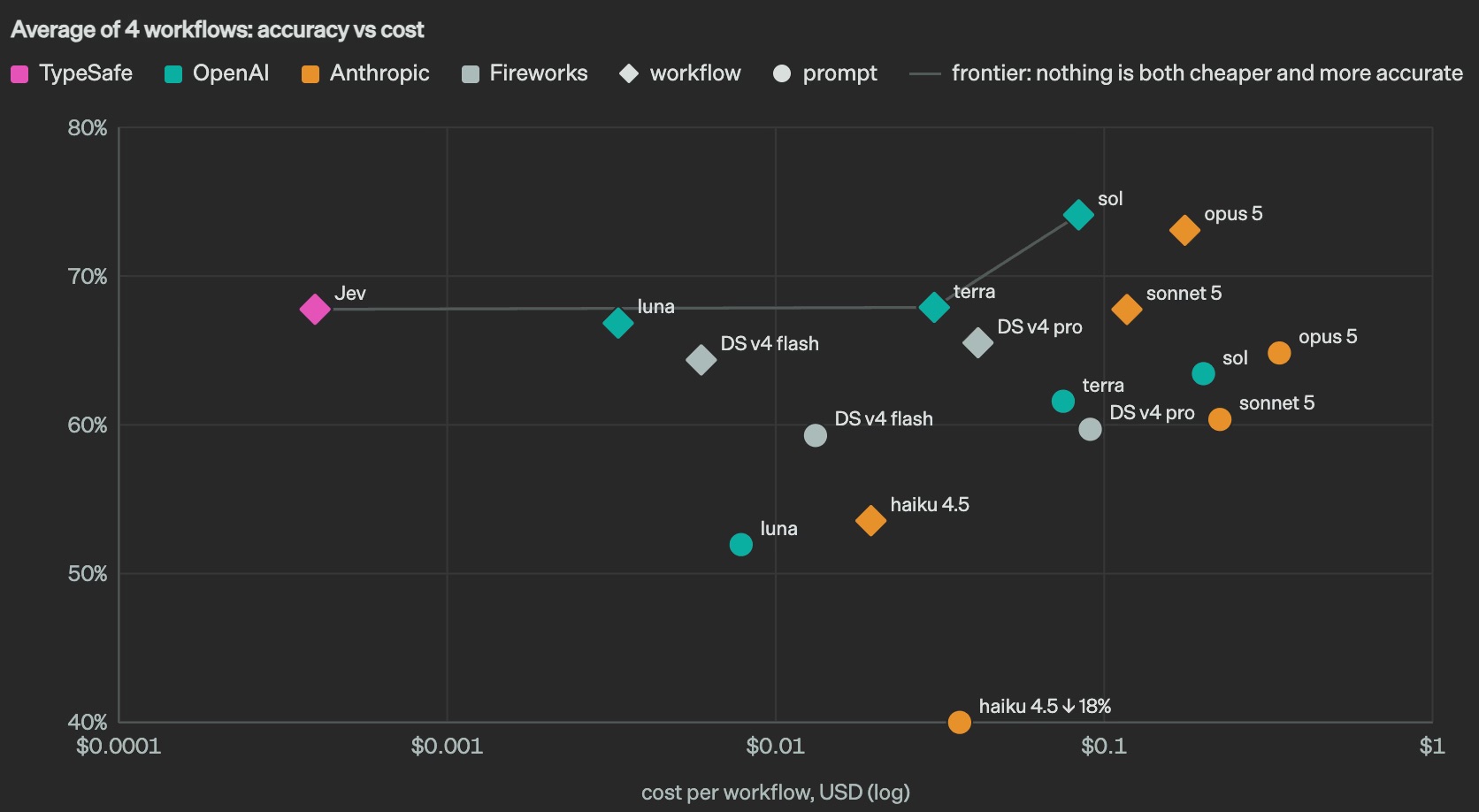
Such a model can be represented as an intelligent function inside the application: data is received at the input, and at the output the program receives a classification, risk assessment, selected route or other specific solution. This allows Jev to be used in automated processes, processing large amounts of data, systems for verifying the results of other models, and applications where minimal latency is important.
TypeSafe AI has developed the Reinforcement Learning for Calibrated Decisions, or RLCD, approach for training. His task is to teach the model not only to choose an answer, but also to honestly assess the probability of its correctness. According to the company, Jev processes requests in 70-500 milliseconds and in some tests turns out to be significantly faster and cheaper than traditional LLMs of a comparable level.
At the same time, Jev is not a universal replacement for language models. It does not create free text and is best suited for tasks in which the possible answers and the structure of the result are determined in advance. The typed format excludes non—existent fields and incorrect response structure, but the model's decision itself may still be erroneous, which is why the returned probabilities and confidence indicators play an important role.
The name System One refers to the "System 1" described by Daniel Kahneman — fast and intuitive thinking. The name Jev is associated with the economist William Stanley Jevons and his observation: increasing the efficiency of resource use may not decrease, but increase demand for it. TypeSafe AI expects that reducing the cost of machine intelligence will similarly open up new automation scenarios.
Jev is currently available in Early Access format. Its appearance shows the possible direction of AI development: from models that talk to humans to specialized systems capable of making decisions quickly and predictably inside software products.
Сегодня разработчики всё чаще используют сразу несколько AI-инструментов: Codex, Claude Code, Gemini CLI и другие. У каждого сервиса свои лимиты, периоды обновления и способы отображения статистики. Чтобы понять, сколько ресурсов осталось, приходится постоянно переключаться между приложениями и терминалом.
Именно поэтому я создал UsageNow — бесплатное нативное приложение для macOS, которое собирает информацию об использовании AI-инструментов в одном месте.

UsageNow 0.3.0
UsageNow разработан на Swift и SwiftUI и работает прямо в строке меню. Одним нажатием можно посмотреть:
- оставшиеся лимиты и время их обновления;
- активность за текущий день;
- количество токенов и запросов;
- статистику по используемым моделям;
- состояние подключённых AI-провайдеров.
Сейчас приложение поддерживает Codex, Claude Code, Gemini CLI и Google Antigravity. В дальнейшем планируется добавить Cursor, GitHub Copilot, DeepSeek и Qwen.
Данные остаются на компьютере
Одним из главных принципов проекта стала приватность. UsageNow работает по подходу local-first: для использования приложения не нужно создавать аккаунт, а отдельного сервера UsageNow не существует.
Приложение анализирует локальные данные AI-инструментов и использует только техническую информацию: идентификаторы сессий, время запросов, названия моделей и количество токенов. Промпты, ответы AI и исходный код пользователя не читаются и никуда не отправляются.
Если провайдер не сообщает определённый лимит, UsageNow не пытается его угадать и честно показывает, что информация недоступна. При этом локальная статистика токенов отражает активность на конкретном Mac и может отличаться от биллинга самого AI-сервиса.
Быстрый доступ
UsageNow можно настроить под свой рабочий процесс: отключить ненужных провайдеров, изменить их порядок или выбрать данные, которые будут отображаться в строке меню.
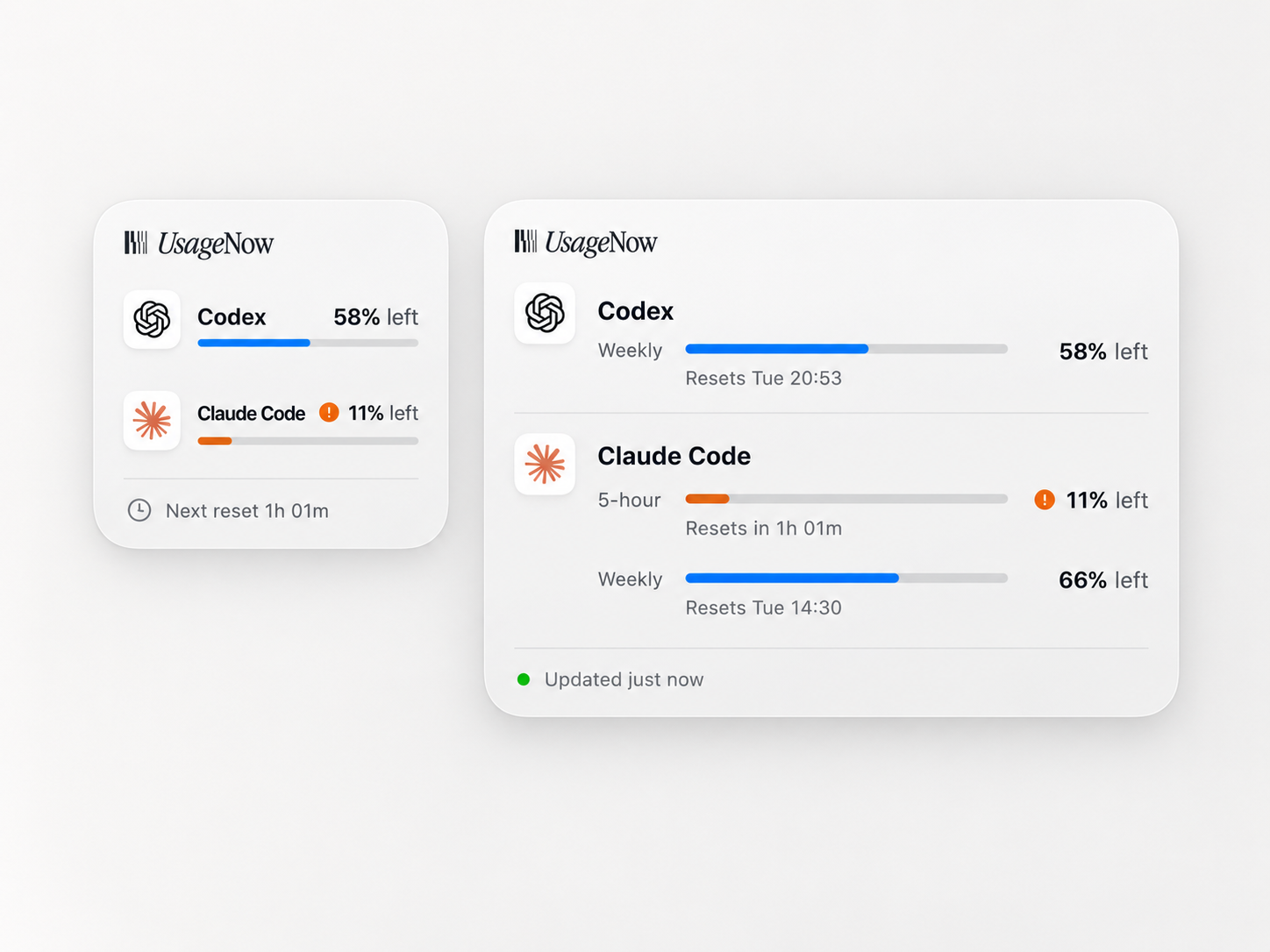
Также доступны небольшие и средние виджеты для рабочего стола. Они позволяют быстро увидеть наиболее важные лимиты и ближайшее время их обновления, даже не открывая приложение.

 Share