
The post has been translated automatically. Original language: Russian





When ChatGPT appeared, it seemed surprising to many how quickly people started using it. You didn't need long instructions, interface training, or separate courses on where to click.
In fact, we have been ready for this type of interaction for a long time. Messengers have prepared us.
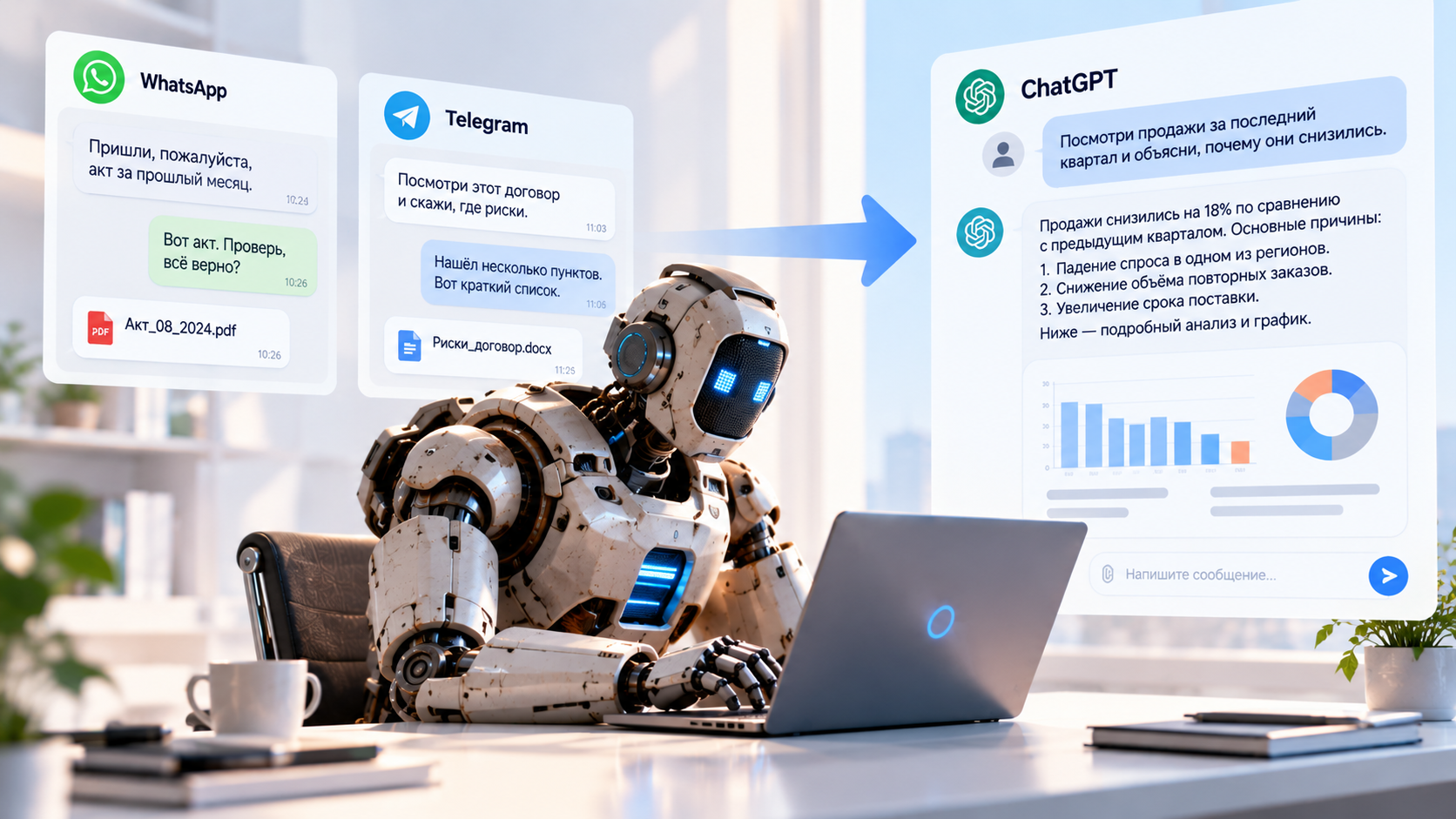
WhatsApp and Telegram have taught us to solve a huge number of tasks through one simple form: write a message.
We are already used to setting tasks in text.
When we need something from another person, we rarely describe the exact procedure to them.
We don't write to the accountant: "Open such a program, go to such a section, select the required period, find a document and send it to me."
We're just writing:
"Please send the report for last month."
We do not explain to the lawyer how to search for a contract. We don't tell our colleague which folder contains the required file. We do not explain to the programmer exactly which commands to execute.
We communicate the goal.
The person on the other side understands by himself what needs to be done to get the result.
Over the years of communication in messengers, this model has become completely natural for us.
ChatGPT took the place of the interlocutor
ChatGPT used a familiar form.
There is an input field.
There is a message history.
You write a phrase and get an answer.
Outwardly, everything is very similar to ordinary correspondence. Only on the other side is now not a colleague, not a consultant or an assistant, but an AI.
That's why the first contact turned out to be so easy.
The user didn't need to understand how the language model worked. You don't need to know its commands or internal functions.
He just starts writing the same way he would write to a human.
This is the main difference.
A regular program requires the user to know its structure.
Imagine that I need to translate a document.
In a traditional program, I have to open the file, select the translation function, specify the language, perhaps adjust the format, and confirm the action.
In the chat, I just write:
"Translate this document into Kazakh."
That is, I do not manage the program step by step.
I'm setting a task.
It is this form of interaction that messengers have long accustomed us to.
We trust the interlocutor with the choice of actions.
When we write to a person, we rarely control their every action.
For example, I ask:
"Look at this contract and tell me where the risks are."
The lawyer decides for himself which page to start with, what is considered essential and which items to check especially carefully.
This is about how we begin to behave with AI.
We write:
"Look at the table and find strange values."
And we don't ask what function it will call, what intermediate calculations it will perform, and in what order it will read the data.
This is no longer a tool management model.
This is a model for assigning tasks to performers.
Messengers have removed the fear of an empty field
An empty input field could once have been a bad interface.
The user looks at the screen and does not understand what to do.
The form is simpler in this sense: it suggests. Here is the "Name" field, here is the "Date", here is the "Send" button.
But after decades of WhatsApp and Telegram, the empty field has stopped scaring.
We know that you need to write a message there.
Moreover, we are used to the fact that the message may be inaccurate, short or conversational.
"Take a look."
"Do it like yesterday."
"No, not that."
"Add one more item."
And this also coincided very well with the capabilities of AI.
It is not necessary to formulate it perfectly
With a regular program, a user error often means an incorrect result.
The wrong filter.
The wrong button.
The wrong field.
In correspondence, the error is corrected more easily.
You can write:
"That's not what I meant."
And the interlocutor will specify the task.
ChatGPT inherits the same model. The request may be incomplete, but the work continues through clarifications.
This makes the interaction much softer.
The user is not required to immediately know the exact wording of the result.
He can come to it gradually.
The chat has become an interface to an unspecified task.
Forms are especially good where the task is clear in advance.
For example, to buy a ticket, fill out an application, or transfer money.
The set of actions is known, so you can create a user-friendly interface in advance.
But what if you don't know in advance what the user wants?
Today he asks me to write a letter.
In a minute, explain the error in the program.
Then build a table.
Then — compare the two documents.
For such a set of possibilities, it is impossible to draw a convenient shape in advance for each case.
But you can leave one input field.
And this field is already familiar to the user from messengers.
Why does chat seem natural
It seems to me that the success of ChatGPT is not only related to the quality of the model itself.
He appeared at a very opportune moment.
By this time, billions of people were already used to solving problems through correspondence.
We are used to the fact that you can write a few words to a person, and he will understand the context, ask a question or do something.
Therefore, the transition turned out to be small.
We used to write:
"Sasha, look at this report."
Now we can write:
"Look at this report."
The name of the interlocutor just disappeared.
But AI is not human after all.
There is also danger here.
The usual form of correspondence forces us to automatically transfer human properties to AI.
It seems to us that he understood the meaning in the same way as a colleague would. That he remembers the context just like a human. That if the answer sounds confident, then he really knows.
This is not always the case.
Therefore, the familiarity of the interface is both helpful and misleading.
Chat makes AI understandable to the user, but it can create too strong a sense of human understanding.
What has changed in the interfaces
Messengers have taught us one important thing: to start interacting, it is not necessary to see all possible actions in advance.
It is enough to have an interlocutor and the opportunity to formulate a request.
ChatGPT has transferred this principle to the software.
It turned out to be a very simple transition:
previously, we chose the program function;
Then we learned how to write to the person who chose the actions for us.;
now we're writing an AI that's trying to do the same thing.
Therefore, the chat turned out to be no random interface for AI.
It has become a natural extension of the habit that WhatsApp and Telegram have been forming for many years.
And maybe that's why we started talking to the programs so quickly, as if there really was an assistant sitting on the other side.
Когда появился ChatGPT, многим казалось удивительным, насколько быстро люди начали им пользоваться. Не понадобились длинные инструкции, обучение интерфейсу или отдельные курсы по тому, куда нажимать.
На самом деле мы были к такому способу взаимодействия готовы уже давно. Нас подготовили мессенджеры.
WhatsApp и Telegram приучили нас решать огромное количество задач через одну простую форму: написать сообщение.
Мы уже привыкли ставить задачи текстом
Когда нам что-то нужно от другого человека, мы редко описываем ему точный порядок действий.
Мы не пишем бухгалтеру: «Открой такую-то программу, перейди в такой-то раздел, выбери нужный период, найди документ и пришли мне его».
Мы просто пишем:
«Пришли, пожалуйста, акт за прошлый месяц».
Не объясняем юристу, как искать договор. Не рассказываем коллеге, в какой папке лежит нужный файл. Не объясняем программисту, какие именно команды ему выполнить.
Мы сообщаем цель.
Человек на другой стороне сам понимает, что нужно сделать для получения результата.
За годы общения в мессенджерах такая модель стала для нас совершенно естественной.
ChatGPT занял место собеседника
ChatGPT использовал уже знакомую форму.
Есть поле ввода.
Есть история сообщений.
Ты пишешь фразу и получаешь ответ.
Внешне всё очень похоже на обычную переписку. Только по другую сторону теперь находится не коллега, не консультант и не помощник, а ИИ.
Именно поэтому первый контакт оказался таким простым.
Пользователю не нужно было понимать, как устроена языковая модель. Не нужно знать её команды или внутренние функции.
Он просто начинает писать так же, как написал бы человеку.
В этом и есть главное отличие
Обычная программа требует от пользователя знания своей структуры.
Представим, что мне нужно перевести документ.
В традиционной программе я должен открыть файл, выбрать функцию перевода, указать язык, возможно, настроить формат и подтвердить действие.
В чате я просто пишу:
«Переведи этот документ на казахский».
То есть я не управляю программой пошагово.
Я ставлю задачу.
Именно к такой форме взаимодействия нас долго приучали мессенджеры.
Мы доверяем собеседнику выбор действий
Когда мы пишем человеку, мы редко контролируем каждое его действие.
Например, я прошу:
«Посмотри этот договор и скажи, где риски».
Юрист сам решает, с какой страницы начать, что считать существенным и какие пункты проверить особенно внимательно.
Примерно так же мы начинаем вести себя с ИИ.
Пишем:
«Посмотри таблицу и найди странные значения».
И не спрашиваем, какую именно функцию он вызовет, какие промежуточные вычисления выполнит и в каком порядке будет читать данные.
Это уже не модель управления инструментом.
Это модель постановки задачи исполнителю.
Мессенджеры сняли страх перед пустым полем
Пустое поле ввода когда-то могло быть плохим интерфейсом.
Пользователь смотрит на экран и не понимает, что делать.
Форма в этом смысле проще: она подсказывает. Вот поле «Имя», вот «Дата», вот кнопка «Отправить».
Но после десятилетий WhatsApp и Telegram пустое поле перестало пугать.
Мы знаем, что туда нужно писать сообщение.
Более того, мы привыкли, что сообщение может быть неточным, коротким или разговорным.
«Посмотри».
«Сделай как вчера».
«Нет, не это».
«Добавь ещё один пункт».
И это тоже очень хорошо совпало с возможностями ИИ.
Необязательно формулировать идеально
С обычной программой ошибка пользователя часто означает неправильный результат.
Не тот фильтр.
Не та кнопка.
Не то поле.
В переписке ошибка исправляется проще.
Можно написать:
«Я не это имел в виду».
И собеседник уточнит задачу.
ChatGPT наследует ту же модель. Запрос может быть неполным, а работа продолжается через уточнения.
Это делает взаимодействие гораздо мягче.
Пользователь не обязан сразу знать точную формулировку результата.
Он может прийти к нему постепенно.
Чат стал интерфейсом к неопределённой задаче
Формы особенно хороши там, где задача заранее понятна.
Например, купить билет, заполнить заявление или перевести деньги.
Набор действий известен, поэтому можно заранее создать удобный интерфейс.
Но что делать, если заранее неизвестно, чего захочет пользователь?
Сегодня он просит написать письмо.
Через минуту — объяснить ошибку в программе.
Потом — построить таблицу.
Потом — сравнить два документа.
Для такого набора возможностей невозможно заранее нарисовать удобную форму на каждый случай.
Зато можно оставить одно поле ввода.
И это поле уже знакомо пользователю по мессенджерам.
Почему чат кажется естественным
Мне кажется, успех ChatGPT связан не только с качеством самой модели.
Он появился в очень подходящий момент.
К этому времени миллиарды людей уже привыкли решать задачи через переписку.
Мы привыкли, что можно написать человеку несколько слов, а он поймёт контекст, задаст вопрос или что-то сделает.
Поэтому переход оказался небольшим.
Раньше мы писали:
«Саша, посмотри этот отчёт».
Теперь можем написать:
«Посмотри этот отчёт».
Имя собеседника просто исчезло.
Но ИИ — всё-таки не человек
Здесь есть и опасность.
Привычная форма переписки заставляет нас автоматически переносить на ИИ свойства человека.
Нам кажется, что он понял смысл так же, как понял бы коллега. Что он помнит контекст так же, как человек. Что если ответ звучит уверенно, значит, он действительно знает.
Это не всегда так.
Поэтому привычность интерфейса одновременно помогает и вводит в заблуждение.
Чат делает ИИ понятным для пользователя, но может создавать слишком сильное ощущение человеческого понимания.
Что изменилось в интерфейсах
Мессенджеры научили нас одной важной вещи: чтобы начать взаимодействие, необязательно видеть все возможные действия заранее.
Достаточно иметь собеседника и возможность сформулировать просьбу.
ChatGPT перенёс этот принцип в программное обеспечение.
Получился очень простой переход:
раньше мы выбирали функцию программы;
потом научились писать человеку, который выбирал действия за нас;
теперь пишем ИИ, который пытается сделать то же самое.
Поэтому чат оказался не случайным интерфейсом для ИИ.
Он стал естественным продолжением привычки, которую WhatsApp и Telegram формировали много лет.
И, возможно, именно поэтому мы так быстро начали разговаривать с программами так, будто по другую сторону действительно сидит помощник.
 Share