




Over several weeks, participants were tasked with building MVP AI products capable of solving real business and user problems, ranging from document workflow automation to cybersecurity and agritech solutions.
Ten strongest teams advanced to the Demo Day. The final was held in a short pitch format: each startup had only three minutes to explain their idea, demonstrate the product, and convince the jury that their solution had scaling potential.
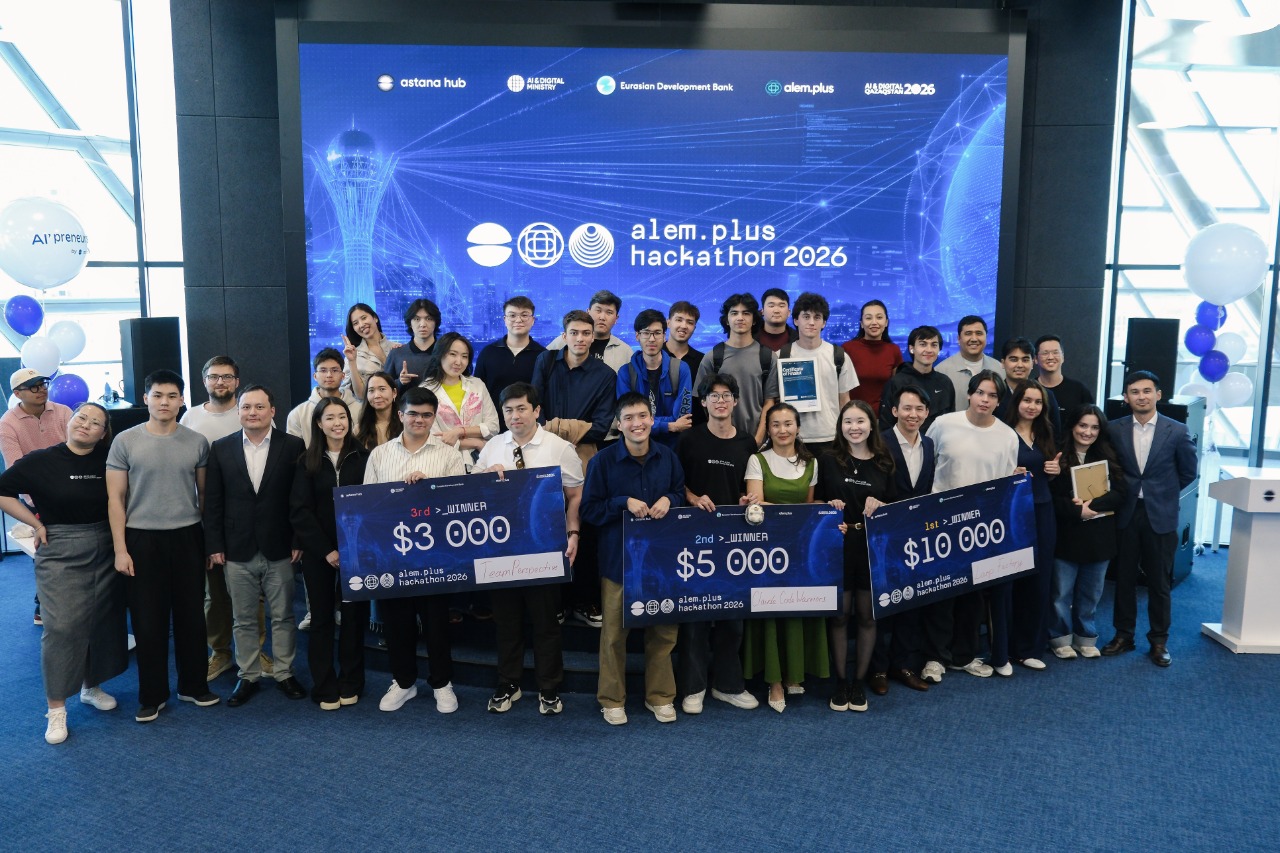
The winner of the hackathon was the Kazakh team Larp Factory with the project RekoAI — an AI assistant that automatically generates electronic invoices from bank statements and PDF documents. The team focused on one of the most painful challenges for SMEs: manual accounting and document processing.
Second place went to the Kyrgyz team Claude Code Warriors with the project Tumar. The name refers to an ancient Kazakh protective amulet, which, according to the creators, in the digital era is meant to protect national LLM models from cyberattacks, vulnerabilities, and attempts to manipulate AI systems.
Third place was awarded to the Tajik team Team Perspective with the project AquaTerra — a Central Asian agriculture platform described by its developers as a “Google Maps for farmers.” The service uses AI and geo-analytics to monitor land, assess field conditions, and improve agricultural efficiency.
For Central Asia, such initiatives are becoming an increasingly important part of the technological ecosystem: the AI market in the region is still in its early stage, but interest in local products, national language models, and AI-driven automation is growing rapidly.
Special attention was given by organizers to the development of the ecosystem around the AlemPlus project. The AlemPlus AI platform was created with the support of the Digital Initiatives Fund of the Eurasian Development Bank and became one of the key hackathon platforms, bringing together participants, experts, and teams around the development of applied AI solutions for the region. Today, the fund actively supports digital initiatives and technological cooperation across Central Asian countries.
Over several weeks, participants were tasked with building MVP AI products capable of solving real business and user problems, ranging from document workflow automation to cybersecurity and agritech solutions.
Ten strongest teams advanced to the Demo Day. The final was held in a short pitch format: each startup had only three minutes to explain their idea, demonstrate the product, and convince the jury that their solution had scaling potential.
The winner of the hackathon was the Kazakh team Larp Factory with the project RekoAI — an AI assistant that automatically generates electronic invoices from bank statements and PDF documents. The team focused on one of the most painful challenges for SMEs: manual accounting and document processing.
Second place went to the Kyrgyz team Claude Code Warriors with the project Tumar. The name refers to an ancient Kazakh protective amulet, which, according to the creators, in the digital era is meant to protect national LLM models from cyberattacks, vulnerabilities, and attempts to manipulate AI systems.
Third place was awarded to the Tajik team Team Perspective with the project AquaTerra — a Central Asian agriculture platform described by its developers as a “Google Maps for farmers.” The service uses AI and geo-analytics to monitor land, assess field conditions, and improve agricultural efficiency.
For Central Asia, such initiatives are becoming an increasingly important part of the technological ecosystem: the AI market in the region is still in its early stage, but interest in local products, national language models, and AI-driven automation is growing rapidly.
Special attention was given by organizers to the development of the ecosystem around the AlemPlus project. The AlemPlus AI platform was created with the support of the Digital Initiatives Fund of the Eurasian Development Bank and became one of the key hackathon platforms, bringing together participants, experts, and teams around the development of applied AI solutions for the region. Today, the fund actively supports digital initiatives and technological cooperation across Central Asian countries.

 Share
Share