
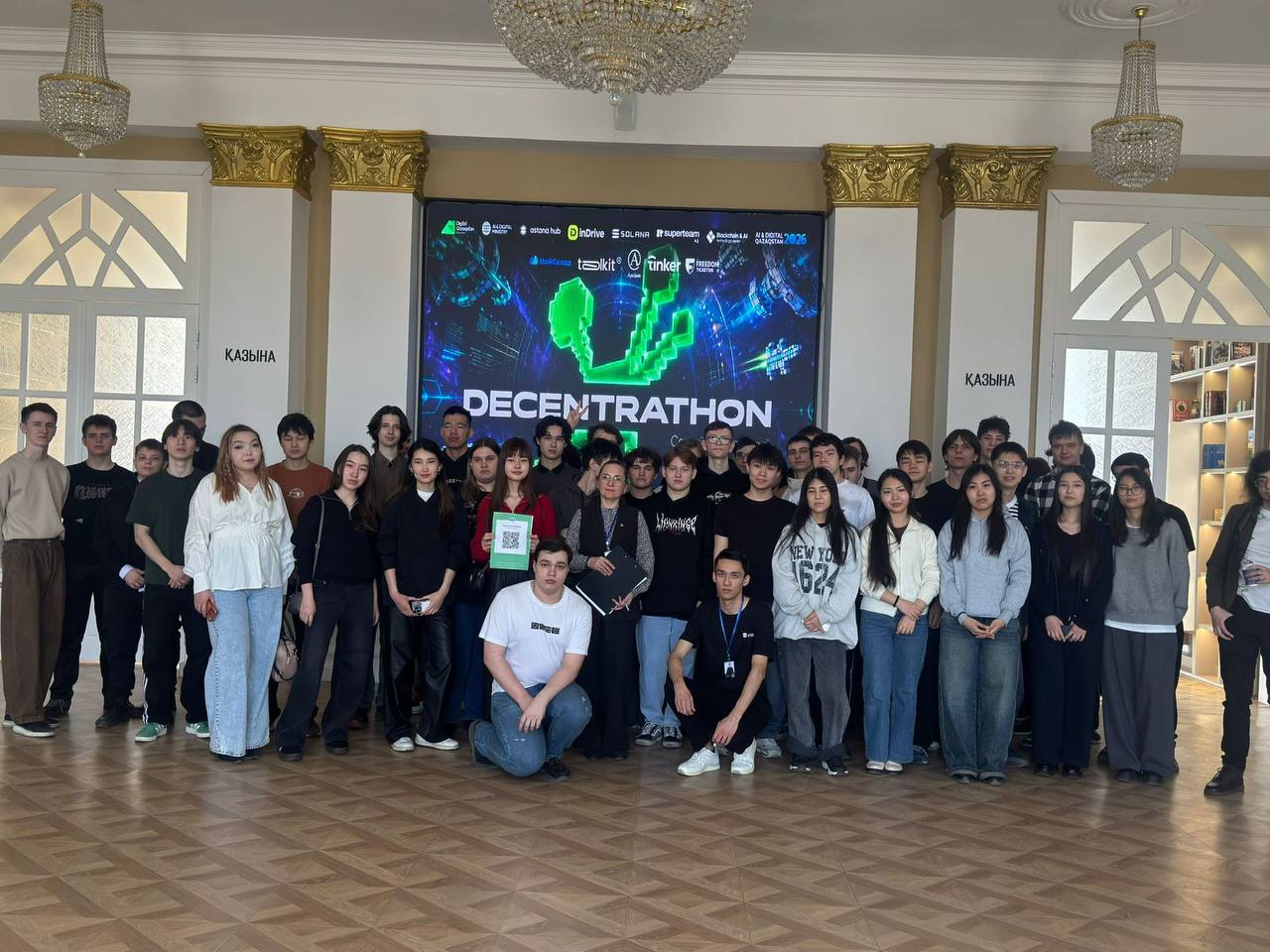





For the first time in the project’s history, the official opening of Decentrathon was held in Shymkent as part of the first national technology forum Digital Qazaqstan, marking the launch of a new national platform aimed at uniting regions around digital and AI transformation.
In its fifth iteration, Decentrathon brought together more than 5,500 participants and over 2,300 teams. As a result of the hackathon, more than 500 technological solutions were presented across artificial intelligence and blockchain tracks. These figures set a new record for the project and confirmed the steady growth of Decentrathon as one of the largest platforms for young developers, startup teams, and tech specialists in the region.
“Decentrathon 5.0 has become not only a record-breaking hackathon for us, but also an important signal of where the culture of technology competitions is heading. Today it is already a platform where, within a few days, projects with startup-level logic, clear market potential, and an AI-driven technological core can emerge. Therefore, we see the next iterations of Decentrathon as a transition to a new level—from a competition of solutions to a competition of technological systems. In the future, teams will launch not only prototypes, but autonomous AI agents capable of acting, making decisions, competing with each other, and delivering real-world results,” said Astana Hub CEO Magzhan Madiev.
This year the hackathon featured two main tracks: AI and Blockchain. In the blockchain direction, the Solana National Hackathon powered by Decentrathon had a prize pool of $20,000. In the AI direction, the inDrive track had a prize pool of 10,000,000 KZT, while the alem.plus track offered 2,500,000 KZT.
The blockchain track was represented by the Solana National Hackathon powered by Decentrathon, with Superteam KZ as a partner. Participants worked on two themes: Tokenization of Real-World Assets and AI + Blockchain: Autonomous Smart Contracts.
In the first track, teams developed solutions related to the tokenization of real-world assets and new models of digital ownership, accounting, and value transfer. In the second, they explored the intersection of AI and blockchain, including autonomous smart contracts and new use cases for decentralized technologies.
“Decentrathon 5.0 demonstrates the maturity of the regional technology ecosystem. We see growing interest in practical blockchain applications—from tokenization of real-world assets to AI integration. For Superteam KZ, it is important that such initiatives form a strong pool of developers ready to work at a global level, and we will continue supporting their development within the Solana ecosystem,” said Superteam KZ lead Talgat Dosanov.
The key AI partner inDrive introduced two tracks. The first focused on building AI/data-driven solutions for selecting candidates for inVision U university. Participants were tasked with creating tools to improve application processing efficiency and identify promising candidates.
The second inDrive track focused on applying artificial intelligence to priority public sector challenges. Teams developed solutions aimed at improving public services efficiency, data analysis, process automation, and AI integration into government workflows.
“Decentrathon showed exactly what we wanted to see: participants approached tasks not as a technical exercise, but as real products. Teams focused on trust, transparency, explainability, and applicability of their solutions rather than simply ‘adding AI’ to an idea. In the final, the gap between top projects was minimal, which shows a very high level. For inDrive, it is especially valuable that the hackathon did not end at the presentation stage: we are considering the best solutions as a foundation for the next step—from prototype to pilot with real clients,” said inDrive CTO Yuri Misnik.
A separate AI track was organized by alem.plus, where participants developed AI projects using the platform’s tools across various domains—from workflow automation to new digital services and user-facing products.
Winners of Decentrathon 5.0 were teams from different cities and countries. In the AI track by inDrive, the best results were shown by teams LA, Kazachi Kapai, Core 2 Duo, Specimen AI, DataNomads, and AInsomnia from Astana, Almaty, and Ust-Kamenogorsk.
In the alem.plus track, winners included Butaq, INSPIRO, and Level up map from Almaty, Karaganda, and Taraz.
In the Solana National Hackathon powered by Decentrathon, the winning teams were Node Runners, Cryptonite, Zerde, Claude Opus, alem zhiv, and EVEREST. Their projects were developed in the areas of Tokenization of Real-World Assets and AI + Blockchain: Autonomous Smart Contracts, with participants from Astana, Almaty, Petropavlovsk, Aktau, and Pavlodar.
Since its launch, Decentrathon has evolved from a regional hackathon into a national technology platform uniting thousands of participants, leading IT companies, government institutions, and the international community. Decentrathon 5.0 marked a new stage of this growth: a record number of participants, hybrid format, teams from six countries, and practical partner-driven tracks showed that the hackathon is becoming not just a competition, but a full-fledged mechanism for talent discovery and real-sector innovation.


For the first time in the project’s history, the official opening of Decentrathon was held in Shymkent as part of the first national technology forum Digital Qazaqstan, marking the launch of a new national platform aimed at uniting regions around digital and AI transformation.
In its fifth iteration, Decentrathon brought together more than 5,500 participants and over 2,300 teams. As a result of the hackathon, more than 500 technological solutions were presented across artificial intelligence and blockchain tracks. These figures set a new record for the project and confirmed the steady growth of Decentrathon as one of the largest platforms for young developers, startup teams, and tech specialists in the region.
“Decentrathon 5.0 has become not only a record-breaking hackathon for us, but also an important signal of where the culture of technology competitions is heading. Today it is already a platform where, within a few days, projects with startup-level logic, clear market potential, and an AI-driven technological core can emerge. Therefore, we see the next iterations of Decentrathon as a transition to a new level—from a competition of solutions to a competition of technological systems. In the future, teams will launch not only prototypes, but autonomous AI agents capable of acting, making decisions, competing with each other, and delivering real-world results,” said Astana Hub CEO Magzhan Madiev.
This year the hackathon featured two main tracks: AI and Blockchain. In the blockchain direction, the Solana National Hackathon powered by Decentrathon had a prize pool of $20,000. In the AI direction, the inDrive track had a prize pool of 10,000,000 KZT, while the alem.plus track offered 2,500,000 KZT.
The blockchain track was represented by the Solana National Hackathon powered by Decentrathon, with Superteam KZ as a partner. Participants worked on two themes: Tokenization of Real-World Assets and AI + Blockchain: Autonomous Smart Contracts.
In the first track, teams developed solutions related to the tokenization of real-world assets and new models of digital ownership, accounting, and value transfer. In the second, they explored the intersection of AI and blockchain, including autonomous smart contracts and new use cases for decentralized technologies.
“Decentrathon 5.0 demonstrates the maturity of the regional technology ecosystem. We see growing interest in practical blockchain applications—from tokenization of real-world assets to AI integration. For Superteam KZ, it is important that such initiatives form a strong pool of developers ready to work at a global level, and we will continue supporting their development within the Solana ecosystem,” said Superteam KZ lead Talgat Dosanov.
The key AI partner inDrive introduced two tracks. The first focused on building AI/data-driven solutions for selecting candidates for inVision U university. Participants were tasked with creating tools to improve application processing efficiency and identify promising candidates.
The second inDrive track focused on applying artificial intelligence to priority public sector challenges. Teams developed solutions aimed at improving public services efficiency, data analysis, process automation, and AI integration into government workflows.
“Decentrathon showed exactly what we wanted to see: participants approached tasks not as a technical exercise, but as real products. Teams focused on trust, transparency, explainability, and applicability of their solutions rather than simply ‘adding AI’ to an idea. In the final, the gap between top projects was minimal, which shows a very high level. For inDrive, it is especially valuable that the hackathon did not end at the presentation stage: we are considering the best solutions as a foundation for the next step—from prototype to pilot with real clients,” said inDrive CTO Yuri Misnik.
A separate AI track was organized by alem.plus, where participants developed AI projects using the platform’s tools across various domains—from workflow automation to new digital services and user-facing products.
Winners of Decentrathon 5.0 were teams from different cities and countries. In the AI track by inDrive, the best results were shown by teams LA, Kazachi Kapai, Core 2 Duo, Specimen AI, DataNomads, and AInsomnia from Astana, Almaty, and Ust-Kamenogorsk.
In the alem.plus track, winners included Butaq, INSPIRO, and Level up map from Almaty, Karaganda, and Taraz.
In the Solana National Hackathon powered by Decentrathon, the winning teams were Node Runners, Cryptonite, Zerde, Claude Opus, alem zhiv, and EVEREST. Their projects were developed in the areas of Tokenization of Real-World Assets and AI + Blockchain: Autonomous Smart Contracts, with participants from Astana, Almaty, Petropavlovsk, Aktau, and Pavlodar.
Since its launch, Decentrathon has evolved from a regional hackathon into a national technology platform uniting thousands of participants, leading IT companies, government institutions, and the international community. Decentrathon 5.0 marked a new stage of this growth: a record number of participants, hybrid format, teams from six countries, and practical partner-driven tracks showed that the hackathon is becoming not just a competition, but a full-fledged mechanism for talent discovery and real-sector innovation.

 Share
Share