
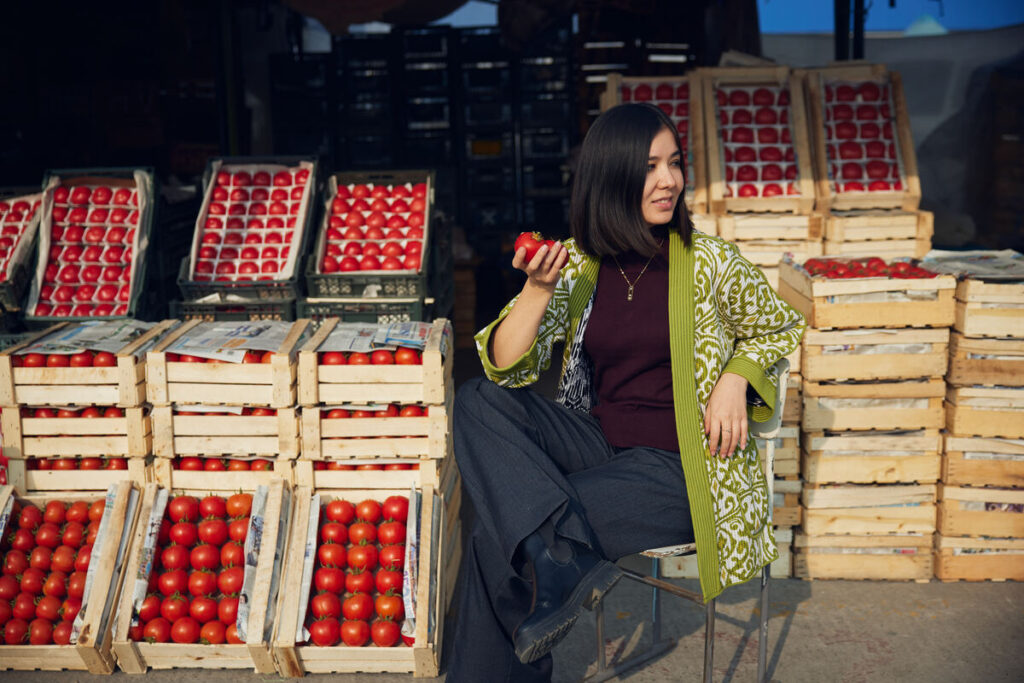





As part of the joint project by Digital Business and Astana Hub, “100 Startup Stories of Central Asia,” Dildora shared how she unexpectedly became the CEO of Dalatek, how much she invested in the startup, and why she shut down a profitable business line. We also discussed why she decided to rebuild the project, what global problem she is now working to solve, and why starting a business does not always require a lot of money.
“Usually, a Startup Founder Comes Up with an Idea First and Funding Later. For Me, It Was the Other Way Around”
— Dildora, you started your entrepreneurial journey with a traditional business. What were you doing?
— In 2017, I returned to Tashkent from Malaysia, where I studied engineering at the Asia Pacific University in Kuala Lumpur. Around the same time, I founded Teodora Goods, a company that exports agricultural products from Uzbekistan worldwide. This project is still operating today.
— Why did you decide to create an IT startup as well?
— Several factors came together. In agricultural exports, each shipment requires the same set of actions, and there are about 20 scenarios of what can go wrong — from spoiled produce to difficulties finding packers, and more.
In addition, nothing in this business in Uzbekistan is digitized. To hire packers or start working with farmers, you have to get in a car, drive to villages, and ask around. And during the first working days, you have to personally supervise the processes.
For example, with packers, you need to arrive at the cold storage facility by 5 a.m., assign people to stations, and explain how everything should be organized. Otherwise, they might sit wherever they want, with boxes in one corner and produce in another. Then you have to pack goods yourself for about an hour to understand how much can realistically be done in that time and correctly assess productivity when you’re not there.
Despite all these challenges, exporting fruits and vegetables is a highly profitable business. One truck can carry goods worth anywhere from $7,000 to $200,000, depending on the product’s cost. If something goes wrong, the losses can be substantial.
Over the years at Teodora Goods, I encountered almost every possible issue, gained a deep understanding of the business, and realized how digitalization could solve many of these problems.
— When did the idea for Dalatek emerge?
— Usually, a startup founder comes up with an idea first and funding later. For me, it was the opposite. In 2020, my future co-founder and investor, Laziz Adkhamov, told me he wanted to create an agrotech platform to digitize the export process and invited me to join as a consultant.
I agreed, but at the first meeting I was introduced as the director, and later I received an equity stake in the company.
— What challenges did you face at the beginning?
— At that point, I had no startup experience and no IT background. For a long time, I was learning processes from scratch, implementing Laziz’s ideas, and trying to keep up with everything.
Joining the Silkway Accelerator by Astana Hub and Google for Startups helped a lot. Because of my experience with Teodora Goods, I was respected right away — in the first year, that business had already reached $500,000 in revenue. But when I mentioned how small my equity stake in Dalatek was at the time, the mentors gave me an ultimatum: if I didn’t talk to my co-founder and increase my share within a day, I wouldn’t move forward in the program. In the end, I managed to increase my stake.
The program helped me understand how startups work and what challenges to expect, but most of the learning still happened in practice.
“We Went Through a Huge Number of Failures — and Accepted Them”
— How did you finance the project?
— In total, about $170,000–200,000 has been invested in Dalatek, with most of it spent during the first two years. This wasn’t classic fundraising. At the end of each month, I reported expenses to Laziz, and we were transferred the required amount — on average $5,000 to $10,000.
— When did you start generating revenue?
— We achieved our first stable profit in the third year, when we began working with HoReCa businesses. We acted as an intermediary between wholesale food markets and restaurants — purchasing produce in bulk, distributing it, and delivering it to restaurants.
Finding clients wasn’t an issue: restaurants were happy to work with us, since they couldn’t deal directly with wholesale suppliers. Sometimes a restaurant needs just 5 kg of potatoes, while farmers sell in batches of 20 tons or more.
We operated under this model for four months, doubling revenue each month, eventually reaching $70,000 in monthly turnover. Our earnings were 10% of that amount — about $7,000.
— Despite this, you shut down that business line. Why?
— When we grew to 35 restaurants, the system broke down. Clients started complaining about product quality and delivery disruptions. Maintaining consistency became almost impossible: the workday started at 5 a.m., and by 6:30 a.m. the goods had to be delivered. In that short time, we had to purchase produce, divide it into batches, issue invoices, and more.
In this constant rush, there was neither time nor resources for proper quality control. As a result, defective or incorrect products could end up in some crates.
— Over five years, Dalatek has transformed several times. What does the startup do now?
— We are rebuilding the project. We went through many failures, accepted them, and stopped positioning ourselves as a startup. We realized that before developing mobile apps or digital products, it’s crucial to establish proper processes between farmers, large businesses, and the government — and to solve a major systemic problem.
— What problem are you referring to?
— Uzbekistan lacks a clear strategy for exporting agricultural products. Today, around 70% of produce grown in the country is wasted. Similar situations exist in other countries. This happens because processes are not properly organized.
Export strategies must be developed separately for each product. You can’t sell cherries, which spoil within three weeks, using the same approach as pumpkins, which can be stored for up to six months. Farm size also matters. A common mistake made by entrepreneurs unfamiliar with agriculture is trying to create a single solution for everyone — which inevitably fails.
Over eight years in business, I’ve traveled frequently for training in different countries. Recently, I spent a month in Japan. That trip changed my strategy: I realized that first, we need to put things in order nationwide for at least one product, and only then expand to others.
— Where did you start?
— I returned to Tashkent and almost immediately received cooperation offers. I am now working as a consultant with three government institutions. We are launching a tomato supply chain by creating a cooperative of small and large tomato farmers, uniting them under a single legal entity and bank account. Together, we are developing a strategy to sell produce domestically and for export.
We are also accelerating the development of insurance products for cooperative members. Despite agricultural exports being a high-risk business — where losses of $100,000 can happen overnight — there are still no protection instruments in the country. We are also working on banking solutions, such as factoring and procurement financing.
Another key area is storage infrastructure. Uzbekistan has many cold storage facilities, but rentals are often informal, without contracts, making it impossible to protect interests in case of issues. As part of a pilot, we are auditing and standardizing cold storage facilities to guarantee product quality.
As a result, a closed-loop supply chain is being formed, ensuring stable delivery from farmers to clients — supermarkets, restaurants, and international buyers. Farmers have already been selected, insurance products and banking solutions are partially ready, and cold storage facilities are currently being inspected.
Read more on Digitalbusiness.kz.
As part of the joint project by Digital Business and Astana Hub, “100 Startup Stories of Central Asia,” Dildora shared how she unexpectedly became the CEO of Dalatek, how much she invested in the startup, and why she shut down a profitable business line. We also discussed why she decided to rebuild the project, what global problem she is now working to solve, and why starting a business does not always require a lot of money.
“Usually, a Startup Founder Comes Up with an Idea First and Funding Later. For Me, It Was the Other Way Around”
— Dildora, you started your entrepreneurial journey with a traditional business. What were you doing?
— In 2017, I returned to Tashkent from Malaysia, where I studied engineering at the Asia Pacific University in Kuala Lumpur. Around the same time, I founded Teodora Goods, a company that exports agricultural products from Uzbekistan worldwide. This project is still operating today.
— Why did you decide to create an IT startup as well?
— Several factors came together. In agricultural exports, each shipment requires the same set of actions, and there are about 20 scenarios of what can go wrong — from spoiled produce to difficulties finding packers, and more.
In addition, nothing in this business in Uzbekistan is digitized. To hire packers or start working with farmers, you have to get in a car, drive to villages, and ask around. And during the first working days, you have to personally supervise the processes.
For example, with packers, you need to arrive at the cold storage facility by 5 a.m., assign people to stations, and explain how everything should be organized. Otherwise, they might sit wherever they want, with boxes in one corner and produce in another. Then you have to pack goods yourself for about an hour to understand how much can realistically be done in that time and correctly assess productivity when you’re not there.
Despite all these challenges, exporting fruits and vegetables is a highly profitable business. One truck can carry goods worth anywhere from $7,000 to $200,000, depending on the product’s cost. If something goes wrong, the losses can be substantial.
Over the years at Teodora Goods, I encountered almost every possible issue, gained a deep understanding of the business, and realized how digitalization could solve many of these problems.
— When did the idea for Dalatek emerge?
— Usually, a startup founder comes up with an idea first and funding later. For me, it was the opposite. In 2020, my future co-founder and investor, Laziz Adkhamov, told me he wanted to create an agrotech platform to digitize the export process and invited me to join as a consultant.
I agreed, but at the first meeting I was introduced as the director, and later I received an equity stake in the company.
— What challenges did you face at the beginning?
— At that point, I had no startup experience and no IT background. For a long time, I was learning processes from scratch, implementing Laziz’s ideas, and trying to keep up with everything.
Joining the Silkway Accelerator by Astana Hub and Google for Startups helped a lot. Because of my experience with Teodora Goods, I was respected right away — in the first year, that business had already reached $500,000 in revenue. But when I mentioned how small my equity stake in Dalatek was at the time, the mentors gave me an ultimatum: if I didn’t talk to my co-founder and increase my share within a day, I wouldn’t move forward in the program. In the end, I managed to increase my stake.
The program helped me understand how startups work and what challenges to expect, but most of the learning still happened in practice.
“We Went Through a Huge Number of Failures — and Accepted Them”
— How did you finance the project?
— In total, about $170,000–200,000 has been invested in Dalatek, with most of it spent during the first two years. This wasn’t classic fundraising. At the end of each month, I reported expenses to Laziz, and we were transferred the required amount — on average $5,000 to $10,000.
— When did you start generating revenue?
— We achieved our first stable profit in the third year, when we began working with HoReCa businesses. We acted as an intermediary between wholesale food markets and restaurants — purchasing produce in bulk, distributing it, and delivering it to restaurants.
Finding clients wasn’t an issue: restaurants were happy to work with us, since they couldn’t deal directly with wholesale suppliers. Sometimes a restaurant needs just 5 kg of potatoes, while farmers sell in batches of 20 tons or more.
We operated under this model for four months, doubling revenue each month, eventually reaching $70,000 in monthly turnover. Our earnings were 10% of that amount — about $7,000.
— Despite this, you shut down that business line. Why?
— When we grew to 35 restaurants, the system broke down. Clients started complaining about product quality and delivery disruptions. Maintaining consistency became almost impossible: the workday started at 5 a.m., and by 6:30 a.m. the goods had to be delivered. In that short time, we had to purchase produce, divide it into batches, issue invoices, and more.
In this constant rush, there was neither time nor resources for proper quality control. As a result, defective or incorrect products could end up in some crates.
— Over five years, Dalatek has transformed several times. What does the startup do now?
— We are rebuilding the project. We went through many failures, accepted them, and stopped positioning ourselves as a startup. We realized that before developing mobile apps or digital products, it’s crucial to establish proper processes between farmers, large businesses, and the government — and to solve a major systemic problem.
— What problem are you referring to?
— Uzbekistan lacks a clear strategy for exporting agricultural products. Today, around 70% of produce grown in the country is wasted. Similar situations exist in other countries. This happens because processes are not properly organized.
Export strategies must be developed separately for each product. You can’t sell cherries, which spoil within three weeks, using the same approach as pumpkins, which can be stored for up to six months. Farm size also matters. A common mistake made by entrepreneurs unfamiliar with agriculture is trying to create a single solution for everyone — which inevitably fails.
Over eight years in business, I’ve traveled frequently for training in different countries. Recently, I spent a month in Japan. That trip changed my strategy: I realized that first, we need to put things in order nationwide for at least one product, and only then expand to others.
— Where did you start?
— I returned to Tashkent and almost immediately received cooperation offers. I am now working as a consultant with three government institutions. We are launching a tomato supply chain by creating a cooperative of small and large tomato farmers, uniting them under a single legal entity and bank account. Together, we are developing a strategy to sell produce domestically and for export.
We are also accelerating the development of insurance products for cooperative members. Despite agricultural exports being a high-risk business — where losses of $100,000 can happen overnight — there are still no protection instruments in the country. We are also working on banking solutions, such as factoring and procurement financing.
Another key area is storage infrastructure. Uzbekistan has many cold storage facilities, but rentals are often informal, without contracts, making it impossible to protect interests in case of issues. As part of a pilot, we are auditing and standardizing cold storage facilities to guarantee product quality.
As a result, a closed-loop supply chain is being formed, ensuring stable delivery from farmers to clients — supermarkets, restaurants, and international buyers. Farmers have already been selected, insurance products and banking solutions are partially ready, and cold storage facilities are currently being inspected.
Read more on Digitalbusiness.kz.

 Share
Share