





Participants discussed the shift from isolated digitalization initiatives to a systemic development model, where data, regional IT hubs, and talent development play a central role. Special attention was given to the creation of regional “data lakes” as foundational infrastructure for AI-driven solutions — ranging from urban management to the development of the agro-industrial sector.
Vice Minister of Artificial Intelligence and Digital Development of the Republic of Kazakhstan, Dmitry Mun, noted that intelligent systems in the regions are not about technology for its own sake, but about efficiency, equal access to services, and real economic impact. “Our task is to implement unified digital standards so that residents of any rural district have the same intelligent access to healthcare, education, and public services as residents of major cities. Digital comfort must become a basic standard of quality of life for every citizen of Kazakhstan,” he said.
Continuing the theme of ecosystem development, CEO of Astana Hub Magzhan Madiyev presented the strategy for building regional IT hubs as growth points for local technology ecosystems. He emphasized that Kazakhstan’s digital transformation is entering a new phase, where regions are becoming centers for talent attraction, investment, and technological entrepreneurship.

The results achieved by Astana Hub serve as a strong argument for expanding the network of 19 regional IT hubs. The central platform has demonstrated significant achievements, including attracting investments from Google and Microsoft, creating 30,000 jobs, and increasing the total revenue of participants by 67 times, reaching 2.5 trillion tenge. Thanks to a unique tax multiplier model tested in the capital, regional hubs are provided with a proven framework for success. Scaling this network will help decentralize the IT industry, giving local businesses access to the same tools for rapid growth and infrastructure expansion that have already proven effective at the national level.
He also noted that ecosystem development follows a full-funnel approach — from Startup School and Startup Orda programs to international accelerators such as Silkway Accelerator, implemented in partnership with Google for Startups, Hero Training, and AlchemistX. This enables startups to attract investment, access infrastructure, and expand into markets such as the United States, the UAE, and China. Among successful case studies are CITIX and Arlan Biotech, which demonstrate Kazakhstan’s potential as a technological bridge between regions.
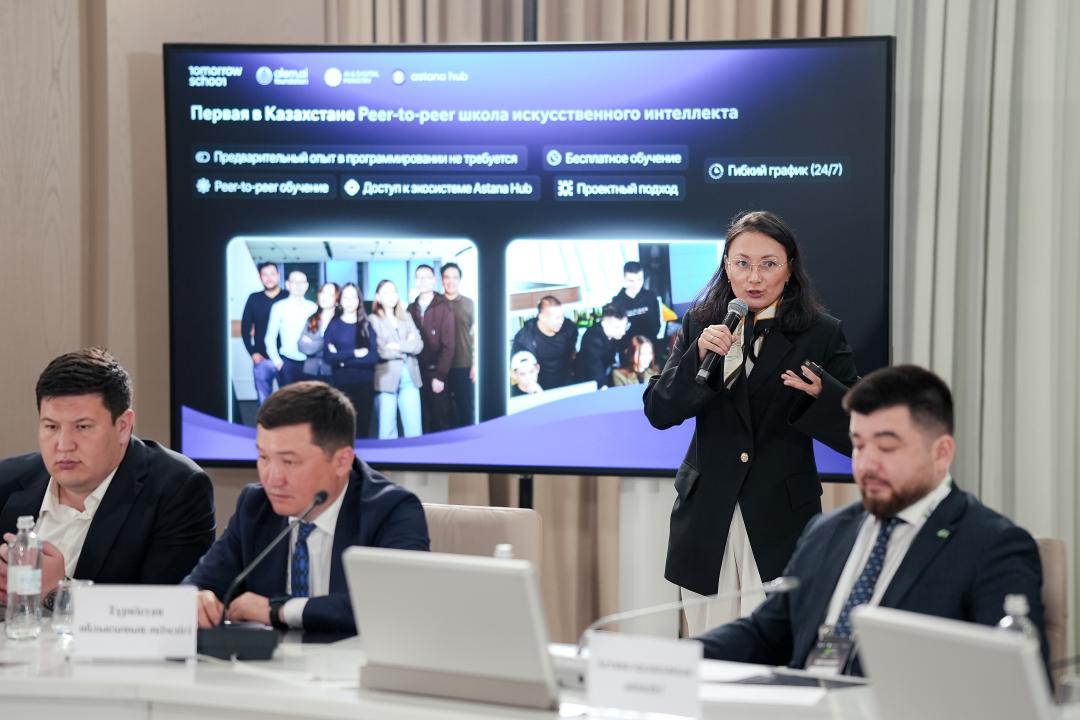
CEO of the Alem.ai Foundation, Adina Magavina, focused on talent development as a key pillar of digital transformation. She presented the TUMO and Tomorrow School initiatives as the foundation for a new generation of specialists in artificial intelligence, programming, and creative industries, providing free access to modern IT education.
It was noted that the TUMO Astana center, implemented on the basis of alem.ai, is part of an international network of creative technology centers offering supplementary education for teenagers aged 12 to 18 in fields related to AI, IT, creative skills, and digital industries. The center is already demonstrating strong demand, with over 2,700 registered participants and more than 1,600 students enrolled, against a planned annual capacity of up to 5,000 learners. The platform serves as a pilot and operational hub for further scaling across Kazakhstan’s regions.
Meanwhile, Tomorrow School is Kazakhstan’s first peer-to-peer programming and AI school, based on a practice-oriented learning model without traditional teachers, focusing on real project work and mutual learning among participants. The project is currently in an active scaling phase, with plans to launch campuses across 17 regions and 2 cities of republican significance in partnership with regional universities and local executive bodies.
The discussion also included Mukhit Kemelov, Head of the Digital Transformation Department of Shymkent, and Ruslan Alishev, Head of the Office of the Akim of North Kazakhstan Region. Participants emphasized the importance of practical implementation of digital solutions at the city and rural levels, including the development of smart cities, AI adoption in agriculture, IT infrastructure in district centers, and improved access to digital government services.
It should be noted that on March 27, the Digital Qazaqstan 2026 Forum is taking place in Shymkent under the theme “Industry 5.0: The Power of Collaboration.” The forum is organized by the Ministry of Artificial Intelligence and Digital Development of the Republic of Kazakhstan, the Akimat of Shymkent, and the Astana Hub international innovation cluster.
This year’s forum is made possible thanks to the support of partners and sponsors. All expenses are covered through sponsorship funding.
General Partner: Freedom Bank – a Kazakh digital bank for retail and corporate clients, part of Freedom Holding Corp. The bank was the first in Kazakhstan to fully digitize mortgage, auto, and business loans, and launched the country’s first investor card, INVEST CARD.
Platinum Partner: Alageum Electric – a major electrical engineering group in Kazakhstan uniting more than 30 enterprises in the energy, engineering, and infrastructure construction sectors.
Gold Partner: Kazakhtelecom.
Innovation Partners: WSE, Damumed.
Partner: Visa.
Participants discussed the shift from isolated digitalization initiatives to a systemic development model, where data, regional IT hubs, and talent development play a central role. Special attention was given to the creation of regional “data lakes” as foundational infrastructure for AI-driven solutions — ranging from urban management to the development of the agro-industrial sector.
Vice Minister of Artificial Intelligence and Digital Development of the Republic of Kazakhstan, Dmitry Mun, noted that intelligent systems in the regions are not about technology for its own sake, but about efficiency, equal access to services, and real economic impact. “Our task is to implement unified digital standards so that residents of any rural district have the same intelligent access to healthcare, education, and public services as residents of major cities. Digital comfort must become a basic standard of quality of life for every citizen of Kazakhstan,” he said.
Continuing the theme of ecosystem development, CEO of Astana Hub Magzhan Madiyev presented the strategy for building regional IT hubs as growth points for local technology ecosystems. He emphasized that Kazakhstan’s digital transformation is entering a new phase, where regions are becoming centers for talent attraction, investment, and technological entrepreneurship.
The results achieved by Astana Hub serve as a strong argument for expanding the network of 19 regional IT hubs. The central platform has demonstrated significant achievements, including attracting investments from Google and Microsoft, creating 30,000 jobs, and increasing the total revenue of participants by 67 times, reaching 2.5 trillion tenge. Thanks to a unique tax multiplier model tested in the capital, regional hubs are provided with a proven framework for success. Scaling this network will help decentralize the IT industry, giving local businesses access to the same tools for rapid growth and infrastructure expansion that have already proven effective at the national level.
He also noted that ecosystem development follows a full-funnel approach — from Startup School and Startup Orda programs to international accelerators such as Silkway Accelerator, implemented in partnership with Google for Startups, Hero Training, and AlchemistX. This enables startups to attract investment, access infrastructure, and expand into markets such as the United States, the UAE, and China. Among successful case studies are CITIX and Arlan Biotech, which demonstrate Kazakhstan’s potential as a technological bridge between regions.
CEO of the Alem.ai Foundation, Adina Magavina, focused on talent development as a key pillar of digital transformation. She presented the TUMO and Tomorrow School initiatives as the foundation for a new generation of specialists in artificial intelligence, programming, and creative industries, providing free access to modern IT education.
It was noted that the TUMO Astana center, implemented on the basis of alem.ai, is part of an international network of creative technology centers offering supplementary education for teenagers aged 12 to 18 in fields related to AI, IT, creative skills, and digital industries. The center is already demonstrating strong demand, with over 2,700 registered participants and more than 1,600 students enrolled, against a planned annual capacity of up to 5,000 learners. The platform serves as a pilot and operational hub for further scaling across Kazakhstan’s regions.
Meanwhile, Tomorrow School is Kazakhstan’s first peer-to-peer programming and AI school, based on a practice-oriented learning model without traditional teachers, focusing on real project work and mutual learning among participants. The project is currently in an active scaling phase, with plans to launch campuses across 17 regions and 2 cities of republican significance in partnership with regional universities and local executive bodies.
The discussion also included Mukhit Kemelov, Head of the Digital Transformation Department of Shymkent, and Ruslan Alishev, Head of the Office of the Akim of North Kazakhstan Region. Participants emphasized the importance of practical implementation of digital solutions at the city and rural levels, including the development of smart cities, AI adoption in agriculture, IT infrastructure in district centers, and improved access to digital government services.
It should be noted that on March 27, the Digital Qazaqstan 2026 Forum is taking place in Shymkent under the theme “Industry 5.0: The Power of Collaboration.” The forum is organized by the Ministry of Artificial Intelligence and Digital Development of the Republic of Kazakhstan, the Akimat of Shymkent, and the Astana Hub international innovation cluster.
This year’s forum is made possible thanks to the support of partners and sponsors. All expenses are covered through sponsorship funding.
General Partner: Freedom Bank – a Kazakh digital bank for retail and corporate clients, part of Freedom Holding Corp. The bank was the first in Kazakhstan to fully digitize mortgage, auto, and business loans, and launched the country’s first investor card, INVEST CARD.
Platinum Partner: Alageum Electric – a major electrical engineering group in Kazakhstan uniting more than 30 enterprises in the energy, engineering, and infrastructure construction sectors.
Gold Partner: Kazakhtelecom.
Innovation Partners: WSE, Damumed.
Partner: Visa.

 Share
Share