
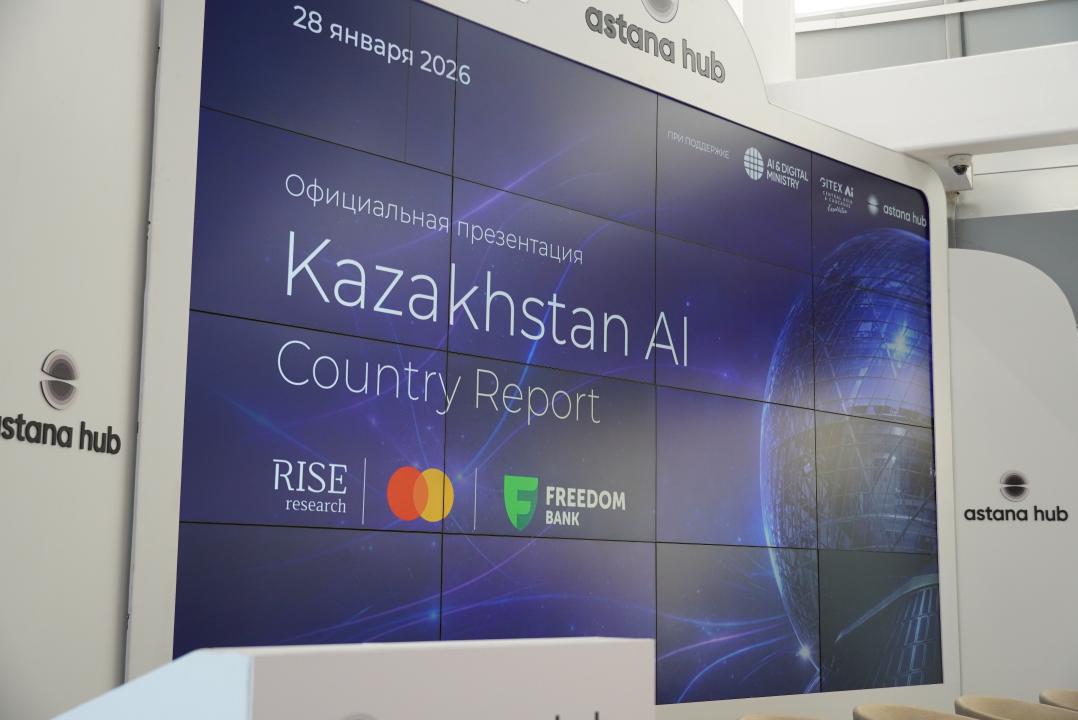





These figures are presented in the Kazakhstan AI Country Report — the country’s first comprehensive overview of the AI market, covering government strategy, digital and computing infrastructure, human capital, startups, venture investments, and sectoral AI use cases. The official presentation of the report took place today at the Astana Hub Event Hall in the capital of Kazakhstan.
The study was prepared by the analytical agency RISE Research in cooperation with Mastercard and Freedom Bank, with the support of the Ministry of Artificial Intelligence and Digital Development of the Republic of Kazakhstan and GITEX AI Central Asia & Caucasus. The report is based on more than 30 in-depth interviews with practitioners, an analysis of international benchmarks, business models of over 100 Kazakhstani AI startups, and 10 practical AI implementation case studies.
According to the report, Kazakhstan is entering a new phase of development, transitioning from digitalization to large-scale adoption of artificial intelligence. AI is viewed as a key factor for economic growth and strengthening the country’s international competitiveness. According to the authors’ estimates, AI adoption could provide an additional annual GDP growth of 0.5–2% in the medium term by increasing productivity across more than half of all jobs.
Dmitry Moon, Vice Minister of Artificial Intelligence and Digital Development of the Republic of Kazakhstan:
“Kazakhstan is implementing a comprehensive and institutionally anchored AI strategy, which includes the adoption of a dedicated Artificial Intelligence Law, the creation of a National AI Platform, the development of sovereign computing infrastructure, support for Kazakh-language large language models, the launch of the international AI center Alem.ai, and large-scale human capital development programs. As a result, by 2025 approximately one million people have already received AI training, and by 2030 we plan to equip five million citizens with basic and advanced AI skills.”
According to the report’s authors, most Kazakhstani AI startups are focused on applied B2B solutions and operate both in domestic and international markets. The highest concentration of projects is observed in Enterprise AI and business automation, Industry 4.0, MarTech, EdTech, and MedTech.
The year 2025 became a turning point for the ecosystem: the market saw the emergence of its first unicorn (a private technology company valued at over $1 billion) — Higgsfield AI — as well as the largest Bridge and Series A deals in Kazakhstan’s history. These milestones confirmed the ability of AI companies founded by Kazakhstani entrepreneurs to attract significant international capital.
Sanzhar Zhamalov, CEO of Mastercard in Kazakhstan and Central Asia:
“Mastercard views artificial intelligence as one of the key drivers of economic transformation, opening new opportunities for growth. The report reflects our vision of AI as a practical tool for improving productivity and strengthening business competitiveness in Kazakhstan. We are witnessing the formation of an ambitious AI ecosystem in the country with the potential to create world-class solutions, and we intend to be an active participant and a reliable technology partner in its development.”
The study separately analyzes the key foundations of the AI ecosystem — computing infrastructure and human capital. The report notes that computing capacity is no longer a critical constraint for AI development due to the launch of two new AI clusters (Alem.Cloud and AI-Farabium by Kazakhtelecom) with a combined capacity of approximately 3.6 exaflops. According to the authors’ estimates, around 2,000 H100/H200-class GPUs are already in operation across the country.
Industries with high digital maturity and significant data volumes are leading the adoption of AI, including the financial sector, telecommunications, electronic government services (eGov), retail, and IT, where AI is widely used in customer service, marketing, and analytics.
Aidos Zhumagulov, Member of the Board of Directors of Freedom Bank:
“The growth of venture investment and the emergence of the first unicorn confirm the maturity of Kazakhstan’s technology market. For the financial sector, this means a transition to more complex intelligent products. Today, banks use AI in risk management, fraud prevention, data analytics, and customer service. Large data volumes and high reliability requirements make financial institutions a natural environment for the practical application of such technologies. When this experience is supported by infrastructure, regulation, and talent development, it begins to work at the level of the entire economy. This approach forms the foundation for Kazakhstan’s long-term digital growth.”
At the same time, the government is placing a strategic emphasis on deploying AI in the real economy, as well as in socially significant sectors with high economic and public impact — including industry, agriculture, transport and logistics, energy, education, and healthcare.
The report also highlights the strengths and structural constraints of the AI market. The advantages include systematic government support, investment in sovereign computing and skills development, high digital maturity of the economy, and a growing startup ecosystem. An additional factor is the country’s young and educated population: in 2025, 21% of graduates chose engineering and ICT disciplines. At the same time, further scaling of AI is constrained by a shortage of high-quality industry data, uneven access to infrastructure and competencies across regions, low levels of R&D funding, a lack of experienced AI specialists, and limited access to late-stage venture capital.
Assel Abdrakhmanova, Managing Partner at RISE Research:
“Artificial intelligence in Kazakhstan is no longer a series of isolated experiments — it is becoming part of the country’s economic architecture, from startups and AI-driven corporate processes to the implementation of public policy in this field. The synchronized development of startups, business, and government is a key indicator of market maturity.”
The Kazakhstan AI Country Report is intended to serve as a reference point for investors, businesses, and government authorities in shaping long-term AI development strategies and integrating the country into the global economy as part of the strategic Generative Nation course.
The full version of the Kazakhstan AI Country Report in Kazakh, English, and Russian is available on the website www.rise.com.kz or via the provided link.
More details are available on the website of the Ministry of Artificial Intelligence and Digital Development of the Republic of Kazakhstan.
These figures are presented in the Kazakhstan AI Country Report — the country’s first comprehensive overview of the AI market, covering government strategy, digital and computing infrastructure, human capital, startups, venture investments, and sectoral AI use cases. The official presentation of the report took place today at the Astana Hub Event Hall in the capital of Kazakhstan.
The study was prepared by the analytical agency RISE Research in cooperation with Mastercard and Freedom Bank, with the support of the Ministry of Artificial Intelligence and Digital Development of the Republic of Kazakhstan and GITEX AI Central Asia & Caucasus. The report is based on more than 30 in-depth interviews with practitioners, an analysis of international benchmarks, business models of over 100 Kazakhstani AI startups, and 10 practical AI implementation case studies.
According to the report, Kazakhstan is entering a new phase of development, transitioning from digitalization to large-scale adoption of artificial intelligence. AI is viewed as a key factor for economic growth and strengthening the country’s international competitiveness. According to the authors’ estimates, AI adoption could provide an additional annual GDP growth of 0.5–2% in the medium term by increasing productivity across more than half of all jobs.
Dmitry Moon, Vice Minister of Artificial Intelligence and Digital Development of the Republic of Kazakhstan:
“Kazakhstan is implementing a comprehensive and institutionally anchored AI strategy, which includes the adoption of a dedicated Artificial Intelligence Law, the creation of a National AI Platform, the development of sovereign computing infrastructure, support for Kazakh-language large language models, the launch of the international AI center Alem.ai, and large-scale human capital development programs. As a result, by 2025 approximately one million people have already received AI training, and by 2030 we plan to equip five million citizens with basic and advanced AI skills.”
According to the report’s authors, most Kazakhstani AI startups are focused on applied B2B solutions and operate both in domestic and international markets. The highest concentration of projects is observed in Enterprise AI and business automation, Industry 4.0, MarTech, EdTech, and MedTech.
The year 2025 became a turning point for the ecosystem: the market saw the emergence of its first unicorn (a private technology company valued at over $1 billion) — Higgsfield AI — as well as the largest Bridge and Series A deals in Kazakhstan’s history. These milestones confirmed the ability of AI companies founded by Kazakhstani entrepreneurs to attract significant international capital.
Sanzhar Zhamalov, CEO of Mastercard in Kazakhstan and Central Asia:
“Mastercard views artificial intelligence as one of the key drivers of economic transformation, opening new opportunities for growth. The report reflects our vision of AI as a practical tool for improving productivity and strengthening business competitiveness in Kazakhstan. We are witnessing the formation of an ambitious AI ecosystem in the country with the potential to create world-class solutions, and we intend to be an active participant and a reliable technology partner in its development.”
The study separately analyzes the key foundations of the AI ecosystem — computing infrastructure and human capital. The report notes that computing capacity is no longer a critical constraint for AI development due to the launch of two new AI clusters (Alem.Cloud and AI-Farabium by Kazakhtelecom) with a combined capacity of approximately 3.6 exaflops. According to the authors’ estimates, around 2,000 H100/H200-class GPUs are already in operation across the country.
Industries with high digital maturity and significant data volumes are leading the adoption of AI, including the financial sector, telecommunications, electronic government services (eGov), retail, and IT, where AI is widely used in customer service, marketing, and analytics.
Aidos Zhumagulov, Member of the Board of Directors of Freedom Bank:
“The growth of venture investment and the emergence of the first unicorn confirm the maturity of Kazakhstan’s technology market. For the financial sector, this means a transition to more complex intelligent products. Today, banks use AI in risk management, fraud prevention, data analytics, and customer service. Large data volumes and high reliability requirements make financial institutions a natural environment for the practical application of such technologies. When this experience is supported by infrastructure, regulation, and talent development, it begins to work at the level of the entire economy. This approach forms the foundation for Kazakhstan’s long-term digital growth.”
At the same time, the government is placing a strategic emphasis on deploying AI in the real economy, as well as in socially significant sectors with high economic and public impact — including industry, agriculture, transport and logistics, energy, education, and healthcare.
The report also highlights the strengths and structural constraints of the AI market. The advantages include systematic government support, investment in sovereign computing and skills development, high digital maturity of the economy, and a growing startup ecosystem. An additional factor is the country’s young and educated population: in 2025, 21% of graduates chose engineering and ICT disciplines. At the same time, further scaling of AI is constrained by a shortage of high-quality industry data, uneven access to infrastructure and competencies across regions, low levels of R&D funding, a lack of experienced AI specialists, and limited access to late-stage venture capital.
Assel Abdrakhmanova, Managing Partner at RISE Research:
“Artificial intelligence in Kazakhstan is no longer a series of isolated experiments — it is becoming part of the country’s economic architecture, from startups and AI-driven corporate processes to the implementation of public policy in this field. The synchronized development of startups, business, and government is a key indicator of market maturity.”
The Kazakhstan AI Country Report is intended to serve as a reference point for investors, businesses, and government authorities in shaping long-term AI development strategies and integrating the country into the global economy as part of the strategic Generative Nation course.
The full version of the Kazakhstan AI Country Report in Kazakh, English, and Russian is available on the website www.rise.com.kz or via the provided link.
More details are available on the website of the Ministry of Artificial Intelligence and Digital Development of the Republic of Kazakhstan.

 Share
Share