
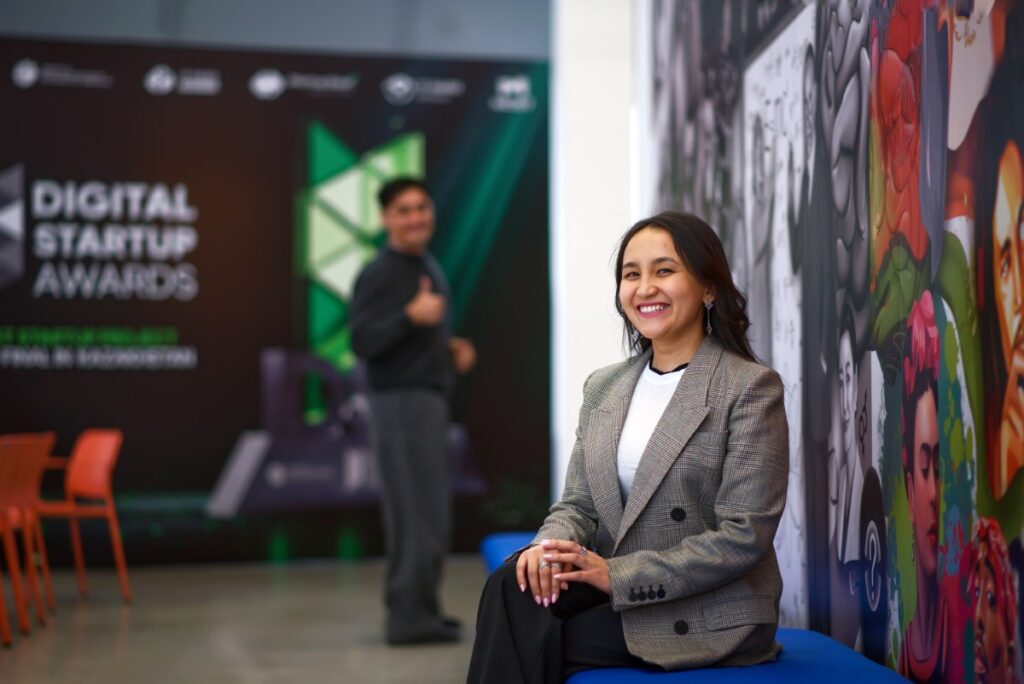




As part of the joint project by Digital Business and Astana Hub, “100 Startup Stories of Central Asia,” Makpal explained why she decided to build a startup specifically for dental clinics, what the main value of MacDent is for practices, and how she managed to make her first sales at the idea stage. We also discussed how AI can improve dental treatment and why a Kazakh solution could be in demand on international markets.
“I Came with Just an Idea — There Was No Team and Not a Single Line of Code”
— Makpal, tell us about your path in IT.
— I studied at the Faculty of Information Systems at D. Serikbayev East Kazakhstan Technical University, and later specialized in computer engineering. I worked in Ust-Kamenogorsk in the IT department of the industrial company KazZinc: I programmed in C#, then was transferred into business analytics. At that time, we were beginning the implementation of ERP systems from the German corporation SAP. I completed training courses and received certification to work with the company’s solutions.
In 2016, I left KazZinc and moved to Astana. There, I worked as a project manager at a company that was implementing a medical information system at an oncology center. A year later, I went on maternity leave. That period marked the beginning of my first startup — I had no prior experience like this.
The idea for MacDent came during my pregnancy. At the time, I was undergoing dental treatment and noticed that the dentist often forgot which procedures had already been done and where the X-rays were stored. That’s when I thought of creating a medical information system for clinics, where all patient information would be stored for doctors, and financial data would be available to help clinic managers. But at that point, it was just an idea: during the early months of maternity leave, I was fully focused on the baby.
Later, when my child was almost a year old, I learned about the launch of Astana Hub, where various startup events were being held. I decided to apply for the first cohort of the accelerator at the hub. Initially, I went there with the concept of a CRM for healthcare in general. But I was told that handling such a broad project alone would be very difficult, and I was advised to narrow the niche. That’s how I arrived at a system for dental clinics. With a refined concept, in the summer of 2018 I joined the second cohort of the Astana Hub accelerator. At that time, 15 projects were accepted, and by the end of the program, 7–8 remained.
— At that point, MacDent didn’t yet exist as a product?
— I came with just an idea — there was no team and not a single line of code. Within a month, I had a clear vision of the target niche and the core functionality of the initial version (appointment scheduling and patient database management). Around the same time, I personally wrote an MVP version to demonstrate to potential clients. Another four weeks were spent on development, for which I found an outsourced programmer. By the third month, the first sales had already happened.
This was an assignment from our mentors in the program — Askhat Sergazin and Alexander Doroshenko — to make the first sale. I went to a dental clinic called Happy Clinic in Astana and showed the director the MVP version of MacDent. Not everything worked perfectly, but after the presentation, he asked: “How much do I need to pay for you to install this?” I came up with a price on the spot — I think it was 15,000 tenge. The director immediately paid in cash. And the MVP wasn’t even hosted — everything was stored only on my personal computer.
Within three weeks, in a rush, I found an outsourced contractor named Samat Kapyshev, who soon joined my startup full-time. At the initial stage, we divided responsibilities as follows: he handled the technical side, and I took care of everything else — sales, marketing, business model, and accounting. Samat is still with us today, now in the role of CTO.
As a result, we created the first release version of MacDent, and I sold the software to several more clinics. I was honest with them, saying that payment was required immediately, but installation would take place in a couple of weeks. And they agreed. I don’t know what kind of magic worked back then: today, if you went door to door to clinics like that, it would probably be much harder to make so many sales. Maybe the market was empty at the time, and now things have changed significantly.
— Do clinics among your first clients still use MacDent?
— Yes, and some of them have even grown into multi-branch practices. It’s gratifying to see businesses develop alongside our product.
Read more on Digitalbusiness.kz.
As part of the joint project by Digital Business and Astana Hub, “100 Startup Stories of Central Asia,” Makpal explained why she decided to build a startup specifically for dental clinics, what the main value of MacDent is for practices, and how she managed to make her first sales at the idea stage. We also discussed how AI can improve dental treatment and why a Kazakh solution could be in demand on international markets.
“I Came with Just an Idea — There Was No Team and Not a Single Line of Code”
— Makpal, tell us about your path in IT.
— I studied at the Faculty of Information Systems at D. Serikbayev East Kazakhstan Technical University, and later specialized in computer engineering. I worked in Ust-Kamenogorsk in the IT department of the industrial company KazZinc: I programmed in C#, then was transferred into business analytics. At that time, we were beginning the implementation of ERP systems from the German corporation SAP. I completed training courses and received certification to work with the company’s solutions.
In 2016, I left KazZinc and moved to Astana. There, I worked as a project manager at a company that was implementing a medical information system at an oncology center. A year later, I went on maternity leave. That period marked the beginning of my first startup — I had no prior experience like this.
The idea for MacDent came during my pregnancy. At the time, I was undergoing dental treatment and noticed that the dentist often forgot which procedures had already been done and where the X-rays were stored. That’s when I thought of creating a medical information system for clinics, where all patient information would be stored for doctors, and financial data would be available to help clinic managers. But at that point, it was just an idea: during the early months of maternity leave, I was fully focused on the baby.
Later, when my child was almost a year old, I learned about the launch of Astana Hub, where various startup events were being held. I decided to apply for the first cohort of the accelerator at the hub. Initially, I went there with the concept of a CRM for healthcare in general. But I was told that handling such a broad project alone would be very difficult, and I was advised to narrow the niche. That’s how I arrived at a system for dental clinics. With a refined concept, in the summer of 2018 I joined the second cohort of the Astana Hub accelerator. At that time, 15 projects were accepted, and by the end of the program, 7–8 remained.
— At that point, MacDent didn’t yet exist as a product?
— I came with just an idea — there was no team and not a single line of code. Within a month, I had a clear vision of the target niche and the core functionality of the initial version (appointment scheduling and patient database management). Around the same time, I personally wrote an MVP version to demonstrate to potential clients. Another four weeks were spent on development, for which I found an outsourced programmer. By the third month, the first sales had already happened.
This was an assignment from our mentors in the program — Askhat Sergazin and Alexander Doroshenko — to make the first sale. I went to a dental clinic called Happy Clinic in Astana and showed the director the MVP version of MacDent. Not everything worked perfectly, but after the presentation, he asked: “How much do I need to pay for you to install this?” I came up with a price on the spot — I think it was 15,000 tenge. The director immediately paid in cash. And the MVP wasn’t even hosted — everything was stored only on my personal computer.
Within three weeks, in a rush, I found an outsourced contractor named Samat Kapyshev, who soon joined my startup full-time. At the initial stage, we divided responsibilities as follows: he handled the technical side, and I took care of everything else — sales, marketing, business model, and accounting. Samat is still with us today, now in the role of CTO.
As a result, we created the first release version of MacDent, and I sold the software to several more clinics. I was honest with them, saying that payment was required immediately, but installation would take place in a couple of weeks. And they agreed. I don’t know what kind of magic worked back then: today, if you went door to door to clinics like that, it would probably be much harder to make so many sales. Maybe the market was empty at the time, and now things have changed significantly.
— Do clinics among your first clients still use MacDent?
— Yes, and some of them have even grown into multi-branch practices. It’s gratifying to see businesses develop alongside our product.
Read more on Digitalbusiness.kz.

 Share
Share