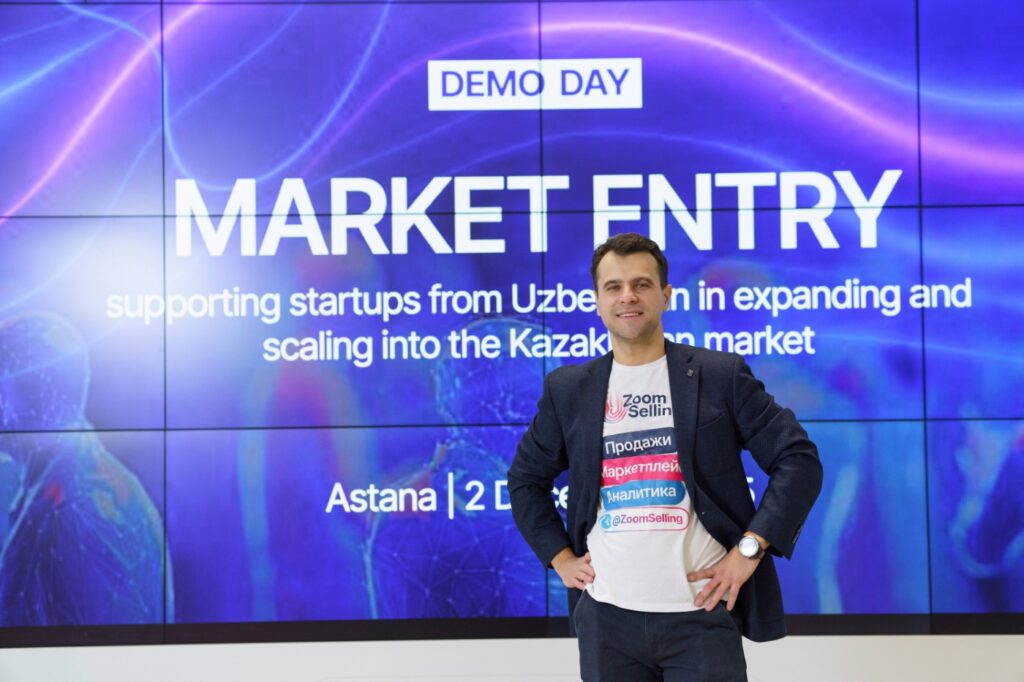





“The growth of the large e-commerce market in Central Asia continues”
— How did your career develop? What brought you into IT?
— I’ve been in the industry for 20 years. I became interested in programming during my first years at university. I devoured books on ASP (Active Server Pages — a Microsoft technology for developing dynamic web pages) and BASIC (a family of educational programming languages). I also wrote macros in VBA (a language for automating repetitive actions in software) and built small websites.
As an employee, I mainly worked as a software developer. After gaining experience, I opened a company creating custom software for clients in the US and Europe. For the past 10 years, I’ve been developing B2B e-commerce. We handle large projects — for example, ERP system integrations, logistics and warehouse accounting setup. Our clients need highly customized solutions tailored to their processes.
In 2022, we opened an office in IT PARK Uzbekistan. We started gaining clients there and are now firmly based in Tashkent.
— Tell us about the transition from outsourcing to your own product — ZoomSelling.
— It happened almost by accident. In 2023, one client, a large distributor of coffee machines, asked us to conduct a project analysis of the Uzbek marketplace Uzum. We started looking into existing solutions on the market and found nothing suitable. As a result, we developed our own analytics service.
Around the same time, e-commerce in Uzbekistan was booming. Everything aligned perfectly: the market was growing, and we had a working sales analytics solution — it just needed to be packaged as a product. That’s how ZoomSelling evolved from an internal project into our core business.
Custom B2B projects are very complex: to land a contract, you need long-term networking and lengthy sales cycles. While ZoomSelling was developing, our other business areas started to stagnate — only a few long-standing projects and clients remained in maintenance mode.
We realized ZoomSelling was taking off and decided to focus on it. The growth of the large e-commerce market in Central Asia continues: there’s room for everyone, opportunities to expand, increase average order value, and scale broadly.
— How many people are on the team?
— The core ZoomSelling team consists of four people: a CTO, two developers, and me as CEO. As needed, colleagues from other departments of the company join in.
“We help develop sellers’ expertise and knowledge, which benefits marketplaces”
— How does ZoomSelling work?
— We provide analytics for marketplace sellers: the service helps assess a trading niche, select SEO keywords, boost product listings in search results, and collect key statistics.
Analytics is divided into two components. The first is external, market-level analytics. Technically speaking, this is data parsing. No permissions from marketplaces are required — we simply collect and process publicly available information, track dynamics and trends, and generate forecasts. Marketplaces have different attitudes toward external analytics services: some are more loyal, others impose technical restrictions on bots, for example.
Take Kaspi and Teez — their data collection models are completely different. In the first case, there are several million product listings, and setting up fast crawling is technologically challenging. With younger and growing marketplaces, it’s easier to work.
The second component is internal analytics. If sellers provide access to their personal dashboards, we work via the marketplace API.
Analytics services, including ZoomSelling, help develop sellers’ expertise and knowledge, which benefits marketplaces. For example, Uzum is interested in attracting prepared sellers — they expand the assortment, work more deeply in niches, help reduce prices, and increase competition. For platforms, it’s crucial to attract buyers with a wide assortment and low prices.
— If marketplaces benefit from seller analytics, why don’t they build native services like ZoomSelling themselves?
— A marketplace’s core business is sales — or rather, commissions from sales. That’s their main focus. Seller tools are secondary. There are many higher-priority tasks that more directly drive order growth: improved search, promotions, gamification, one-click purchases.
Seller analytics ends up at the bottom of the priority list. We, on the other hand, are fully focused and can build a more detailed, deeper service with comprehensive data and sales forecasts.
“60–70% of our clients are beginners”
— What kind of analytics do you provide to clients?
— First, it’s important to define who the client is — a large distributor, a vendor, or a beginner sole proprietor. Each has different goals and capabilities: some need market insights, others track the performance of partner retail networks, while some want to achieve stable sales.
Large stores care about separating online and offline sales. For example, the Chinese sportswear brand Li-Ning uses ZoomSelling to analyze consumer demand in niches, plan stock for online and offline channels, and leverage SEO optimization and advertising tools to accelerate sales.
— Who is your main customer — large distributors or small businesses?
— The largest group is individual entrepreneurs. In Uzbekistan, about 60–70% of our clients are beginners testing the market. Naturally, this group also has the highest churn: many come to ZoomSelling just to assess the situation. It’s far from guaranteed they’ll become sellers. The main revenue comes from long-term sellers — not necessarily large ones. What matters is that they sell consistently and successfully and usually buy annual analytics subscriptions. Churn in this group is only 5–10%. Overall, we have more than 200 clients with paid subscriptions.
“There is a case where a large clothing distributor tripled sales”
— Big Data, analytics, sales forecasts — this all seems ideal for AI. Do you use it in ZoomSelling?
— Yes, we use AI for raw analytics. Over the past year, the quality of AI models has improved significantly — current outputs can almost be delivered directly to clients. But there’s an important caveat: you must clearly instruct the language model to rely only on your data, not abstract reasoning. Without data sources, neural networks will produce generic statements or hallucinate. We have a built-in chatbot that sellers can interact with.
Sometimes AI recommendations differ from ours. For example, in niches with a small number of active sellers or product listings. AI interprets this as lower competition. In reality, it’s often the opposite. A large number of sellers usually means the niche is easier to enter — there’s likely no dominant monopolist. But when 2–3 stores control 50% of a niche, that’s a red flag: they’re likely direct distributors, and an individual seller can’t compete.
What’s important is that our analytics are not solely dependent on AI — the product’s value doesn’t disappear without it.
— How do you measure ZoomSelling’s effectiveness?
— Objectively, there are successful sellers who’ve operated for years without analytics tools. But they’re becoming fewer. Tools help sellers better understand their niche, promote products more effectively, and evaluate competitors more accurately.
There’s a case where a large clothing distributor tripled sales thanks to ZoomSelling. This was the result of comprehensive work: revising advertising, product listings, pricing strategy, and SEO optimization. We identified relevant queries where competitors weren’t visible — for example, in the sneaker niche, no one was optimizing for the keyword “Skechers.” This simple step significantly expanded reach.
By analyzing metrics and understanding market positioning, sellers begin to view both the marketplace and their product lineup differently — they become more flexible and adaptive, experimenting with advertising, optimization, and refining their sales funnel.
For beginner sellers, even a basic product listing audit can immediately yield positive results. Improving content quality, selecting SEO keywords, and setting up internal ads already boosts sales.
“Target markets are Uzbekistan and Kazakhstan”
— Is ZoomSelling financially successful?
— Yes, we’re operating profitably. Our current MRR is approaching $15,000, averaging around $12,000 annually. We have over 200 recurring paid subscribers. There are also many one-time clients — usually beginners exploring the market. We’re working to expand services for them to reduce churn.
Large clients don’t need explanations of what each metric means, but beginners require guidance. It’s important to help them understand which products will sell well.
— Which countries does the project operate in?
— Our target markets are Uzbekistan and Kazakhstan. In Uzbekistan, we work with Uzum and are implementing digital tools for Yandex Market. In Kazakhstan, we’re currently in an acceleration program with Astana Hub and have launched services for Kaspi and Teez. We already have our first subscribers and a strong pipeline of interested clients.
“In the long term, we aim to cover all of Central Asia”
— What brought you to the Astana Hub accelerator, and what did you expect?
— We’d been eyeing Kaspi for a while and ran two market analysis projects on it last year. We knew we needed to move in that direction. When we learned about the Market Entry program for Uzbek startups entering Kazakhstan, we immediately decided to join.
The accelerator seriously reshapes your thinking — though you realize this only during the process. Two months ago, I wouldn’t have been able to explain why it’s necessary. From the outside, people often think: “I know my business — what can they tell me?” But once you’re in the program, you realize how much you don’t know. We’re not only launching ZoomSelling in Kazakhstan, but also restructuring the product in Uzbekistan — adjusting sales funnels, metrics, and customer interactions.
The trackers have incredible exposure: after a quick review, they grasp the essence and ask the right questions — without ever saying “do it this way.” This helps founders arrive at improvements themselves.
— What’s coming next for ZoomSelling?
— Increased technological sophistication, especially for Uzum and Kaspi — particularly advertising tools on these platforms. In the longer term, we aim to cover all of Central Asia and possibly the Caucasus. The next year will be focused on Kazakhstan.
Read more on Digitalbusiness.kz.
“The growth of the large e-commerce market in Central Asia continues”
— How did your career develop? What brought you into IT?
— I’ve been in the industry for 20 years. I became interested in programming during my first years at university. I devoured books on ASP (Active Server Pages — a Microsoft technology for developing dynamic web pages) and BASIC (a family of educational programming languages). I also wrote macros in VBA (a language for automating repetitive actions in software) and built small websites.
As an employee, I mainly worked as a software developer. After gaining experience, I opened a company creating custom software for clients in the US and Europe. For the past 10 years, I’ve been developing B2B e-commerce. We handle large projects — for example, ERP system integrations, logistics and warehouse accounting setup. Our clients need highly customized solutions tailored to their processes.
In 2022, we opened an office in IT PARK Uzbekistan. We started gaining clients there and are now firmly based in Tashkent.
— Tell us about the transition from outsourcing to your own product — ZoomSelling.
— It happened almost by accident. In 2023, one client, a large distributor of coffee machines, asked us to conduct a project analysis of the Uzbek marketplace Uzum. We started looking into existing solutions on the market and found nothing suitable. As a result, we developed our own analytics service.
Around the same time, e-commerce in Uzbekistan was booming. Everything aligned perfectly: the market was growing, and we had a working sales analytics solution — it just needed to be packaged as a product. That’s how ZoomSelling evolved from an internal project into our core business.
Custom B2B projects are very complex: to land a contract, you need long-term networking and lengthy sales cycles. While ZoomSelling was developing, our other business areas started to stagnate — only a few long-standing projects and clients remained in maintenance mode.
We realized ZoomSelling was taking off and decided to focus on it. The growth of the large e-commerce market in Central Asia continues: there’s room for everyone, opportunities to expand, increase average order value, and scale broadly.
— How many people are on the team?
— The core ZoomSelling team consists of four people: a CTO, two developers, and me as CEO. As needed, colleagues from other departments of the company join in.
“We help develop sellers’ expertise and knowledge, which benefits marketplaces”
— How does ZoomSelling work?
— We provide analytics for marketplace sellers: the service helps assess a trading niche, select SEO keywords, boost product listings in search results, and collect key statistics.
Analytics is divided into two components. The first is external, market-level analytics. Technically speaking, this is data parsing. No permissions from marketplaces are required — we simply collect and process publicly available information, track dynamics and trends, and generate forecasts. Marketplaces have different attitudes toward external analytics services: some are more loyal, others impose technical restrictions on bots, for example.
Take Kaspi and Teez — their data collection models are completely different. In the first case, there are several million product listings, and setting up fast crawling is technologically challenging. With younger and growing marketplaces, it’s easier to work.
The second component is internal analytics. If sellers provide access to their personal dashboards, we work via the marketplace API.
Analytics services, including ZoomSelling, help develop sellers’ expertise and knowledge, which benefits marketplaces. For example, Uzum is interested in attracting prepared sellers — they expand the assortment, work more deeply in niches, help reduce prices, and increase competition. For platforms, it’s crucial to attract buyers with a wide assortment and low prices.
— If marketplaces benefit from seller analytics, why don’t they build native services like ZoomSelling themselves?
— A marketplace’s core business is sales — or rather, commissions from sales. That’s their main focus. Seller tools are secondary. There are many higher-priority tasks that more directly drive order growth: improved search, promotions, gamification, one-click purchases.
Seller analytics ends up at the bottom of the priority list. We, on the other hand, are fully focused and can build a more detailed, deeper service with comprehensive data and sales forecasts.
“60–70% of our clients are beginners”
— What kind of analytics do you provide to clients?
— First, it’s important to define who the client is — a large distributor, a vendor, or a beginner sole proprietor. Each has different goals and capabilities: some need market insights, others track the performance of partner retail networks, while some want to achieve stable sales.
Large stores care about separating online and offline sales. For example, the Chinese sportswear brand Li-Ning uses ZoomSelling to analyze consumer demand in niches, plan stock for online and offline channels, and leverage SEO optimization and advertising tools to accelerate sales.
— Who is your main customer — large distributors or small businesses?
— The largest group is individual entrepreneurs. In Uzbekistan, about 60–70% of our clients are beginners testing the market. Naturally, this group also has the highest churn: many come to ZoomSelling just to assess the situation. It’s far from guaranteed they’ll become sellers. The main revenue comes from long-term sellers — not necessarily large ones. What matters is that they sell consistently and successfully and usually buy annual analytics subscriptions. Churn in this group is only 5–10%. Overall, we have more than 200 clients with paid subscriptions.
“There is a case where a large clothing distributor tripled sales”
— Big Data, analytics, sales forecasts — this all seems ideal for AI. Do you use it in ZoomSelling?
— Yes, we use AI for raw analytics. Over the past year, the quality of AI models has improved significantly — current outputs can almost be delivered directly to clients. But there’s an important caveat: you must clearly instruct the language model to rely only on your data, not abstract reasoning. Without data sources, neural networks will produce generic statements or hallucinate. We have a built-in chatbot that sellers can interact with.
Sometimes AI recommendations differ from ours. For example, in niches with a small number of active sellers or product listings. AI interprets this as lower competition. In reality, it’s often the opposite. A large number of sellers usually means the niche is easier to enter — there’s likely no dominant monopolist. But when 2–3 stores control 50% of a niche, that’s a red flag: they’re likely direct distributors, and an individual seller can’t compete.
What’s important is that our analytics are not solely dependent on AI — the product’s value doesn’t disappear without it.
— How do you measure ZoomSelling’s effectiveness?
— Objectively, there are successful sellers who’ve operated for years without analytics tools. But they’re becoming fewer. Tools help sellers better understand their niche, promote products more effectively, and evaluate competitors more accurately.
There’s a case where a large clothing distributor tripled sales thanks to ZoomSelling. This was the result of comprehensive work: revising advertising, product listings, pricing strategy, and SEO optimization. We identified relevant queries where competitors weren’t visible — for example, in the sneaker niche, no one was optimizing for the keyword “Skechers.” This simple step significantly expanded reach.
By analyzing metrics and understanding market positioning, sellers begin to view both the marketplace and their product lineup differently — they become more flexible and adaptive, experimenting with advertising, optimization, and refining their sales funnel.
For beginner sellers, even a basic product listing audit can immediately yield positive results. Improving content quality, selecting SEO keywords, and setting up internal ads already boosts sales.
“Target markets are Uzbekistan and Kazakhstan”
— Is ZoomSelling financially successful?
— Yes, we’re operating profitably. Our current MRR is approaching $15,000, averaging around $12,000 annually. We have over 200 recurring paid subscribers. There are also many one-time clients — usually beginners exploring the market. We’re working to expand services for them to reduce churn.
Large clients don’t need explanations of what each metric means, but beginners require guidance. It’s important to help them understand which products will sell well.
— Which countries does the project operate in?
— Our target markets are Uzbekistan and Kazakhstan. In Uzbekistan, we work with Uzum and are implementing digital tools for Yandex Market. In Kazakhstan, we’re currently in an acceleration program with Astana Hub and have launched services for Kaspi and Teez. We already have our first subscribers and a strong pipeline of interested clients.
“In the long term, we aim to cover all of Central Asia”
— What brought you to the Astana Hub accelerator, and what did you expect?
— We’d been eyeing Kaspi for a while and ran two market analysis projects on it last year. We knew we needed to move in that direction. When we learned about the Market Entry program for Uzbek startups entering Kazakhstan, we immediately decided to join.
The accelerator seriously reshapes your thinking — though you realize this only during the process. Two months ago, I wouldn’t have been able to explain why it’s necessary. From the outside, people often think: “I know my business — what can they tell me?” But once you’re in the program, you realize how much you don’t know. We’re not only launching ZoomSelling in Kazakhstan, but also restructuring the product in Uzbekistan — adjusting sales funnels, metrics, and customer interactions.
The trackers have incredible exposure: after a quick review, they grasp the essence and ask the right questions — without ever saying “do it this way.” This helps founders arrive at improvements themselves.
— What’s coming next for ZoomSelling?
— Increased technological sophistication, especially for Uzum and Kaspi — particularly advertising tools on these platforms. In the longer term, we aim to cover all of Central Asia and possibly the Caucasus. The next year will be focused on Kazakhstan.
Read more on Digitalbusiness.kz.

 Share
Share