
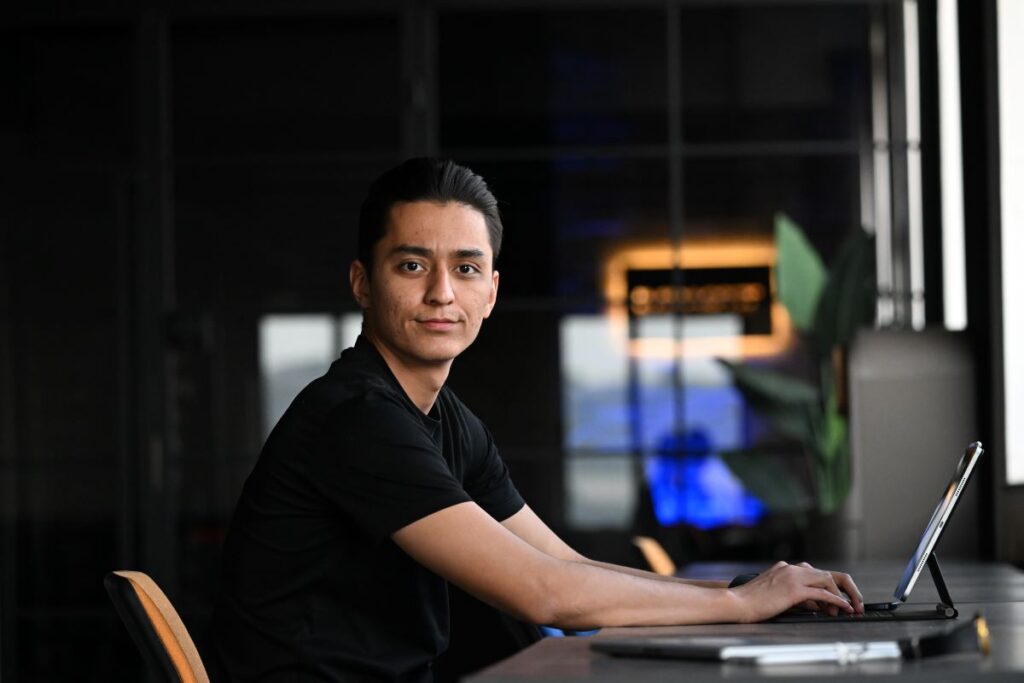





As part of the joint project by Digital Business and Astana Hub, “100 Startup Stories of Central Asia,” co-founder and CEO of TASS Vision Shakhzod Umirzakov shared how he manually counted visitors while training a neural network, why AI cameras are beneficial for retail businesses, and what will happen to the startup when its valuation reaches $100 million.
— How did the idea to create TASS Vision come about?
— In 2018, when I was 19, I was helping my father with his business. He managed a small bus fleet and was involved in passenger transportation. There is a specific issue in this business: conductors skim part of the revenue, but it is difficult to prove. To change the situation, I suggested to my father a device that would automatically count passengers.
It was an infrared counter: when a person passed through the door, they crossed an invisible beam, and the system recorded the passenger’s entry. Over three months, I assembled the device and connected it to the buses. When the conductors saw that their fraud could be exposed, they started working honestly—and in the first two weeks, revenues almost doubled, fully paying back the project.
Then I put together a team and began connecting other bus depots. I remember how at night we installed equipment on vehicles, in the morning went to sleep, during the day wrote code, printed casings on a 3D printer, soldered microcontrollers—and by evening went back to the bus depot again. Later, it was this project that pushed me toward the idea of analyzing customer behavior in retail.
— Why didn’t you stay in the transportation sector?
— In 2019, when I was in Almaty, I noticed that transport cards Onay (a cashless public transport payment system) were already operating there, and I realized that a similar system would soon appear in Uzbekistan. Cash would disappear, and our device would no longer make sense. I decided it was necessary to change direction.
I started looking for a new idea: I made several hundred cold calls—to retail, construction companies, cafés, and restaurants—to understand where analytics was truly in demand. I simply asked: “How many people enter your store? How do you count them?”
The reactions were different. Some said, “Why do we need this?” Others showed interest. Eventually, I realized that in offline retail almost no one understands who exactly comes into the store and what affects sales. That’s when I saw the opportunity—to make analytics for physical points of sale as accurate and accessible as it is for online stores. Soon Jamshid Khakimjonov joined me. He had a strong engineering background and experience in computer systems—together we began designing the first version of the product, which later became TASS Vision.
— Who became your first client?
— A large Uzbek electronics retail chain, Texnomart. Their chief marketing officer said that they were already using a system that counted how many people entered the store, but they needed deeper metrics: customers’ age, gender, and behavior. Then we promised that within three months we would create a new device based on “smart” cameras and computer vision that analyzes video streams and turns them into analytics in real time. Not just “how many people visited,” but “who came in and how they behaved.”
We planned to complete the project in three months, but in reality, training neural networks and developing algorithms took more time.
To fulfill the contract terms, we had to improvise. We were required to provide statistics after the fact—after one business day. I told the client that visitors were being recognized by AI, but in reality, I did it manually. I watched 12 hours of video at accelerated speed on two screens and processed one day’s data in 1.5 hours. I counted visitors, determined their gender and age, entered the data into Excel, built charts, and sent reports to the client. And I did this 99 days in a row. As they say, fake it till you make it (an English saying — Digital Business note). At that time, it was the only way to hold on.
But it was precisely this experience that helped us understand how artificial intelligence should work. By comparing my results with the model’s output, I saw that the AI’s accuracy was only 50–60%. We found the errors and retrained the algorithms. After a few months, the system truly began working automatically.
Read more on Digitalbusiness.kz.
As part of the joint project by Digital Business and Astana Hub, “100 Startup Stories of Central Asia,” co-founder and CEO of TASS Vision Shakhzod Umirzakov shared how he manually counted visitors while training a neural network, why AI cameras are beneficial for retail businesses, and what will happen to the startup when its valuation reaches $100 million.
— How did the idea to create TASS Vision come about?
— In 2018, when I was 19, I was helping my father with his business. He managed a small bus fleet and was involved in passenger transportation. There is a specific issue in this business: conductors skim part of the revenue, but it is difficult to prove. To change the situation, I suggested to my father a device that would automatically count passengers.
It was an infrared counter: when a person passed through the door, they crossed an invisible beam, and the system recorded the passenger’s entry. Over three months, I assembled the device and connected it to the buses. When the conductors saw that their fraud could be exposed, they started working honestly—and in the first two weeks, revenues almost doubled, fully paying back the project.
Then I put together a team and began connecting other bus depots. I remember how at night we installed equipment on vehicles, in the morning went to sleep, during the day wrote code, printed casings on a 3D printer, soldered microcontrollers—and by evening went back to the bus depot again. Later, it was this project that pushed me toward the idea of analyzing customer behavior in retail.
— Why didn’t you stay in the transportation sector?
— In 2019, when I was in Almaty, I noticed that transport cards Onay (a cashless public transport payment system) were already operating there, and I realized that a similar system would soon appear in Uzbekistan. Cash would disappear, and our device would no longer make sense. I decided it was necessary to change direction.
I started looking for a new idea: I made several hundred cold calls—to retail, construction companies, cafés, and restaurants—to understand where analytics was truly in demand. I simply asked: “How many people enter your store? How do you count them?”
The reactions were different. Some said, “Why do we need this?” Others showed interest. Eventually, I realized that in offline retail almost no one understands who exactly comes into the store and what affects sales. That’s when I saw the opportunity—to make analytics for physical points of sale as accurate and accessible as it is for online stores. Soon Jamshid Khakimjonov joined me. He had a strong engineering background and experience in computer systems—together we began designing the first version of the product, which later became TASS Vision.
— Who became your first client?
— A large Uzbek electronics retail chain, Texnomart. Their chief marketing officer said that they were already using a system that counted how many people entered the store, but they needed deeper metrics: customers’ age, gender, and behavior. Then we promised that within three months we would create a new device based on “smart” cameras and computer vision that analyzes video streams and turns them into analytics in real time. Not just “how many people visited,” but “who came in and how they behaved.”
We planned to complete the project in three months, but in reality, training neural networks and developing algorithms took more time.
To fulfill the contract terms, we had to improvise. We were required to provide statistics after the fact—after one business day. I told the client that visitors were being recognized by AI, but in reality, I did it manually. I watched 12 hours of video at accelerated speed on two screens and processed one day’s data in 1.5 hours. I counted visitors, determined their gender and age, entered the data into Excel, built charts, and sent reports to the client. And I did this 99 days in a row. As they say, fake it till you make it (an English saying — Digital Business note). At that time, it was the only way to hold on.
But it was precisely this experience that helped us understand how artificial intelligence should work. By comparing my results with the model’s output, I saw that the AI’s accuracy was only 50–60%. We found the errors and retrained the algorithms. After a few months, the system truly began working automatically.
Read more on Digitalbusiness.kz.

 Share
Share