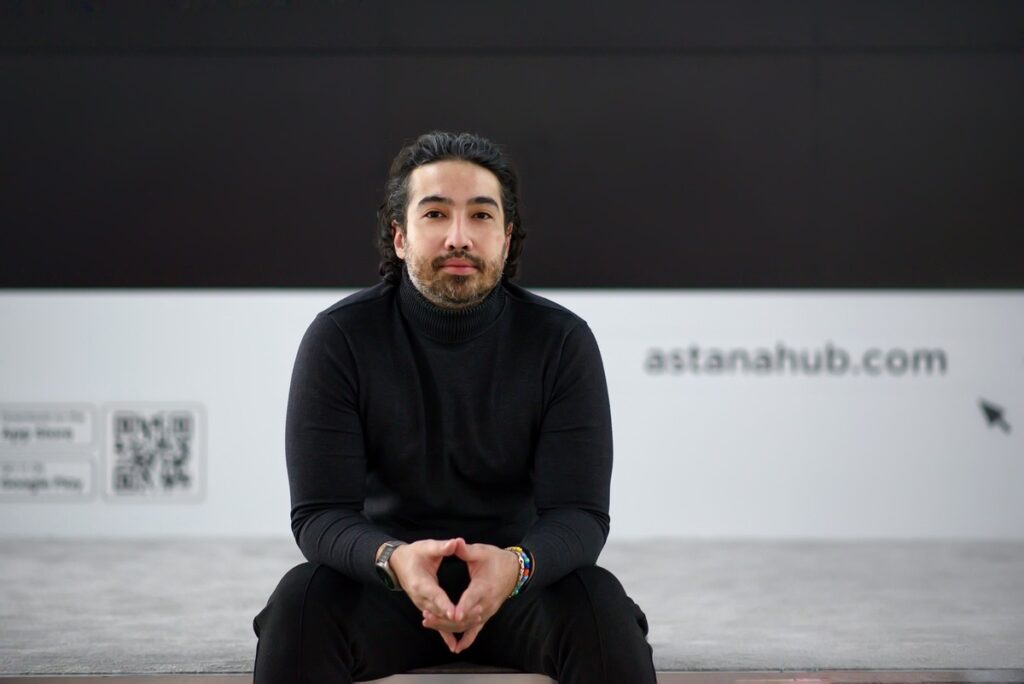





For the joint project by Digital Business and Astana Hub, “100 Startup Stories of Central Asia,” Dadammuhammad explained how to develop IT solutions on $200 a month without “burning” money, why many startup founders are dreamers, and what surprised him about the attitude of Kazakhstani restaurateurs toward IT projects.
“My first business was in agriculture: I rented land and planted watermelons”
— My parents are from Tashkent, but I was born in Moscow and studied at a physics and mathematics gymnasium, so I’ve always had a passion for numbers. After school, I enrolled in a university in the UK. I studied at the London campus of Heriot-Watt University, completed my bachelor’s degree in Business Management and Finance, and my master’s degree in Financial Risk Management.
I have experience both as an employee and as an entrepreneur, and I’ve tried myself in different fields. My first business was in agriculture: I rented a field and planted watermelons. I wanted to earn money and feel what it’s like to generate income on my own. But I knew nothing about agriculture or its specifics, and it was almost a miracle that everything grew and I managed to sell it wholesale.
After that, I worked for a long time as an employee: in a development company in Tashkent, and my last job was as a representative of Soyuzlegprom, a quasi-governmental organization in the textile sector. I worked there for a year and a half, but due to circumstances, staff was reduced and the representative offices were closed.
— And that’s when you decided you needed to build your own project?
— I realized that working as an employee is, of course, fine, but endless approvals for basic actions and constant reporting slow everything down. I don’t like staying in one place for too long: if I hit a ceiling and stop feeling drive or development dynamics, it becomes boring.
I wanted to return to entrepreneurship and create something of my own — that’s how the company Duckers appeared, within which we are developing our project REZVO together with partners.
— How did the idea for the IT startup come about?
— I had successful cases in traditional business, but no experience in IT. By education, I’m not a tech person, and before that I didn’t understand this field at all. But thanks to my previous experience, I knew how to structure and organize business processes.
As for the idea, initially we were doing a completely different project — a document constructor in Uzbek and Russian called DocxBox. We invested our own money, developed it, but never launched it to the market — we lacked experience and understanding of how the IT industry works. We closed that project and started REZVO from scratch.
The idea was born out of personal pain. I’m the kind of guest who likes to get what I ordered in advance as soon as I arrive at a restaurant. I want the hookah to be ready by the time I get there. But depending on how busy the place is, you usually have to wait from 15 minutes to half an hour. I surveyed friends, and many agreed that the idea was cool and would be convenient. That’s how, based on my own needs and the desires of people like me, the idea of the REZVO service — online table reservations at venues — appeared.
— Who else is involved in the project as a founder?
— There are three founders: myself, Rafael Khanzafarov, and Maksim Vedeneev. Rafael has a strong background — more than 10 years in development — and he built about 90% of the platform. Maksim acts as a co-investor and shares financial risks with us.
My wife, Sevara Salimova, is also involved in the project and handles marketing, promotion, SMM, and PR.
The role distribution is as follows: attracting venues, initial contacts, and partner relations are on me. The technical side and development are handled by Rafael. Promotion, advertising, and shoot planning are managed by Sevara. Through experience, we came to the conclusion that for a small project, 4–5 people are more than enough.
“If a product is just an alternative to booking by phone, it has no future”
— What is the essence of your solution?
— For users, REZVO is a service that helps organize leisure time efficiently: reserve a table in the app at a convenient time, make and pay for a pre-order, build a route to the restaurant, and so on.
But the essence of our project is not booking — that’s just a nice free bonus for users. REZVO creates value for venues: the ability to form, manage, and interact with a customer base. When a business understands who its regular guests are, how often they come, and what they order, it helps optimize processes and increase revenue.
A manager of one of the venues in Tashkent helped us arrive at this concept. During testing, he asked: “Okay, a person booked a table — what’s next? How do we contact them?” That’s when we realized that a simple booking button is pointless. So we focused our value proposition on two things: building a customer base and alternative communication. REZVO allows venues to collect customer data, analyze it, and communicate with it cheaply.
But working with restaurants is only the beginning. According to our development strategy, we want to cover HoReCa as a whole, and then move into TravelTech — the global hospitality and tourism industry.
— How many venues are working with REZVO?
— We’ve only been operating for 2.5 months, and currently around ten venues are connected. For this stage, that’s a normal number, because quality is more important to us than quantity. As for near-term plans, covering 20–25% of the 430 suitable venues in Tashkent would be more than enough.
As for users, in the very first month we got more than a thousand app downloads and about 600 active users. Of course, we’d like to move faster, but the main thing is that there is momentum: we’ve gotten on track and are slowly moving forward.
— Are there cases showing how REZVO has already helped venues?
— I can’t name the venues due to confidentiality policies, but we brought one of them 25 customers in the first month, and another more than 10 customers. Considering the subscription cost, our effectiveness far exceeds the cost of using REZVO.
But these are examples where venues actually use the service’s capabilities (working with the database, sending push notifications), not just signing up. And it makes me happy when owners understand the need for digitalization, because increasing customer flow means increasing profit.
Read more on Digitalbusiness.kz.
For the joint project by Digital Business and Astana Hub, “100 Startup Stories of Central Asia,” Dadammuhammad explained how to develop IT solutions on $200 a month without “burning” money, why many startup founders are dreamers, and what surprised him about the attitude of Kazakhstani restaurateurs toward IT projects.
“My first business was in agriculture: I rented land and planted watermelons”
— My parents are from Tashkent, but I was born in Moscow and studied at a physics and mathematics gymnasium, so I’ve always had a passion for numbers. After school, I enrolled in a university in the UK. I studied at the London campus of Heriot-Watt University, completed my bachelor’s degree in Business Management and Finance, and my master’s degree in Financial Risk Management.
I have experience both as an employee and as an entrepreneur, and I’ve tried myself in different fields. My first business was in agriculture: I rented a field and planted watermelons. I wanted to earn money and feel what it’s like to generate income on my own. But I knew nothing about agriculture or its specifics, and it was almost a miracle that everything grew and I managed to sell it wholesale.
After that, I worked for a long time as an employee: in a development company in Tashkent, and my last job was as a representative of Soyuzlegprom, a quasi-governmental organization in the textile sector. I worked there for a year and a half, but due to circumstances, staff was reduced and the representative offices were closed.
— And that’s when you decided you needed to build your own project?
— I realized that working as an employee is, of course, fine, but endless approvals for basic actions and constant reporting slow everything down. I don’t like staying in one place for too long: if I hit a ceiling and stop feeling drive or development dynamics, it becomes boring.
I wanted to return to entrepreneurship and create something of my own — that’s how the company Duckers appeared, within which we are developing our project REZVO together with partners.
— How did the idea for the IT startup come about?
— I had successful cases in traditional business, but no experience in IT. By education, I’m not a tech person, and before that I didn’t understand this field at all. But thanks to my previous experience, I knew how to structure and organize business processes.
As for the idea, initially we were doing a completely different project — a document constructor in Uzbek and Russian called DocxBox. We invested our own money, developed it, but never launched it to the market — we lacked experience and understanding of how the IT industry works. We closed that project and started REZVO from scratch.
The idea was born out of personal pain. I’m the kind of guest who likes to get what I ordered in advance as soon as I arrive at a restaurant. I want the hookah to be ready by the time I get there. But depending on how busy the place is, you usually have to wait from 15 minutes to half an hour. I surveyed friends, and many agreed that the idea was cool and would be convenient. That’s how, based on my own needs and the desires of people like me, the idea of the REZVO service — online table reservations at venues — appeared.
— Who else is involved in the project as a founder?
— There are three founders: myself, Rafael Khanzafarov, and Maksim Vedeneev. Rafael has a strong background — more than 10 years in development — and he built about 90% of the platform. Maksim acts as a co-investor and shares financial risks with us.
My wife, Sevara Salimova, is also involved in the project and handles marketing, promotion, SMM, and PR.
The role distribution is as follows: attracting venues, initial contacts, and partner relations are on me. The technical side and development are handled by Rafael. Promotion, advertising, and shoot planning are managed by Sevara. Through experience, we came to the conclusion that for a small project, 4–5 people are more than enough.
“If a product is just an alternative to booking by phone, it has no future”
— What is the essence of your solution?
— For users, REZVO is a service that helps organize leisure time efficiently: reserve a table in the app at a convenient time, make and pay for a pre-order, build a route to the restaurant, and so on.
But the essence of our project is not booking — that’s just a nice free bonus for users. REZVO creates value for venues: the ability to form, manage, and interact with a customer base. When a business understands who its regular guests are, how often they come, and what they order, it helps optimize processes and increase revenue.
A manager of one of the venues in Tashkent helped us arrive at this concept. During testing, he asked: “Okay, a person booked a table — what’s next? How do we contact them?” That’s when we realized that a simple booking button is pointless. So we focused our value proposition on two things: building a customer base and alternative communication. REZVO allows venues to collect customer data, analyze it, and communicate with it cheaply.
But working with restaurants is only the beginning. According to our development strategy, we want to cover HoReCa as a whole, and then move into TravelTech — the global hospitality and tourism industry.
— How many venues are working with REZVO?
— We’ve only been operating for 2.5 months, and currently around ten venues are connected. For this stage, that’s a normal number, because quality is more important to us than quantity. As for near-term plans, covering 20–25% of the 430 suitable venues in Tashkent would be more than enough.
As for users, in the very first month we got more than a thousand app downloads and about 600 active users. Of course, we’d like to move faster, but the main thing is that there is momentum: we’ve gotten on track and are slowly moving forward.
— Are there cases showing how REZVO has already helped venues?
— I can’t name the venues due to confidentiality policies, but we brought one of them 25 customers in the first month, and another more than 10 customers. Considering the subscription cost, our effectiveness far exceeds the cost of using REZVO.
But these are examples where venues actually use the service’s capabilities (working with the database, sending push notifications), not just signing up. And it makes me happy when owners understand the need for digitalization, because increasing customer flow means increasing profit.
Read more on Digitalbusiness.kz.

 Share
Share