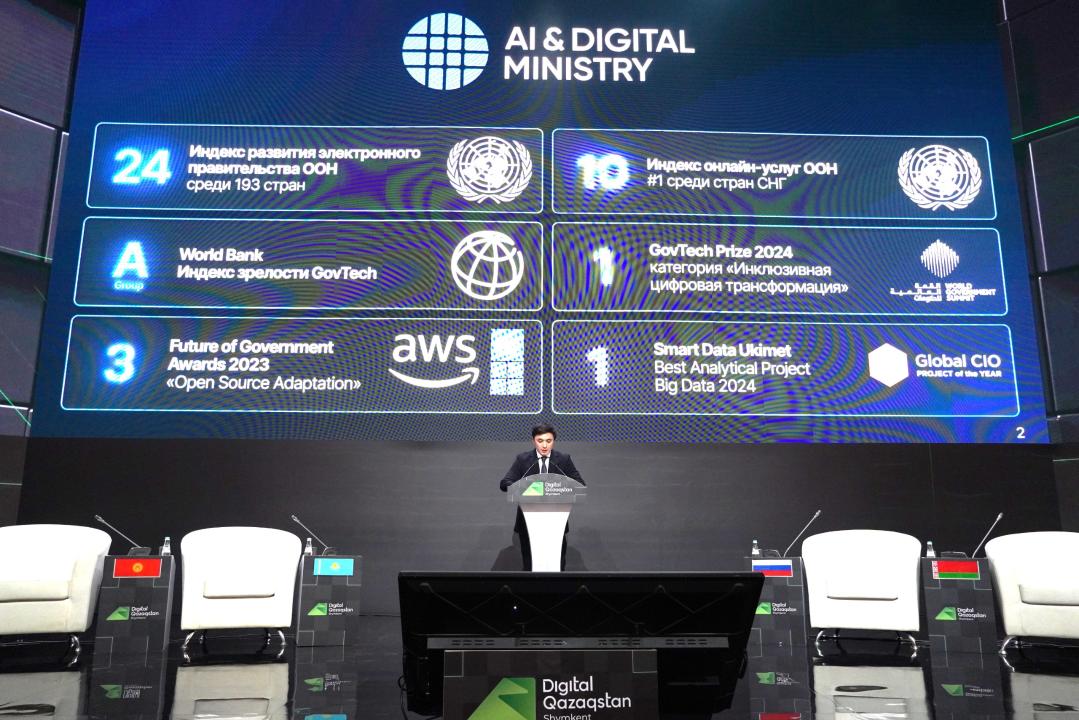





As Dmitry Mun noted, this unified ecosystem has already become the foundation for the creation and deployment of AI solutions across the public sector, bringing together access to supercomputers, large language models, and more than 120 government databases. The platform goes beyond process automation, functioning as a kind of “factory” where more than 50 specialized AI agents have already been developed to serve both citizens and government institutions.
Particular attention during the presentation at the Ministry’s exhibition stand was given to the effectiveness of AI tools in the day-to-day operations of ministries and government agencies. The Vice Minister emphasized that the AI assistant has already processed more than 1 million inquiries out of the 5.5 million requests received annually, significantly accelerating the work of 16 government bodies. Public servants are actively using a secure AI-powered translation tool, which has completed more than 400,000 translations, as well as real-time meeting transcription systems. The scale of the transformation is further reflected in workforce development efforts: more than 60,000 employees have completed AI Qyzmet training courses, while the total number of platform users has exceeded 15,000.
The foundation of these innovations is AI DataHub—a centralized government data management model that transforms fragmented systems into a unified digital environment for analytics. According to Dmitry Mun, advanced data processing capabilities are what enable the launch of next-generation public services. The intelligent eGov AI assistant has already successfully handled more than 2 million requests, significantly reducing the workload of contact centers and Public Service Centers (PSCs). Today, AI agents are being used across a wide range of areas, from automated gas meter readings to supporting general practitioners in 38 clinics nationwide and providing legal guidance through the Qazaq Law system.
Concluding the presentation for the Head of Government, the Vice Minister demonstrated the capabilities of a new model powered by AlemGPT. This universal assistant is designed to fully automate routine processes while ensuring transparent and rapid outcomes in sensitive matters, such as transferring a child from one school to another.
This AI-driven architecture of public administration is enabling Kazakhstan to steadily move toward the concept of an “invisible government,” where technologies work proactively to create the most convenient conditions for citizens and businesses.
For more information, visit the website of the Ministry of Artificial Intelligence and Digital Development of the Republic of Kazakhstan.
As Dmitry Mun noted, this unified ecosystem has already become the foundation for the creation and deployment of AI solutions across the public sector, bringing together access to supercomputers, large language models, and more than 120 government databases. The platform goes beyond process automation, functioning as a kind of “factory” where more than 50 specialized AI agents have already been developed to serve both citizens and government institutions.
Particular attention during the presentation at the Ministry’s exhibition stand was given to the effectiveness of AI tools in the day-to-day operations of ministries and government agencies. The Vice Minister emphasized that the AI assistant has already processed more than 1 million inquiries out of the 5.5 million requests received annually, significantly accelerating the work of 16 government bodies. Public servants are actively using a secure AI-powered translation tool, which has completed more than 400,000 translations, as well as real-time meeting transcription systems. The scale of the transformation is further reflected in workforce development efforts: more than 60,000 employees have completed AI Qyzmet training courses, while the total number of platform users has exceeded 15,000.
The foundation of these innovations is AI DataHub—a centralized government data management model that transforms fragmented systems into a unified digital environment for analytics. According to Dmitry Mun, advanced data processing capabilities are what enable the launch of next-generation public services. The intelligent eGov AI assistant has already successfully handled more than 2 million requests, significantly reducing the workload of contact centers and Public Service Centers (PSCs). Today, AI agents are being used across a wide range of areas, from automated gas meter readings to supporting general practitioners in 38 clinics nationwide and providing legal guidance through the Qazaq Law system.
Concluding the presentation for the Head of Government, the Vice Minister demonstrated the capabilities of a new model powered by AlemGPT. This universal assistant is designed to fully automate routine processes while ensuring transparent and rapid outcomes in sensitive matters, such as transferring a child from one school to another.
This AI-driven architecture of public administration is enabling Kazakhstan to steadily move toward the concept of an “invisible government,” where technologies work proactively to create the most convenient conditions for citizens and businesses.
For more information, visit the website of the Ministry of Artificial Intelligence and Digital Development of the Republic of Kazakhstan.

 Share
Share