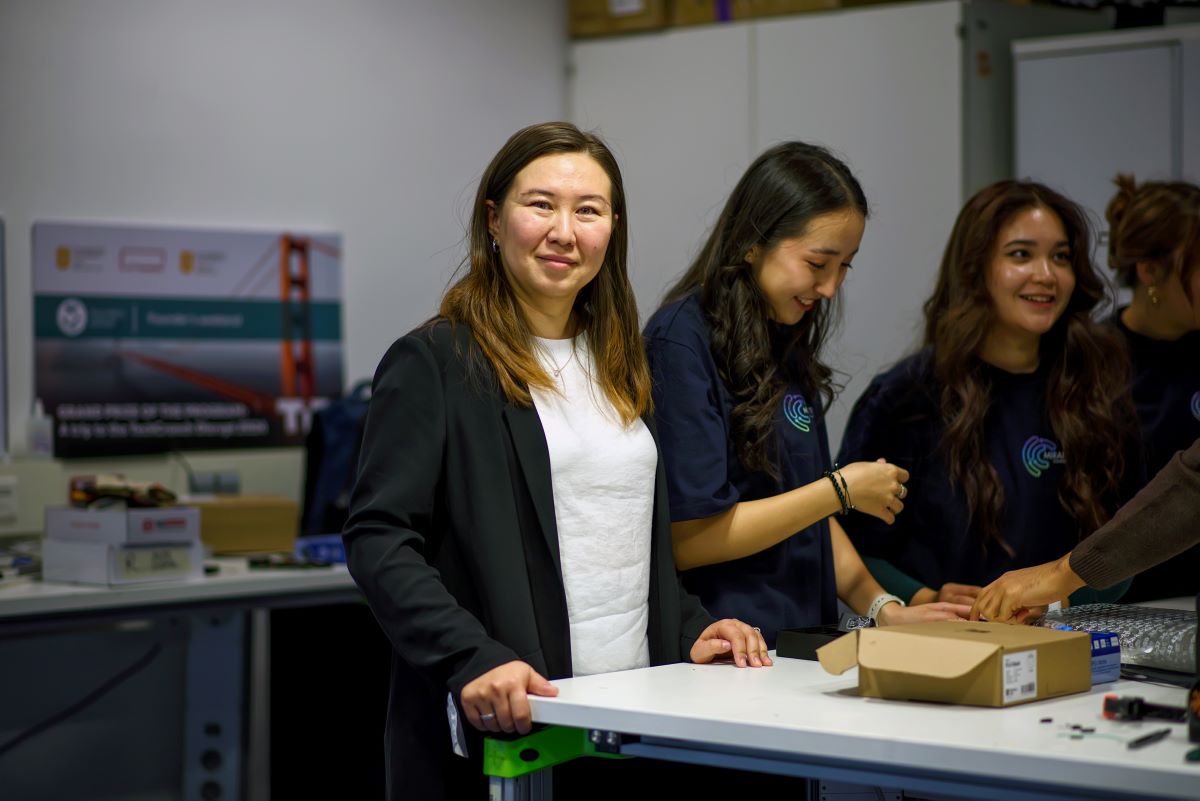




Today, Mirai Tech’s technology is being tested by football clubs in Kazakhstan, and the team has already secured its first $90,000 in investment. As part of the joint project by Digital Business and Astana Hub titled “100 Startup Stories of Central Asia,” Gulnur explained how shoe-mounted sensors can save sports clubs millions of dollars, when Mirai Tech insoles will become available to the general public, when the project expects to reach $100,000 in profit, which international markets it plans to enter, and where mass production is expected to be launched.
“In two minutes, an insole collects more than 20,000 data points”
— Mirai Tech grew out of academic research. At what point did you realize the idea could become a full-fledged startup?
— The idea of launching a startup emerged while we were studying materials that can generate electricity through motion. At some point, we noticed that these sensors were not just producing electric current—they reacted differently depending on how a person walked. That’s when it became clear this could be a real technology capable of helping people.
This is how “smart” nano-insoles were born—insoles with sensors based on nanogenerators that capture the slightest movements and loads. That’s where the name comes from: “nano” refers to the technologies from which everything started.
At first, we explored various applications—from rehabilitation for Paralympic athletes to tracking motor development in children with autism spectrum disorders. Eventually, however, our focus shifted entirely to sports. We registered the company in January this year and concentrated on SportTech—technologies that help athletes train and recover using data and artificial intelligence.
— Why did you choose sports?
— We saw strong interest from professional sports clubs, especially in team sports. In football, hockey, or basketball, any injury means not only forced downtime from training but also serious financial losses: treatment, rehabilitation, and player replacements. In elite leagues, such cases are measured in millions of dollars.
At the same time, Kazakhstan faces an acute shortage of qualified rehabilitation specialists who can detect problems early. Our nano-insole essentially performs this function—it works as an early diagnostic system. An athlete walks for two minutes, and we can immediately see asymmetry, overload, or improper weight distribution. This data helps doctors and coaches understand where to look and how to adjust training loads more precisely.
— How exactly do the nano-insoles work, and what kind of data do they collect?
— We embed sensors into footwear that record even the smallest movements—how the foot is placed, how body weight is transferred, and how load is distributed during walking, running, or jumping. They respond even to micro-movements. In just two minutes, the device collects more than 20,000 data points, which are processed by our proprietary algorithms. This creates a digital movement profile.
In addition, we use supplementary wearable sensors attached to the athlete’s body. They capture joint angles, identify imbalances, and detect deviations in movement technique. For example, a coach may notice a decline in an athlete’s performance without understanding the cause. Sensor data helps pinpoint the source—whether it’s movement asymmetry, incorrect technique, or hidden overload.
— What was the system trained on? Everyone has a unique gait, posture, and movement style. How does the algorithm distinguish personal characteristics from real warning signs?
— The system is built on mathematics—algorithms that calculate human movement and analyze micro-signals coming from the sensors. Every step and every pressure point creates a unique pattern, and it’s through these patterns that the system understands whether movement is physiological or not.
To teach it to “see” the difference, we compiled a large anonymized dataset. We tested the technology in nine clinics in Astana and several sports centers, analyzing how people move with different gait types, with and without injuries.
Using this data, we calibrate the system, refine its accuracy, and intensively train it to recognize patterns. In essence, these are not just sensors—they form an analytical model that understands when the body is functioning correctly and when it needs support.
— How does a coach receive and interpret this analytics?
— All information is displayed in a clear and user-friendly format. Coaches see key parameters such as asymmetry, load, and recovery dynamics. If questions arise about how to translate the data into a training plan, our in-house rehabilitation specialists get involved.
At the moment, we have a limited number of clients, which allows us to work with each one individually. As we scale, however, we will increasingly rely on artificial intelligence—a model we have already started training on anonymized clinical and research data.
Read more at Digitalbusiness.kz.
Today, Mirai Tech’s technology is being tested by football clubs in Kazakhstan, and the team has already secured its first $90,000 in investment. As part of the joint project by Digital Business and Astana Hub titled “100 Startup Stories of Central Asia,” Gulnur explained how shoe-mounted sensors can save sports clubs millions of dollars, when Mirai Tech insoles will become available to the general public, when the project expects to reach $100,000 in profit, which international markets it plans to enter, and where mass production is expected to be launched.
“In two minutes, an insole collects more than 20,000 data points”
— Mirai Tech grew out of academic research. At what point did you realize the idea could become a full-fledged startup?
— The idea of launching a startup emerged while we were studying materials that can generate electricity through motion. At some point, we noticed that these sensors were not just producing electric current—they reacted differently depending on how a person walked. That’s when it became clear this could be a real technology capable of helping people.
This is how “smart” nano-insoles were born—insoles with sensors based on nanogenerators that capture the slightest movements and loads. That’s where the name comes from: “nano” refers to the technologies from which everything started.
At first, we explored various applications—from rehabilitation for Paralympic athletes to tracking motor development in children with autism spectrum disorders. Eventually, however, our focus shifted entirely to sports. We registered the company in January this year and concentrated on SportTech—technologies that help athletes train and recover using data and artificial intelligence.
— Why did you choose sports?
— We saw strong interest from professional sports clubs, especially in team sports. In football, hockey, or basketball, any injury means not only forced downtime from training but also serious financial losses: treatment, rehabilitation, and player replacements. In elite leagues, such cases are measured in millions of dollars.
At the same time, Kazakhstan faces an acute shortage of qualified rehabilitation specialists who can detect problems early. Our nano-insole essentially performs this function—it works as an early diagnostic system. An athlete walks for two minutes, and we can immediately see asymmetry, overload, or improper weight distribution. This data helps doctors and coaches understand where to look and how to adjust training loads more precisely.
— How exactly do the nano-insoles work, and what kind of data do they collect?
— We embed sensors into footwear that record even the smallest movements—how the foot is placed, how body weight is transferred, and how load is distributed during walking, running, or jumping. They respond even to micro-movements. In just two minutes, the device collects more than 20,000 data points, which are processed by our proprietary algorithms. This creates a digital movement profile.
In addition, we use supplementary wearable sensors attached to the athlete’s body. They capture joint angles, identify imbalances, and detect deviations in movement technique. For example, a coach may notice a decline in an athlete’s performance without understanding the cause. Sensor data helps pinpoint the source—whether it’s movement asymmetry, incorrect technique, or hidden overload.
— What was the system trained on? Everyone has a unique gait, posture, and movement style. How does the algorithm distinguish personal characteristics from real warning signs?
— The system is built on mathematics—algorithms that calculate human movement and analyze micro-signals coming from the sensors. Every step and every pressure point creates a unique pattern, and it’s through these patterns that the system understands whether movement is physiological or not.
To teach it to “see” the difference, we compiled a large anonymized dataset. We tested the technology in nine clinics in Astana and several sports centers, analyzing how people move with different gait types, with and without injuries.
Using this data, we calibrate the system, refine its accuracy, and intensively train it to recognize patterns. In essence, these are not just sensors—they form an analytical model that understands when the body is functioning correctly and when it needs support.
— How does a coach receive and interpret this analytics?
— All information is displayed in a clear and user-friendly format. Coaches see key parameters such as asymmetry, load, and recovery dynamics. If questions arise about how to translate the data into a training plan, our in-house rehabilitation specialists get involved.
At the moment, we have a limited number of clients, which allows us to work with each one individually. As we scale, however, we will increasingly rely on artificial intelligence—a model we have already started training on anonymized clinical and research data.
Read more at Digitalbusiness.kz.

 Share
Share